

Tested Applications
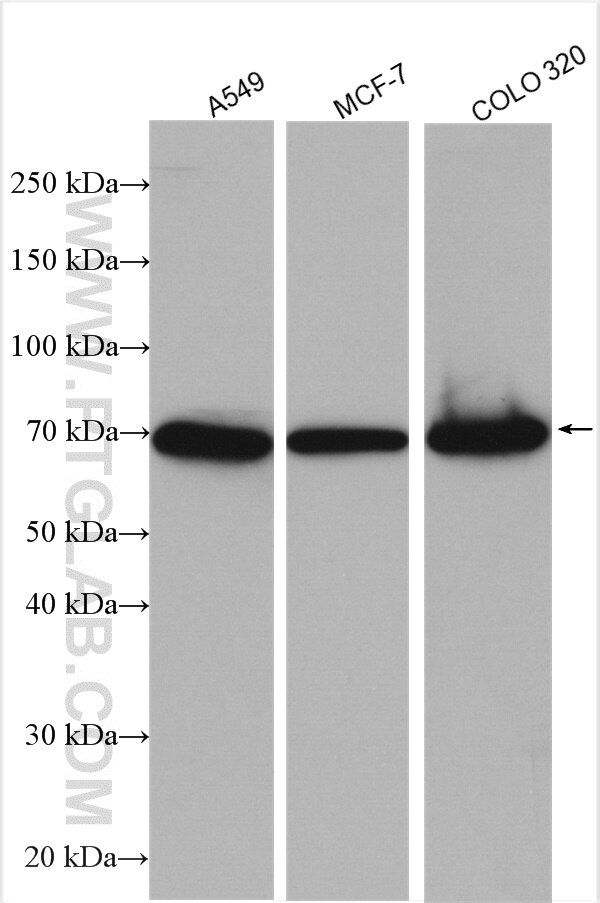
| Positive WB detected in | A549 cells, MCF-7 cells, COLO320 cells |
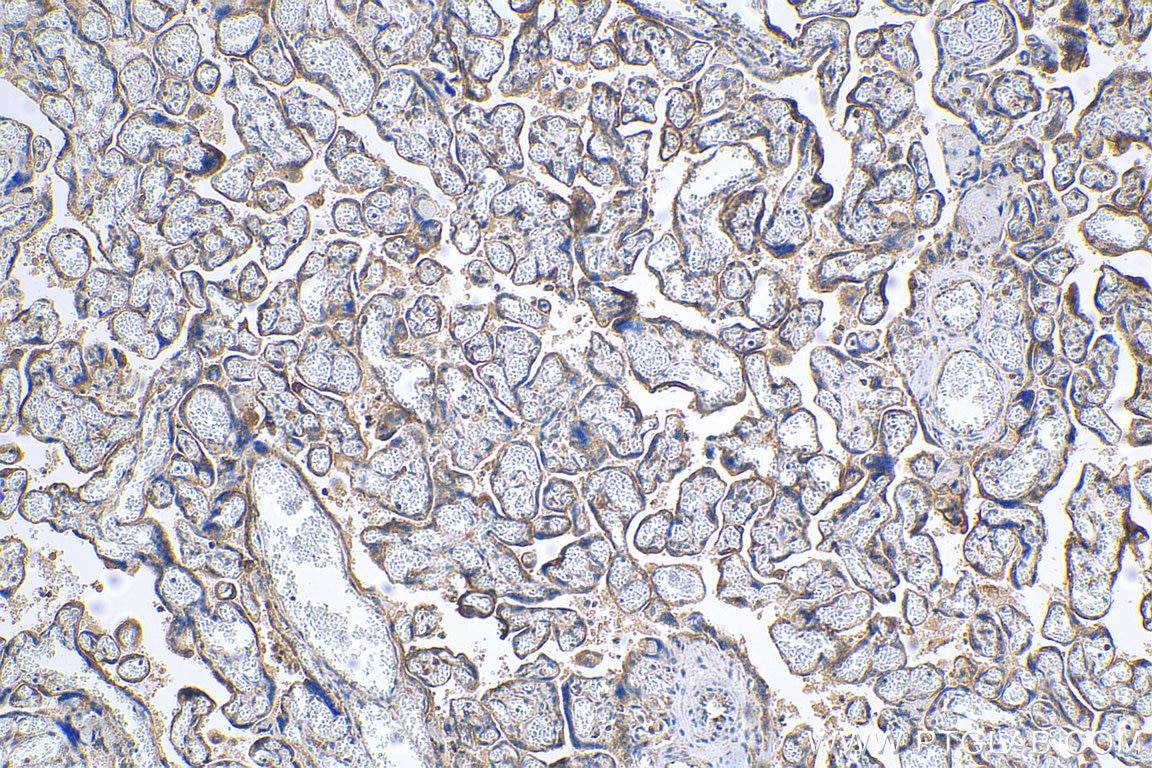
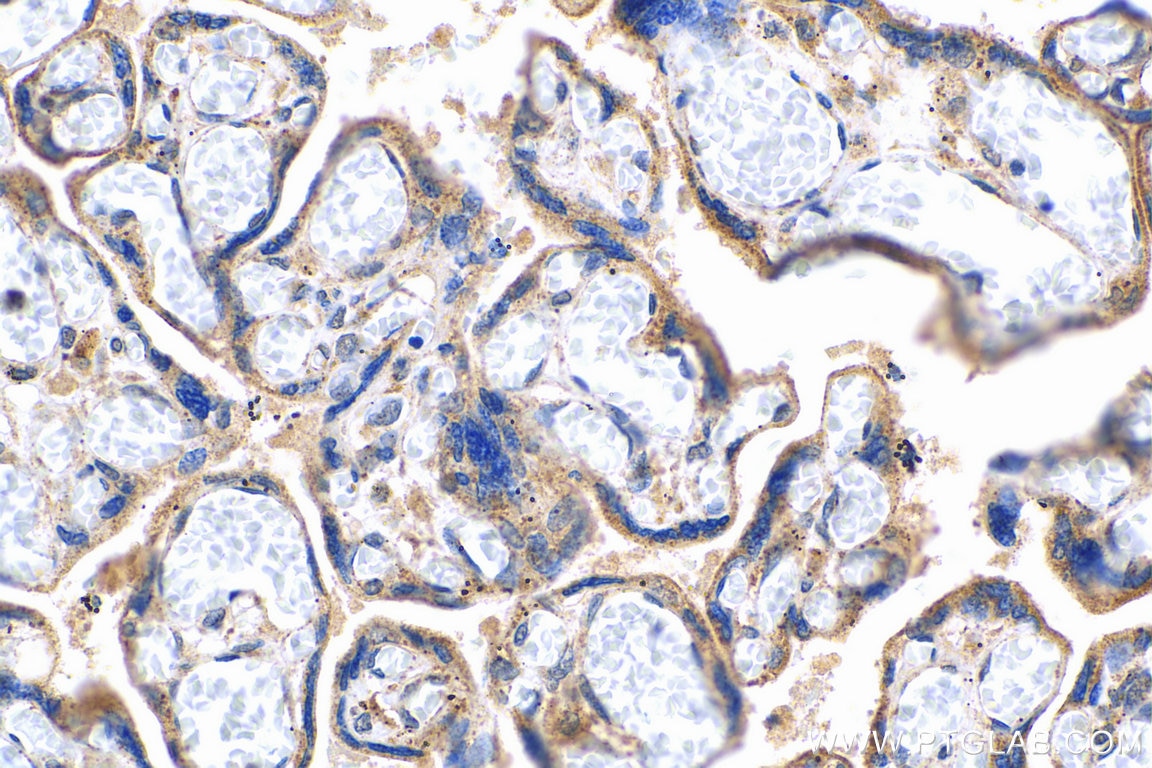
| Positive IHC detected in | human placenta tissue Note: suggested antigen retrieval with TE buffer pH 9.0; (*) Alternatively, antigen retrieval may be performed with citrate buffer pH 6.0 |
Recommended dilution
| Application | Dilution |
|---|---|
| Western Blot (WB) | WB : 1:500-1:2000 |
| Immunohistochemistry (IHC) | IHC : 1:50-1:500 |
| It is recommended that this reagent should be titrated in each testing system to obtain optimal results. | |
| Sample-dependent, Check data in validation data gallery. | |
Product Information
27212-1-AP targets TGFBR2 in WB, IHC, ELISA applications and shows reactivity with human samples.
| Tested Reactivity | human |
| Cited Reactivity | human, mouse, rat, sheep |
| Host / Isotype | Rabbit / IgG |
| Class | Polyclonal |
| Type | Antibody |
| Immunogen |
CatNo: Ag25767 Product name: Recombinant human TGFBR2 protein Source: e coli.-derived, PGEX-4T Tag: GST Domain: 23-166 aa of BC040499 Sequence: TIPPHVQKSVNNDMIVTDNNGAVKFPQLCKFCDVRFSTCDNQKSCMSNCSITSICEKPQEVCVAVWRKNDENITLETVCHDPKLPYHDFILEDAASPKCIMKEKKKPGETFFMCSCSSDECNDNIIFSEEYNTSNPDLLLVIFQ Predict reactive species |
| Full Name | transforming growth factor, beta receptor II (70/80kDa) |
| Calculated Molecular Weight | 65 kDa |
| Observed Molecular Weight | 65-80 kDa |
| GenBank Accession Number | BC040499 |
| Gene Symbol | TGFBR2 |
| Gene ID (NCBI) | 7048 |
| RRID | AB_2918119 |
| Conjugate | Unconjugated |
| Form | Liquid |
| Purification Method | Antigen affinity purification |
| UNIPROT ID | P37173 |
| Storage Buffer | PBS with 0.02% sodium azide and 50% glycerol, pH 7.3. |
| Storage Conditions | Store at -20°C. Stable for one year after shipment. Aliquoting is unnecessary for -20oC storage. 20ul sizes contain 0.1% BSA. |
Background Information
TGF beta Receptor II (TGFBR2) is a member of the transforming growth factor-β (TGF-β) superfamily, which are critical regulators of cell proliferation and differentiation, developmental patterning and morphogenesis, and disease pathogenesis (PMID: 10974075). TGFBR2 result in both SMAD4-dependent constraint of proliferation and SMAD4-independent activation of apoptosis (PMID: 29396446). The calculated molecular weight of TGFBR2 is 65 kDa. It has some isoforms with the molecular weight of 70-80 kDa and ~90 kDa after glycosylated.
Protocols
| Product Specific Protocols | |
|---|---|
| IHC protocol for TGFBR2 antibody 27212-1-AP | Download protocol |
| WB protocol for TGFBR2 antibody 27212-1-AP | Download protocol |
| Standard Protocols | |
|---|---|
| Click here to view our Standard Protocols |
Publications
What published studies show
The TGFBR2 Polyclonal antibody (Cat# 27212-1-AP) has 13 citations published in journals including Cell Chem Biol, Cell Commun Signal, Front Pharmacol, iScience, Oncogene, Exp Eye Res, Biology, Biochim Biophys Acta Mol Cell Res, Theriogenology, Acta Histochem, Reprod Sci, and Int J Rheum Dis. Research fields span pulmonary fibrosis, TGF-β/SMAD signaling, epithelial-mesenchymal transition, pancreatic cancer liver metastasis, ovarian dysfunction, rheumatoid arthritis, and prostate cancer bone metastasis.
| Species | Application | Title |
|---|---|---|
Cell Commun Signal The activation of PPARγ enhances Treg responses through up-regulating CD36/CPT1-mediated fatty acid oxidation and subsequent N-glycan branching of TβRII/IL-2Rα. | ||
Cell Chem Biol Therapeutic potency of compound RMY-205 for pulmonary fibrosis induced by SARS-CoV-2 nucleocapsid protein | ||
Front Pharmacol Tangeretin attenuates bleomycin-induced pulmonary fibrosis by inhibiting epithelial-mesenchymal transition via the PI3K/Akt pathway | ||
Front Pharmacol 2,3,5,4'-tetrahydroxystilbene-2-O-β-D-glucoside ameliorates bleomycin-induced pulmonary fibrosis via regulating pro-fibrotic signaling pathways | ||
iScience RRM2 promotes liver metastasis of pancreatic cancer by stabilizing YBX1 and activating the TGF-beta pathway | ||
Biology (Basel) miR-134-3p Regulates Cell Proliferation and Apoptosis by Targeting INHBA via Inhibiting the TGF-β/PI3K/AKT Pathway in Sheep Granulosa Cells |




