
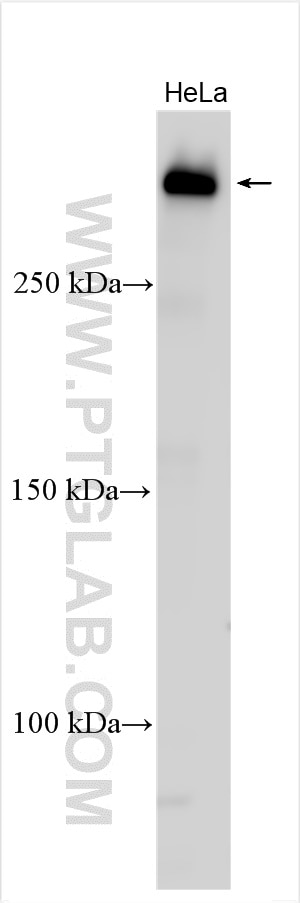
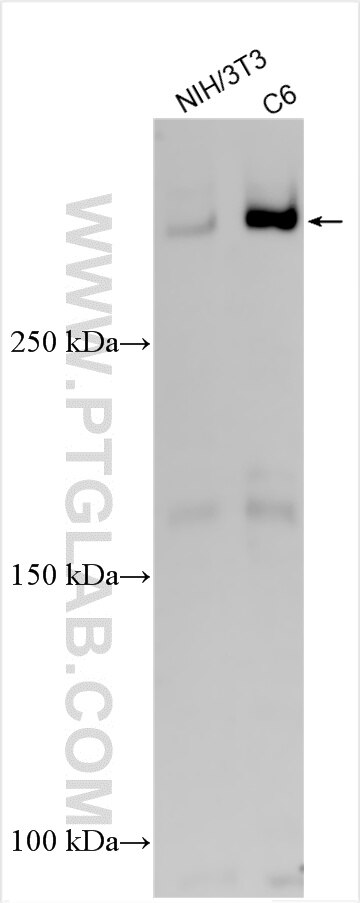

Tested Applications
| Positive WB detected in | HeLa cells, C6 cells, NIH/3T3 cells |
Recommended dilution
| Application | Dilution |
|---|---|
| Western Blot (WB) | WB : 1:500-1:2000 |
| It is recommended that this reagent should be titrated in each testing system to obtain optimal results. | |
| Sample-dependent, Check data in validation data gallery. | |
Product Information
20002-1-AP targets TP53BP1-Specific in WB, IHC, IF, ELISA applications and shows reactivity with human, mouse, rat samples.
| Tested Reactivity | human, mouse, rat |
| Cited Reactivity | human |
| Host / Isotype | Rabbit / IgG |
| Class | Polyclonal |
| Type | Antibody |
| Immunogen |
Peptide Predict reactive species |
| Full Name | tumor protein p53 binding protein 1 |
| Calculated Molecular Weight | 214 kDa |
| Observed Molecular Weight | 450 kDa |
| GenBank Accession Number | NM_005657 |
| Gene Symbol | TP53BP1 |
| Gene ID (NCBI) | 7158 |
| RRID | AB_3085592 |
| Conjugate | Unconjugated |
| Form | Liquid |
| Purification Method | Antigen affinity purification |
| UNIPROT ID | Q12888 |
| Storage Buffer | PBS with 0.02% sodium azide and 50% glycerol, pH 7.3. |
| Storage Conditions | Store at -20°C. Stable for one year after shipment. Aliquoting is unnecessary for -20oC storage. 20ul sizes contain 0.1% BSA. |
Background Information
TP53BP1, also named as p53BP1, p202, 53BP1 and FLJ41424, may have a role in checkpoint signaling during mitosis. TP53BP1 enhances TP53-mediated transcriptional activation. TP53BP1 plays a role in the response to DNA damage. This antibody is specific to TP53BP1.
Protocols
| Product Specific Protocols | |
|---|---|
| WB protocol for TP53BP1-Specific antibody 20002-1-AP | Download protocol |
| Standard Protocols | |
|---|---|
| Click here to view our Standard Protocols |
Publications
What published studies show
The TP53BP1-Specific Polyclonal antibody (Cat# 20002-1-AP) has 9 citations published in journals including Molecular Cancer, Cell Death & Disease, Oncogene, Antioxidants, Stem Cells Translational Medicine, Heliyon, Molecular Biology Reports, and Cell Biochemistry and Biophysics. The associated research fields span cancer biology (renal cell, endometrial, colorectal, lung, and ovarian cancers), DNA damage repair, radioresistance, ferroptosis, and skin photoaging.
| Species | Application | Title |
|---|---|---|
Mol Cancer Inhibition of PRMT5 triggers synthetic lethality in ARID1A-deficient endometrial cancer by promoting aberrant R-loop accumulation. | ||
Mol Cancer ACOX2 destabilizes the MRE11-RAD50-NBS1 complex and boosts anticancer immunity via the cGAS-STING pathway in clear cell renal cell carcinoma. | ||
Cell Death Dis CNOT7 facilitates radiation resistance in colorectal cancer through TRIM21/XRCC6-mediated non-homologous end joining repair. | ||
Oncogene Phospho-TRIM21 orchestrates RPA2 ubiquitination switch to promote homologous recombination and tumor radio/chemo-resistance | ||
Antioxidants (Basel) Camellia japonica Flower Extract and the Active Constituent Hyperoside Repair DNA Damage Through FUNDC1-Mediated Mitophagy Pathway for Skin Anti-Aging | ||
Stem Cells Transl Med Mesenchymal stromal cells-derived small extracellular vesicles protect against UV-induced photoaging via regulating pregnancy zone protein |



