
Product Information
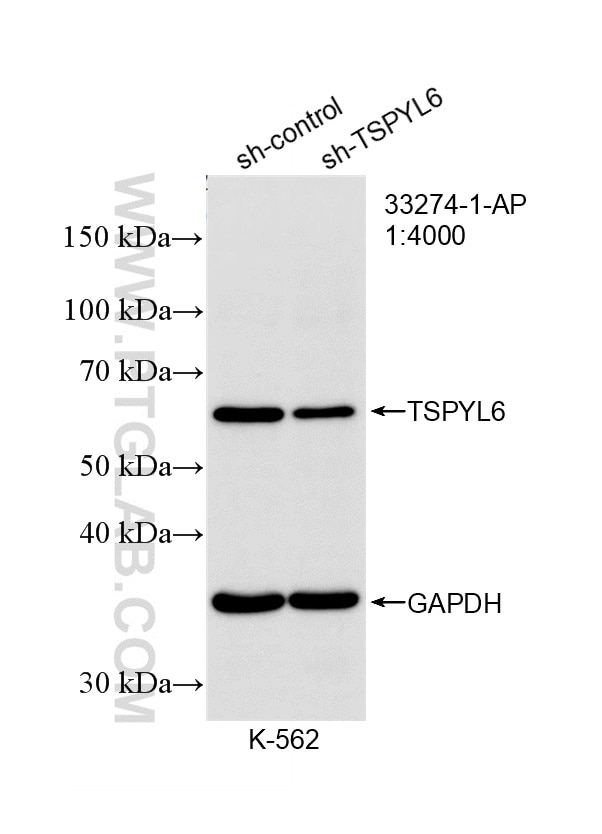
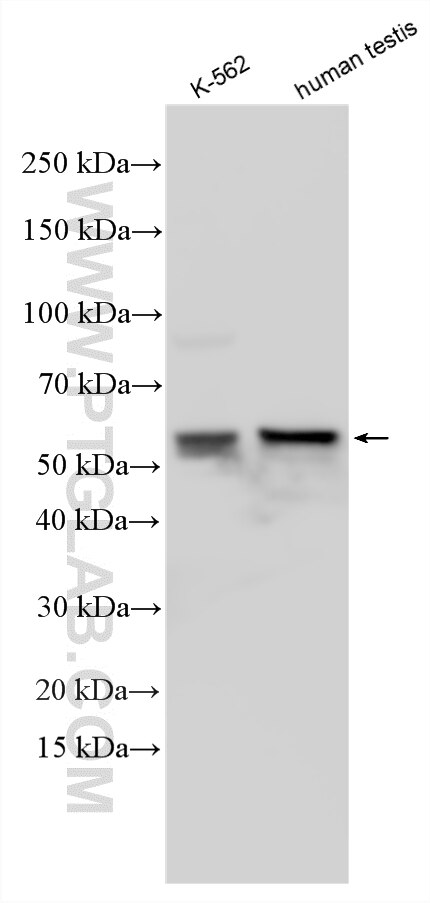
33274-1-PBS targets TSPYL6 in WB, Indirect ELISA applications and shows reactivity with human samples.
| Tested Reactivity | human |
| Host / Isotype | Rabbit / IgG |
| Class | Polyclonal |
| Type | Antibody |
| Immunogen |
CatNo: Ag38157 Product name: Recombinant human TSPYL6 protein Source: e coli.-derived, PGEX-4T Tag: GST Domain: 1-410 aa of BC068576 Sequence: MSLPESPHSPATLDYALEDPHQGQRSREKSKATEVMADMFDGRLEPIVFPPPRLPEEGVAPQDPADGGHTFHILVDAGRSHGAIKAGQEVTPPPAEGLEAASASLTTDSSLKNGFPGEETHGLGGEKALETCGAGRSESEVIAEGKAEDVKPEECAMFSAPVDEKPGGEEMDVAEENRAIDEVNREAGPGPGPGPLNVGLHLNPLESIQLELDSVNAEADRALLQVERRFGQIHEYYLEQRNDIICNIPGFWVTAFRHHPQLSAMIRGQDAEMLSYLTNLEVKELRHPRTGCKFKFFFQRNPYFRNKLIVKVYEVRSFGQVVSFSTLIMWRRGHGPQSFIHRNRHVICSFFTWFSDHSLPESDRIAQIIKEDLWSNPLQYYLLGEDAHRARRRLVREPVEIPRPFGFQCG Predict reactive species |
| Full Name | TSPY-like 6 |
| Calculated Molecular Weight | 410 aa, 46 kDa |
| Observed Molecular Weight | 60 kDa |
| GenBank Accession Number | BC068576 |
| Gene Symbol | TSPYL6 |
| Gene ID (NCBI) | 388951 |
| RRID | AB_3742922 |
| Conjugate | Unconjugated |
| Form | Liquid |
| Purification Method | Antigen affinity Purification |
| UNIPROT ID | Q8N831 |
| Storage Buffer | PBS only, pH 7.3. |
| Storage Conditions | Store at -80°C. |
Background Information
TSPYL6 (TSPY-like 6) protein is a member of the TSPY-like nucleoprotein family, and its specific physiological function has not yet been fully elucidated. However, this protein has garnered significant attention in cancer research as "an important tumor biomarker". Studies have shown that TSPYL6 is frequently overexpressed in various malignant tumors, such as breast cancer, lung cancer, colorectal cancer, and hepatocellular carcinoma. Its overexpression promotes tumor cell proliferation, invasion, and metastasis, while inhibiting apoptosis, and is closely associated with poor patient prognosis. Mechanistically, TSPYL6 is believed to exert its cancer-promoting effects by influencing cell cycle progression (e.g., promoting the G1/S phase transition) and regulating key oncogenic signaling pathways such as Wnt/β-catenin. Therefore, TSPYL6 is not only a potential diagnostic and prognostic biomarker but also considered a potential therapeutic target for cancer.



