
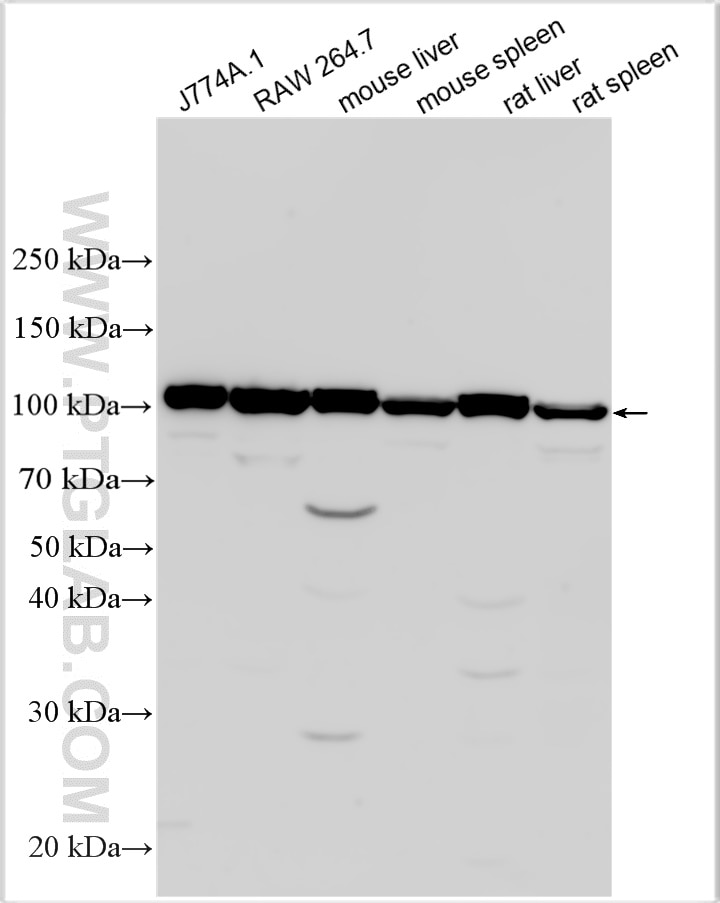
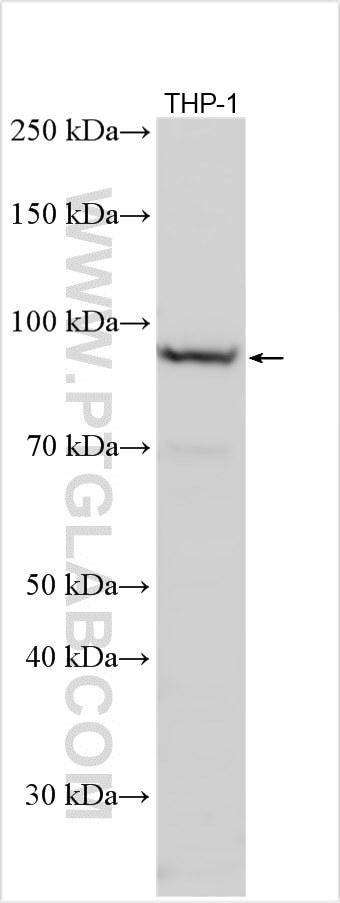

Tested Applications
| Positive WB detected in | J774A.1 cells, THP-1 cells, RAW 264.7 cells, mouse liver tissue, mouse spleen tissue, rat liver tissue, rat spleen tissue |
Recommended dilution
| Application | Dilution |
|---|---|
| Western Blot (WB) | WB : 1:1000-1:8000 |
| It is recommended that this reagent should be titrated in each testing system to obtain optimal results. | |
| Sample-dependent, Check data in validation data gallery. | |
Product Information
30400-1-AP targets TLR4 in WB, IF, ELISA applications and shows reactivity with human, mouse, rat samples.
| Tested Reactivity | human, mouse, rat |
| Cited Reactivity | mouse, rat |
| Host / Isotype | Rabbit / IgG |
| Class | Polyclonal |
| Type | Antibody |
| Immunogen |
CatNo: Ag32998 Product name: Recombinant mouse Tlr4 protein Source: e coli.-derived, PGEX-4T Tag: GST Domain: 198-395 aa of NM_021297 Sequence: RENPQVNLSLDMSLNPIDFIQDQAFQGIKLHELTLRGNFNSSNIMKTCLQNLAGLHVHRLILGEFKDERNLEIFEPSIMEGLCDVTIDEFRLTYTNDFSDDIVKFHCLANVSAMSLAGVSIKYLEDVPKHFKWQSLSIIRCQLKQFPTLDLPFLKSLTLTMNKGSISFKKVALPSLSYLDLSRNALSFSGCCSYSDLG Predict reactive species |
| Full Name | toll-like receptor 4 |
| Calculated Molecular Weight | 96 kDa |
| Observed Molecular Weight | 95-100 kDa |
| GenBank Accession Number | NM_021297 |
| Gene Symbol | Tlr4 |
| Gene ID (NCBI) | 21898 |
| RRID | AB_3086308 |
| Conjugate | Unconjugated |
| Form | Liquid |
| Purification Method | Antigen affinity purification |
| UNIPROT ID | Q9QUK6 |
| Storage Buffer | PBS with 0.02% sodium azide and 50% glycerol, pH 7.3. |
| Storage Conditions | Store at -20°C. Stable for one year after shipment. Aliquoting is unnecessary for -20oC storage. 20ul sizes contain 0.1% BSA. |
Background Information
TLR4, also known as CD284, belongs to the Toll-like receptor family. It is a type I transmembrane protein consisting of an extracellular leucine-rich repeat region, a helix transmembrane domain, and an intracellular Toll-IL-1 receptor domain. TLR4 functions as a pattern recognition receptor recognizing pathogen- and damage-associated molecular patterns (PAMPs and DAMPs) to induce innate immune responses via downstream signaling pathways. It interacts with LY96 and CD14 to mediate the innate immune response to bacterial lipopolysaccharide (LPS). TLR4 acts via MYD88, TIRAP, and TRAF6, leading to NF-kB activation, cytokine secretion, and the inflammatory response.
Protocols
| Product Specific Protocols | |
|---|---|
| WB protocol for TLR4 antibody 30400-1-AP | Download protocol |
| Standard Protocols | |
|---|---|
| Click here to view our Standard Protocols |
Publications
What published studies show
The TLR4 antibody (Cat# 30400-1-AP) has 20 citations published in journals including Advanced Materials, Journal of Nanobiotechnology, Phytomedicine, ACS Applied Materials & Interfaces, Free Radical Biology and Medicine, Life Sciences, International Immunopharmacology, Scientific Reports, Frontiers in Nutrition, and Heliyon. Associated research fields span immunology, inflammation, nanomedicine, liver disease, pulmonary injury, atherosclerosis, neuroprotection, wound healing, and sepsis.
| Species | Application | Title |
|---|---|---|
Adv Mater Inhalable Nanovaccine Based on Bioengineered Bacteria-Derived Membrane Vesicles Against Lung Metastasis. | ||
J Nanobiotechnology Folate-modified biomimetic nanovesicles loaded with a PU.1 inhibitor alleviate atherosclerosis by suppressing inflammation. | ||
Phytomedicine Tumor-derived S100A14 targeted astrocytes via TLR4 to Recruit myeloid-derived suppressor cells promoting brain metastasis and Curdione reversal effect. | ||
Arch Toxicol Oxidative stress-driven disease-associated microglia (DAM)-like polarization in human microglia (HMC3) cells exposed to small-size silver nanoparticles in a transwell co-culture system with neurons (cholinergic differentiated SH-SY5Y) cells in vitro | ||
Int J Nanomedicine Enhancement of Psoriasis Treatment by Phellodendri Chinensis Cortex Carbon Dots (PCC-CDs) Through Modulation of the HMGB1/TLR4/MAPK/NF-κB Pathway. |



