
Tested Applications
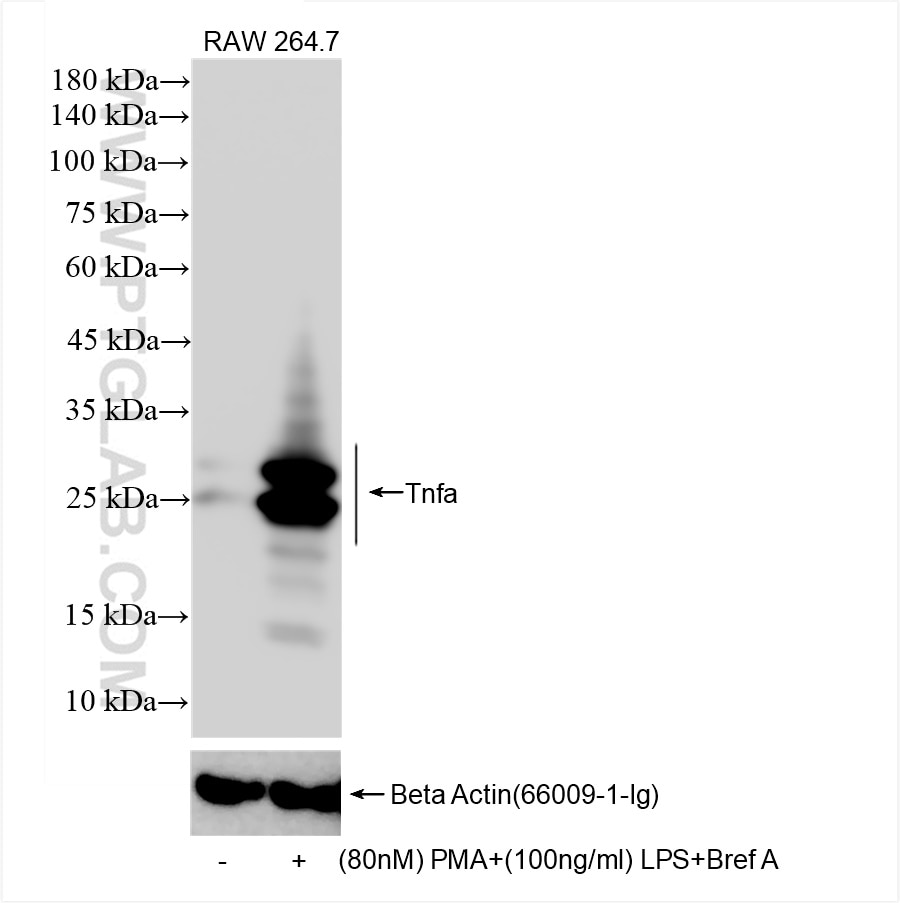
| Positive WB detected in | PMA, LPS and Brefeldin A treated RAW 264.7 cells |
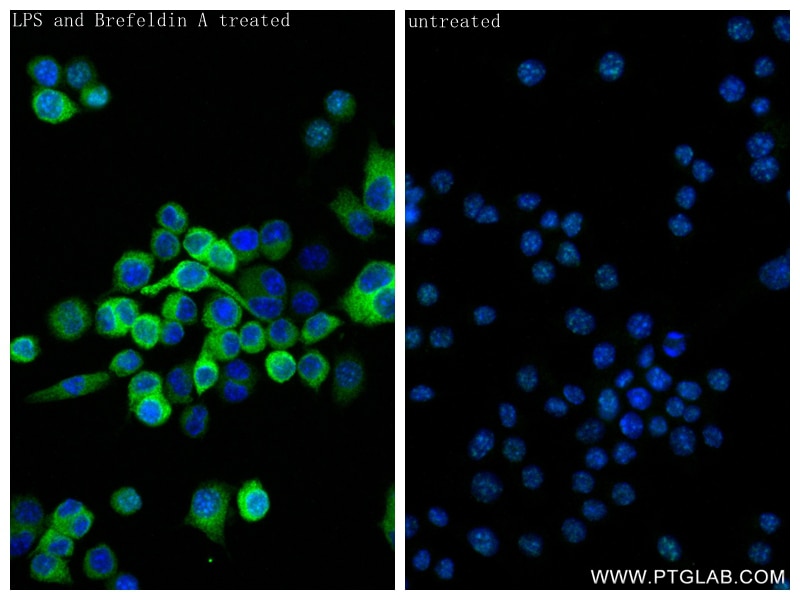
| Positive IF/ICC detected in | LPS and Brefeldin A treated RAW 264.7 cells |
Recommended dilution
| Application | Dilution |
|---|---|
| Western Blot (WB) | WB : 1:2000-1:10000 |
| Immunofluorescence (IF)/ICC | IF/ICC : 1:125-1:500 |
| It is recommended that this reagent should be titrated in each testing system to obtain optimal results. | |
| Sample-dependent, Check data in validation data gallery. | |
Product Information
80258-6-RR targets TNF-alpha in WB, IHC, IF/ICC, ELISA applications and shows reactivity with mouse samples.
| Tested Reactivity | mouse |
| Cited Reactivity | human, mouse, rat |
| Host / Isotype | Rabbit / IgG |
| Class | Recombinant |
| Type | Antibody |
| Immunogen |
Fusion Protein Predict reactive species |
| Full Name | tumor necrosis factor |
| Observed Molecular Weight | 25-26 kDa |
| GenBank Accession Number | NM-013693 |
| Gene Symbol | TNF-alpha |
| Gene ID (NCBI) | 21926 |
| RRID | AB_3670472 |
| Conjugate | Unconjugated |
| Form | Liquid |
| Purification Method | Protein A purfication |
| UNIPROT ID | P06804 |
| Storage Buffer | PBS with 0.02% sodium azide and 50% glycerol, pH 7.3. |
| Storage Conditions | Store at -20°C. Stable for one year after shipment. Aliquoting is unnecessary for -20oC storage. 20ul sizes contain 0.1% BSA. |
Background Information
TNF, as also known as TNF-alpha, or cachectin, is a multifunctional proinflammatory cytokine that belongs to the tumor necrosis factor (TNF) superfamily. It is expressed as a 26 kDa membrane bound protein and is then cleaved by TNF-alpha converting enzyme (TACE) to release the soluble 17 kDa monomer, which forms homotrimers in circulation. It is produced chiefly by activated macrophages, although it can be produced by many other cell types such as CD4+ lymphocytes, NK cells, neutrophils, mast cells, eosinophils, and neurons. It can bind to, and thus functions through its receptors TNFRSF1A/TNFR1 and TNFRSF1B/TNFBR. This cytokine is involved in the regulation of a wide spectrum of biological processes including cell proliferation, differentiation, apoptosis, lipid metabolism, and coagulation. Mouse and human TNF-alpha share 79% amino acid sequence identity. Unlike human TNF-alpha, the mouse form is glycosylated. In mouse deficiency of this gene is associated with defects in response to bacterial infection, with defects in forming organized follicular dendritic cell networks and germinal centers, and with a lack of primary B cell follicles.
Protocols
| Product Specific Protocols | |
|---|---|
| IF protocol for TNF-alpha antibody 80258-6-RR | Download protocol |
| WB protocol for TNF-alpha antibody 80258-6-RR | Download protocol |
| Standard Protocols | |
|---|---|
| Click here to view our Standard Protocols |
Publications
What published studies show
| Species | Application | Title |
|---|---|---|
Bioact Mater Mossy-textured hydroxyapatite-modified poly (lactic-co-glycolic acid) microspheres promote collagen regeneration via calcium/TGF-β and chemokine signaling pathways in soft tissue augmentation. | ||
Adv Sci (Weinh) Amelioration of Post-Stroke Edema and Microcirculatory Dysfunction via Targeted AQP4 Inhibition While Preserving the Glymphatic System. | ||
Aging Cell Adipose-Specific GHR Deletion Attenuates Brain Aging and Cognitive Decline in Aged Mice. | ||
Adv Healthc Mater Structured Polymers Enable the Sustained Delivery of Glucocorticoids within the Intra-Articular Space | ||
Biomedicines miR-21-5p Alleviates Retinal Ischemia-Reperfusion Injury by Inhibiting M1 Polarization of Microglia via Suppression of STAT3 Signaling. | ||
Mater Today Bio An integrated nano-delivery platform via baicalein-loaded polydopamine-MOF for enhanced neuroprotection against retinal ischemia reperfusion injury. |




