
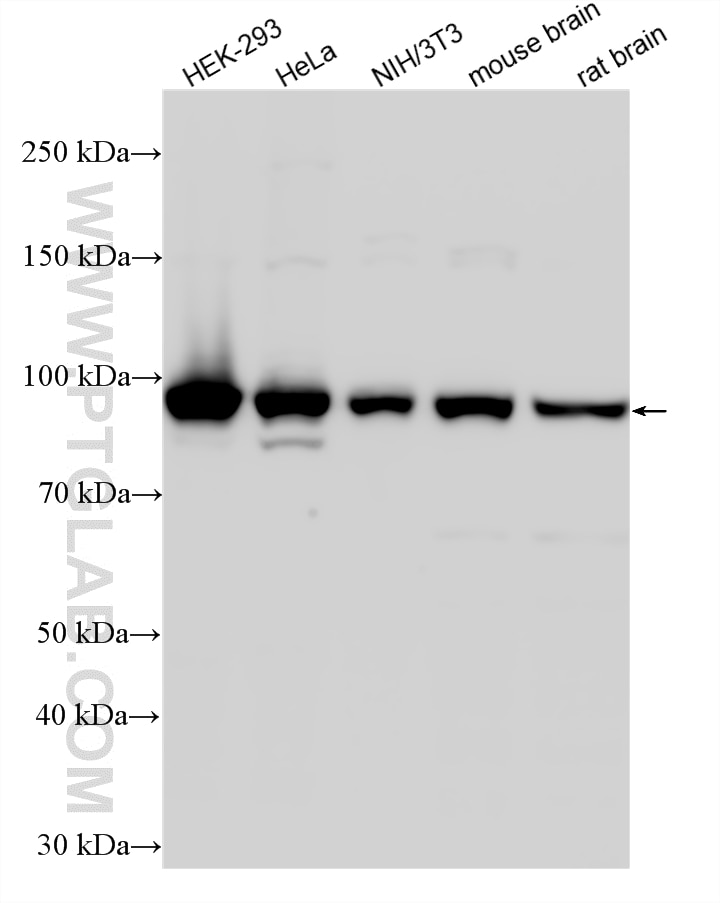



Tested Applications
| Positive WB detected in | HEK-293 cells, HeLa cells, NIH/3T3 cells, mouse brain tissue, rat brain tissue |
| Positive IP detected in | K-562 cells |
| Positive IHC detected in | human thyroid cancer tissue, human kidney tissue, mouse lung tissue, rat liver tissue, mouse kidney tissue Note: suggested antigen retrieval with TE buffer pH 9.0; (*) Alternatively, antigen retrieval may be performed with citrate buffer pH 6.0 |
Recommended dilution
| Application | Dilution |
|---|---|
| Western Blot (WB) | WB : 1:1000-1:6000 |
| Immunoprecipitation (IP) | IP : 0.5-4.0 ug for 1.0-3.0 mg of total protein lysate |
| Immunohistochemistry (IHC) | IHC : 1:250-1:1000 |
| It is recommended that this reagent should be titrated in each testing system to obtain optimal results. | |
| Sample-dependent, Check data in validation data gallery. | |
Product Information
10344-1-AP targets UBE3A in WB, IHC, IF, IP, ELISA applications and shows reactivity with human, mouse, rat samples.
| Tested Reactivity | human, mouse, rat |
| Cited Reactivity | human, mouse, rat |
| Host / Isotype | Rabbit / IgG |
| Class | Polyclonal |
| Type | Antibody |
| Immunogen |
CatNo: Ag0346 Product name: Recombinant human UBE3A protein Source: e coli.-derived, PGEX-4T Tag: GST Domain: 30-235 aa of BC002582 Sequence: IERYYHQLTEGCGNEACTNEFCASCPTFLRMDNNAAAIKALELYKINAKLCDPHPSKKGASSAYLENSKGAPNNSCSEIKMNKKGARIDFKDVTYLTEEKVYEILELCREREDYSPLIRVIGRVFSSAEALVQSFRKVKQHTKEELKSLQAKDEDKDEDEKEKAACSAAAMEEDSEASSSRIGDSSQGDNNLQKLGPDDVSVDIDA Predict reactive species |
| Full Name | ubiquitin protein ligase E3A |
| Calculated Molecular Weight | 852 aa, 98 kDa |
| Observed Molecular Weight | 100 kDa |
| GenBank Accession Number | BC002582 |
| Gene Symbol | UBE3A |
| Gene ID (NCBI) | 7337 |
| RRID | AB_2211801 |
| Conjugate | Unconjugated |
| Form | Liquid |
| Purification Method | Antigen affinity purification |
| UNIPROT ID | Q05086 |
| Storage Buffer | PBS with 0.02% sodium azide and 50% glycerol, pH 7.3. |
| Storage Conditions | Store at -20°C. Stable for one year after shipment. Aliquoting is unnecessary for -20oC storage. 20ul sizes contain 0.1% BSA. |
Background Information
UBE3A(Ubiquitin-protein ligase E3A) is also named as E6AP, EPVE6AP, HPVE6A and belongs to the E3 ubiquitin protein ligase family. It functions as both an E3 ligase in the ubiquitin proteasome pathway and as a transcriptional coactivator. It is also initially identified as a cellular protein that mediates in vitro association of the human papillomavirus E6 protein with p53, leading to the ubiquitin-dependent degradation of p53(PMID:1661671). Defects in UBE3A are a cause of Angelman syndrome (AS)(PMID:10508479). It has 3 isoforms with MW of 97-101 kDa produced by alternative splicing.
Protocols
| Product Specific Protocols | |
|---|---|
| IHC protocol for UBE3A antibody 10344-1-AP | Download protocol |
| IP protocol for UBE3A antibody 10344-1-AP | Download protocol |
| WB protocol for UBE3A antibody 10344-1-AP | Download protocol |
| Standard Protocols | |
|---|---|
| Click here to view our Standard Protocols |
Publications
What published studies show
The UBE3A Polyclonal antibody (Cat# 10344-1-AP) has 23 citations. Journals include Nature, Cell Stem Cell, Nature Communications, Science Advances, Cell Death & Disease, Oncogene, Cell Reports, Structure, Gene Therapy, and others. Research fields span neurology (Angelman syndrome, ALS, Alzheimer's, synucleinopathies), cancer (breast, renal, esophageal, cervical, lung, colorectal), ubiquitin-proteasome degradation pathways, organoid modeling, osteoarthritis, and MASH. Applications include WB, IF, IP, and IHC in human, mouse, and rat studies.
| Species | Application | Title |
|---|---|---|
Cell Stem Cell Generation of human pineal gland organoids with melatonin production for disease modeling | ||
Nat Commun UBE3A promotes foam cell formation and counters remyelination by targeting ABCA1 for proteasomal degradation | ||
J Nanobiotechnology UBQLN1 Inhibition reduces MASH progression through downregulating SIKE/p38 MAPK pathway in hepatocyte. | ||
Sci Adv Single-nucleus multi-omics identifies shared and distinct pathways in Pick's and Alzheimer's disease. | ||
Cell Death Dis The RBPJ/DAPK3/UBE3A signaling axis induces PBRM1 degradation to modulate the sensitivity of renal cell carcinoma to CDK4/6 inhibitors.
|



