
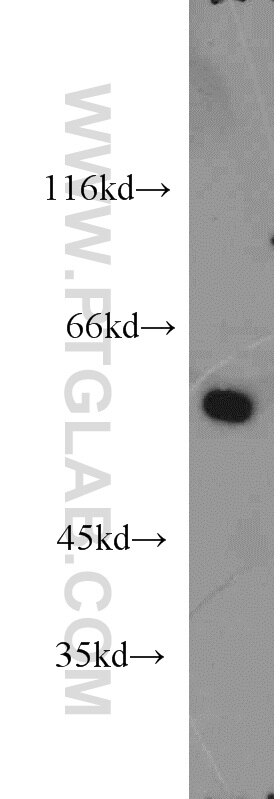
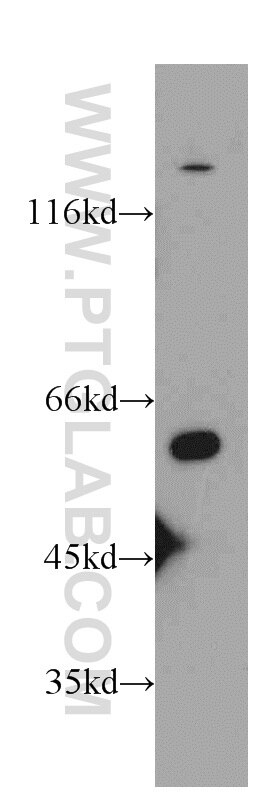

Tested Applications
| Positive WB detected in | mouse kidney tissue |
Recommended dilution
| Application | Dilution |
|---|---|
| Western Blot (WB) | WB : 1:500-1:1000 |
| It is recommended that this reagent should be titrated in each testing system to obtain optimal results. | |
| Sample-dependent, Check data in validation data gallery. | |
Product Information
20241-1-AP targets UNC5D-Specific in WB, ELISA applications and shows reactivity with human, mouse samples.
| Tested Reactivity | human, mouse |
| Cited Reactivity | human |
| Host / Isotype | Rabbit / IgG |
| Class | Polyclonal |
| Type | Antibody |
| Immunogen |
Peptide Predict reactive species |
| Full Name | unc-5 homolog D (C. elegans) |
| Calculated Molecular Weight | 106 kDa |
| Observed Molecular Weight | 59-65 kDa |
| GenBank Accession Number | NM_080872 |
| Gene Symbol | UNC5D |
| Gene ID (NCBI) | 137970 |
| RRID | AB_10699878 |
| Conjugate | Unconjugated |
| Form | Liquid |
| Purification Method | Antigen affinity purification |
| UNIPROT ID | Q6UXZ4 |
| Storage Buffer | PBS with 0.02% sodium azide and 50% glycerol, pH 7.3. |
| Storage Conditions | Store at -20°C. Stable for one year after shipment. Aliquoting is unnecessary for -20oC storage. 20ul sizes contain 0.1% BSA. |
Background Information
UNC5D, also named as KIAA1777 and UNC5H4, belongs to the unc-5 family. It is a receptor for netrin. It may be involved in axon guidance by mediating axon repulsion of neuronal growth cones in the developing nervous system upon ligand binding. Axon repulsion in growth cones may be caused by its association with DCC that may trigger signaling for repulsion. It also acts as a dependence receptor required for apoptosis induction when not associated with netrin ligand. The antibody is specific to UNC5D.
Publications
What published studies show
The UNC5D-Specific Polyclonal antibody (Cat# 20241-1-AP) has 1 citation to date. It appears in Science Advances (IF 13.9), published in March 2024 by Kushal Prajapati et al. The cited study investigates the FLRT3-UNC5B checkpoint pathway and its role in inhibiting T cell-based cancer immunotherapies, placing this antibody's use in the fields of cancer immunology and neural receptor signaling in immune regulation.
| Species | Application | Title |
|---|---|---|



