


Tested Applications
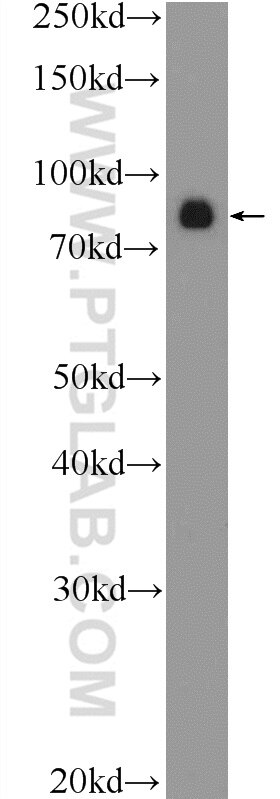
| Positive WB detected in | MCF-7 cells |
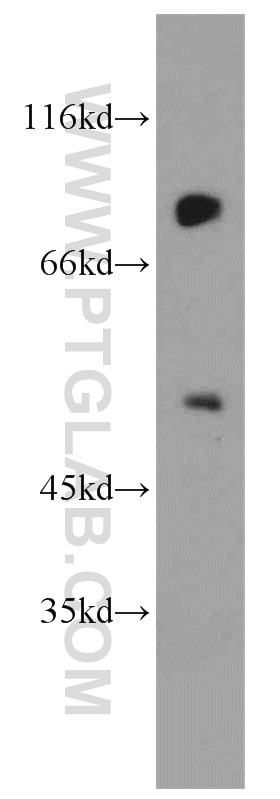
| Positive IP detected in | BxPC-3 cells |
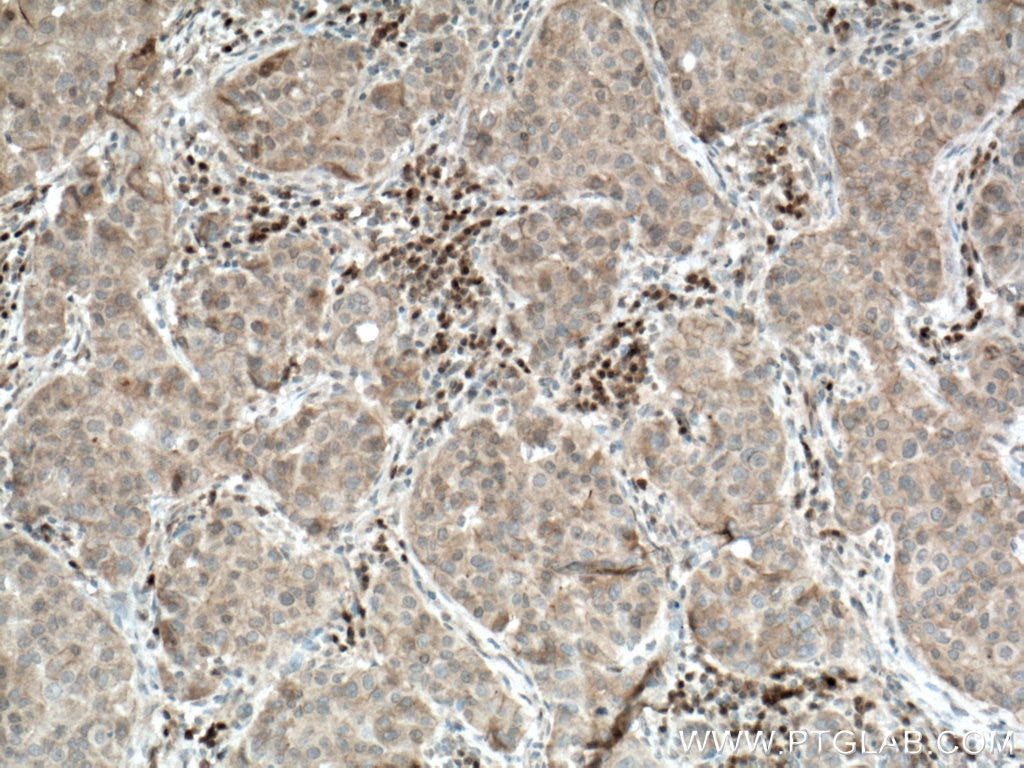
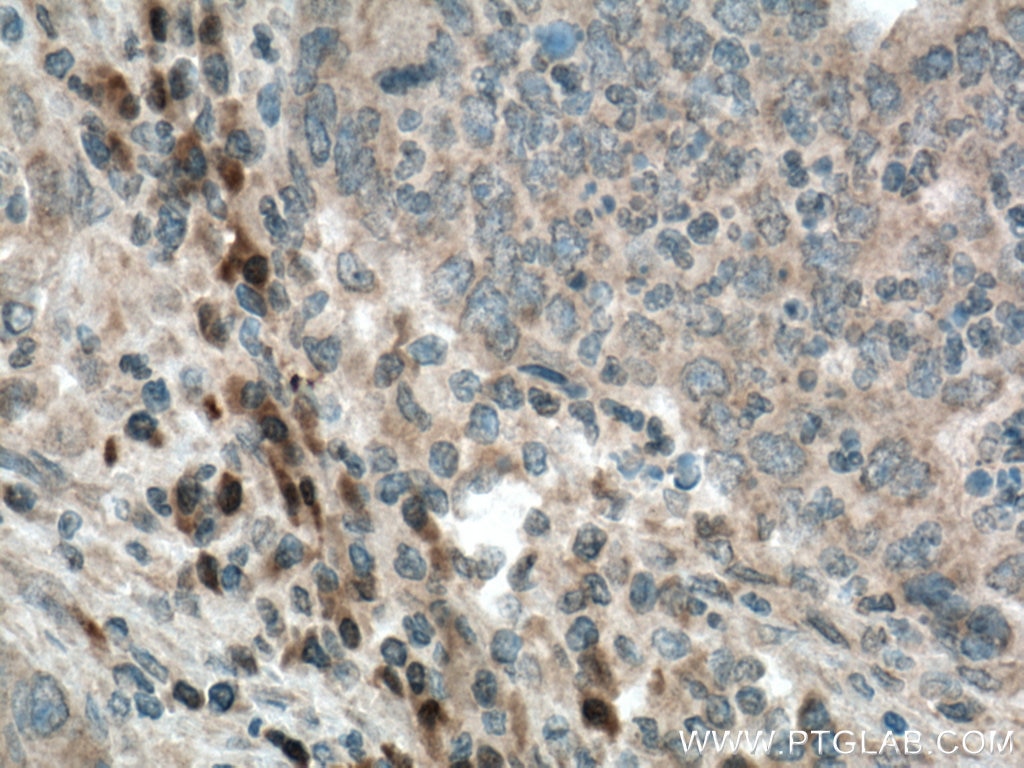
| Positive IHC detected in | human colon cancer tissue, human breast cancer tissue Note: suggested antigen retrieval with TE buffer pH 9.0; (*) Alternatively, antigen retrieval may be performed with citrate buffer pH 6.0 |
Recommended dilution
| Application | Dilution |
|---|---|
| Western Blot (WB) | WB : 1:500-1:1000 |
| Immunoprecipitation (IP) | IP : 0.5-4.0 ug for 1.0-3.0 mg of total protein lysate |
| Immunohistochemistry (IHC) | IHC : 1:50-1:500 |
| It is recommended that this reagent should be titrated in each testing system to obtain optimal results. | |
| Sample-dependent, Check data in validation data gallery. | |
Product Information
18066-1-AP targets USP49 in WB, IHC, IF, IP, CoIP, ChIP, ELISA applications and shows reactivity with human, mouse, rat samples.
| Tested Reactivity | human, mouse, rat |
| Cited Reactivity | human, mouse, rat |
| Host / Isotype | Rabbit / IgG |
| Class | Polyclonal |
| Type | Antibody |
| Immunogen |
CatNo: Ag12697 Product name: Recombinant human USP49 protein Source: e coli.-derived, PGEX-4T Tag: GST Domain: 1-351 aa of BC014176 Sequence: MDRCKHVGRLRLAQDHSILNPQKWCCLECATTESVWACLKCSHVACGRYIEDHALKHFEETGHPLAMEVRDLYVFCYLCKDYVLNDNPEGDLKLLRSSLLAVRGQKQDTPVRRGRTLRSMASGEDVVLPQRAPQGQPQMLTALWYRRQRLLARTLRLWFEKSSRGQAKLEQRRQEEALERKKEEARRRRREVKRRLLEELASTPPRKSARLLLHTPRDAGPAASRPAALPTSRRVPAATLKLRRQPAMAPGVTGLRNLGNTCYMNSILQVLSHLQKFRECFLNLDPSKTEHLFPKATNGKTQLSGKPTNSSATELSLRNDRAEACEREGFCWNGRASISRSLELIQNKEPS Predict reactive species |
| Full Name | ubiquitin specific peptidase 49 |
| Calculated Molecular Weight | 73 kDa, 79 kDa |
| Observed Molecular Weight | 79-85 kDa |
| GenBank Accession Number | BC014176 |
| Gene Symbol | USP49 |
| Gene ID (NCBI) | 25862 |
| RRID | AB_10643992 |
| Conjugate | Unconjugated |
| Form | Liquid |
| Purification Method | Antigen affinity purification |
| UNIPROT ID | Q70CQ1 |
| Storage Buffer | PBS with 0.02% sodium azide and 50% glycerol, pH 7.3. |
| Storage Conditions | Store at -20°C. Stable for one year after shipment. Aliquoting is unnecessary for -20oC storage. 20ul sizes contain 0.1% BSA. |
Background Information
USPs are cysteine proteases that vary greatly in size and structural complexity. Outside of the core catalytic domain, USPs exhibit N-terminal and C-terminal extensions that have been proposed to play roles in determining cellular localization and substrate specificity of these enzymes(PMID:14715245). USP49(Ubiquitin carboxyl-terminal hydrolase 49) belongs to this family. It has 2 isoforms produced by alternative splicing.
Protocols
| Product Specific Protocols | |
|---|---|
| IHC protocol for USP49 antibody 18066-1-AP | Download protocol |
| IP protocol for USP49 antibody 18066-1-AP | Download protocol |
| WB protocol for USP49 antibody 18066-1-AP | Download protocol |
| Standard Protocols | |
|---|---|
| Click here to view our Standard Protocols |
Publications
What published studies show
The USP49 Polyclonal antibody (Cat# 18066-1-AP) has 23 citations published in journals including Theranostics, Cell Death & Differentiation, EMBO Journal, PLoS Pathogens, eLife, Oncogene, and Biochemical & Biophysical Research Communications. Research fields span cancer biology (colorectal, lung, breast, pancreatic, endometrial, thyroid, cervical, and esophageal cancers), apoptosis, ferroptosis, DNA damage repair, antiviral immunity, odontogenesis, chondrocyte biology, and cardioprotection.
| Species | Application | Title |
|---|---|---|
Theranostics USP32 confers cancer cell resistance to YM155 via promoting ER-associated degradation of solute carrier protein SLC35F2
| ||
Cell Death Differ Genome-wide screening for deubiquitinase subfamily identifies ubiquitin-specific protease 49 as a novel regulator of odontogenesis.
| ||
Cell Death Dis Fbxo45 facilitates pancreatic carcinoma progression by targeting USP49 for ubiquitination and degradation. | ||
Cell Death Discov miR-5000-3p confers oxaliplatin resistance by targeting ubiquitin-specific peptidase 49 in colorectal cancer. | ||
J Transl Med Cold atmospheric plasma drives USP49/HDAC3 axis mediated ferroptosis as a novel therapeutic strategy in endometrial cancer via reinforcing lactylation dependent p53 expression
| ||
EMBO J USP49 negatively regulates tumorigenesis and chemoresistance through FKBP51-AKT signaling.
|






