



Tested Applications
| Positive WB detected in | Jurkat cells, HeLa cells, Raji cells |
| Positive IHC detected in | human kidney tissue, human liver cancer tissue Note: suggested antigen retrieval with TE buffer pH 9.0; (*) Alternatively, antigen retrieval may be performed with citrate buffer pH 6.0 |
| Positive IF/ICC detected in | HepG2 cells |
Recommended dilution
| Application | Dilution |
|---|---|
| Western Blot (WB) | WB : 1:500-1:2000 |
| Immunohistochemistry (IHC) | IHC : 1:50-1:500 |
| Immunofluorescence (IF)/ICC | IF/ICC : 1:10-1:100 |
| It is recommended that this reagent should be titrated in each testing system to obtain optimal results. | |
| Sample-dependent, Check data in validation data gallery. | |
Product Information
24756-1-AP targets VHL in WB, IHC, IF/ICC, IP, CoIP, ELISA applications and shows reactivity with human samples.
| Tested Reactivity | human |
| Cited Reactivity | human, mouse, rat |
| Host / Isotype | Rabbit / IgG |
| Class | Polyclonal |
| Type | Antibody |
| Immunogen |
CatNo: Ag21447 Product name: Recombinant human VHL protein Source: e coli.-derived, PGEX-4T Tag: GST Domain: 90-172 aa of BC058831 Sequence: NFDGEPQPYPTLPPGTGRRIYSYRVYTLKERCLQVVRSLVKPENYRRLDIVRSLYEDLEDHPNVQKDLERLTQERIAHQRMGD Predict reactive species |
| Full Name | von Hippel-Lindau tumor suppressor |
| Calculated Molecular Weight | 172 aa, 20 kDa |
| Observed Molecular Weight | 18-24 kDa |
| GenBank Accession Number | BC058831 |
| Gene Symbol | VHL |
| Gene ID (NCBI) | 7428 |
| RRID | AB_2879705 |
| Conjugate | Unconjugated |
| Form | Liquid |
| Purification Method | Antigen affinity purification |
| UNIPROT ID | P40337 |
| Storage Buffer | PBS with 0.02% sodium azide and 50% glycerol, pH 7.3. |
| Storage Conditions | Store at -20°C. Stable for one year after shipment. Aliquoting is unnecessary for -20oC storage. 20ul sizes contain 0.1% BSA. |
Background Information
VHL (von Hippel-Lindau tumor suppressor) gene was identified as the tumor suppressor gene whose germ line mutations are associated with the inherited von Hippel-Lindau cancer syndrome (PMID: 8603073, 10722748). VHL patients develop a wide variety of tumors including retinal angioma, central nervous system hemangioblastoma, pheochromocytoma, and renal clear cell carcinoma (PMID: 10722748). VHL localizes predominantly to the cytoplasmic compartment but engages in a dynamic nuclear-cytoplasmic shuttle (PMID: 8700833, 9891082, 12101228). VHL has 3 isoforms with the molecular mass of 24, 20 and 18 kDa.
Protocols
| Product Specific Protocols | |
|---|---|
| IF protocol for VHL antibody 24756-1-AP | Download protocol |
| IHC protocol for VHL antibody 24756-1-AP | Download protocol |
| WB protocol for VHL antibody 24756-1-AP | Download protocol |
| Standard Protocols | |
|---|---|
| Click here to view our Standard Protocols |
Publications
What published studies show
The VHL Polyclonal antibody (catalog #24756-1-AP) has 32 citations. These appear in journals including Nature Cell Biology, Nature Communications, Cancer Research, Journal of Clinical Investigation, EMBO Journal, Cell Death & Differentiation, Oncogene, and Acta Pharmaceutica Sinica B, among others. Research fields span oncology (renal, colorectal, breast, lung, and liver cancers), hypoxia/HIF-1α signaling, angiogenesis, metabolism, fibrosis, endometriosis, and protein degradation (PROTAC) studies.
| Species | Application | Title |
|---|---|---|
Nat Cell Biol AMPK-regulated glycerol excretion maintains metabolic crosstalk between reductive and energetic stress | ||
Cancer Res Fatty Acid Oxidation Mediated by Malonyl-CoA Decarboxylase Represses Renal Cell Carcinoma Progression | ||
Clin Mol Hepatol UBE2S promotes glycolysis in hepatocellular carcinoma by enhancing E3 enzyme-independent polyubiquitination of VHL | ||
Nat Commun Hypoxia-induced downregulation of PGK1 crotonylation promotes tumorigenesis by coordinating glycolysis and the TCA cycle | ||
Nat Commun Cytoplasmic TRIM24 promotes colorectal cancer cell proliferation by activating Wnt/β-catenin signaling | ||
Nat Chem Biol PROTAR Vaccine 2.0 generates influenza vaccines by degrading multiple viral proteins |
Reviews
What customers say
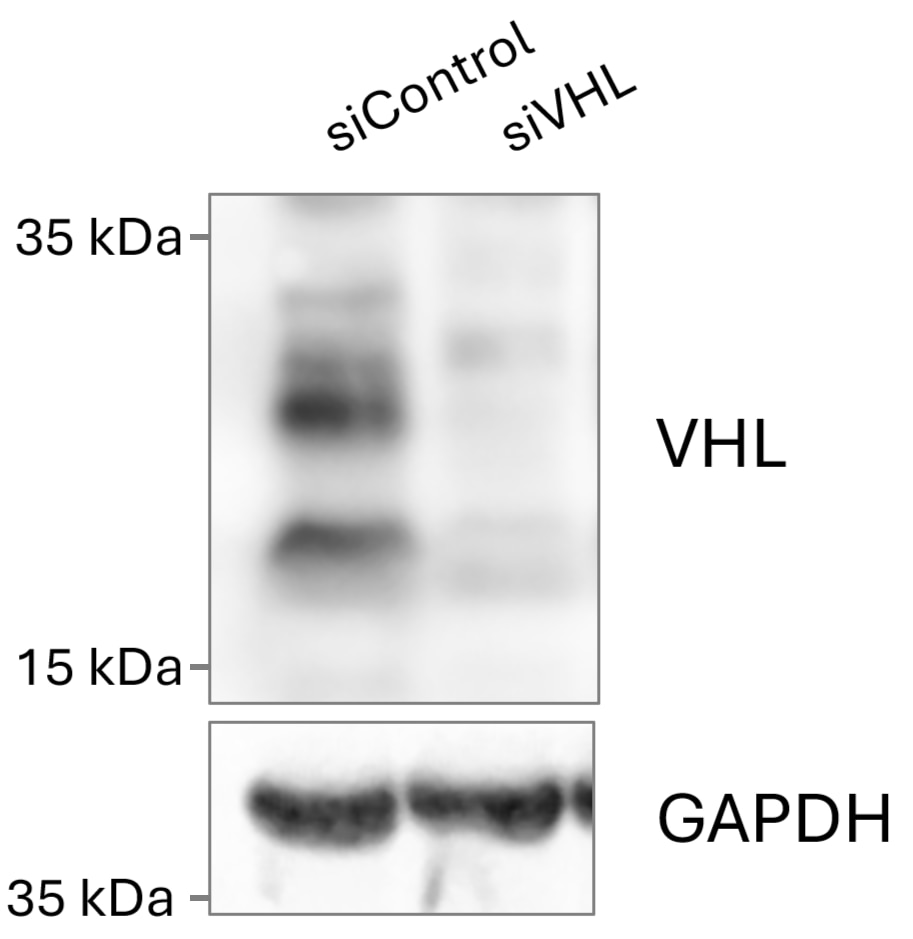
Both reviews concern Western blot performance. One user (3/5) reported the antibody detects multiple bands, though siRNA knockdown of VHL reduced many of these signals, suggesting relative specificity; they noted results can be difficult to interpret without an appropriate control. Another user (1/5) found the antibody did not work in their hands, citing too many non-specific bands to clearly identify the VHL band. Overall, feedback is mixed, with the main concern being non-specific banding that complicates interpretation.
The reviews below have been submitted by verified Proteintech customers who received an incentive for providing their feedback.
Matteo (Verified Customer) (09-01-2026) | The antibody detects multiple bands. However, siRNA knockdown of VHL reduced the signal of many of these bands, suggesting that the antibody is relatively specific. That said, it can be difficult to interpret the results without an appropriate control.
 |
S (Verified Customer) (11-22-2021) | This antibody didn't work in my hands. There are too many non-specific bands to identify the VHL band.
 |


