
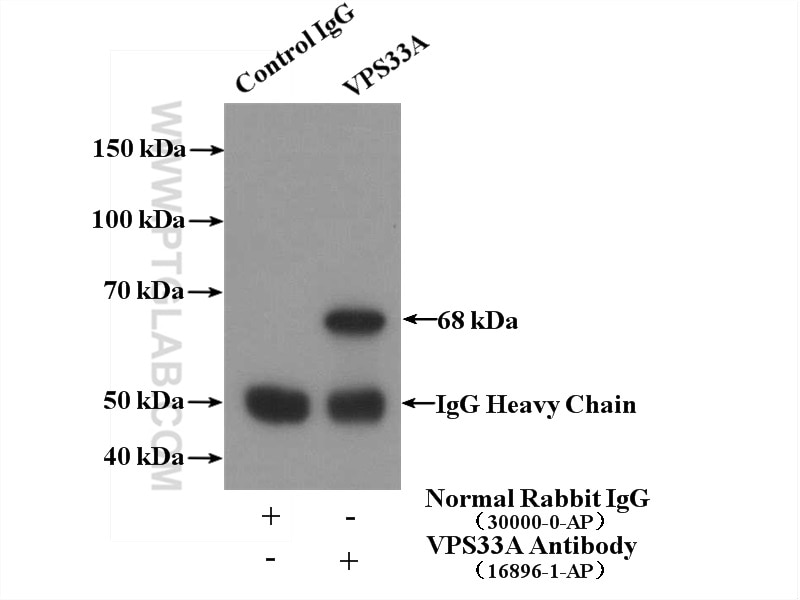

Tested Applications
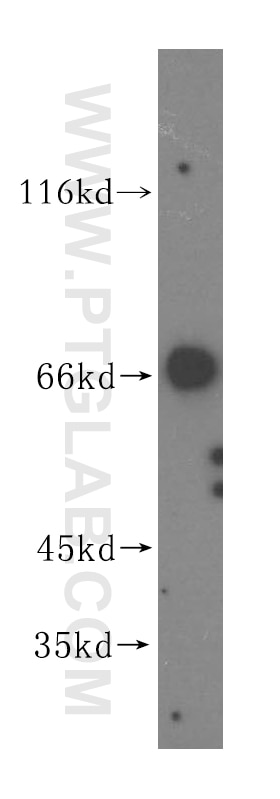
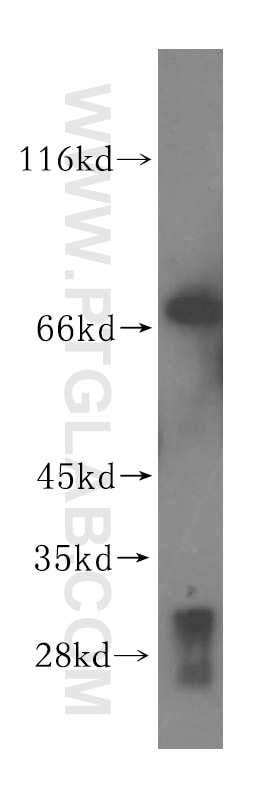
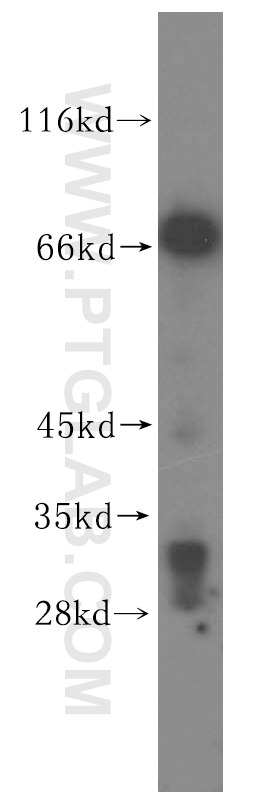
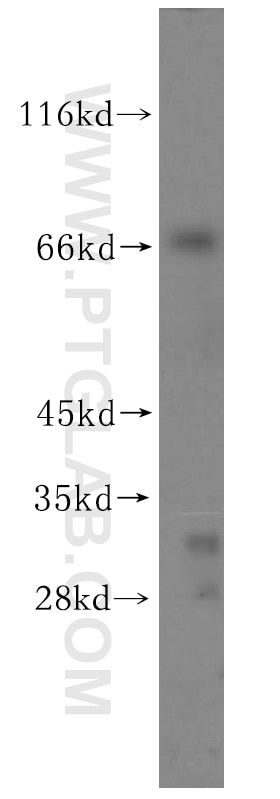
| Positive WB detected in | human brain tissue, HepG2 cells, human cerebellum tissue, NIH/3T3 cells |
| Positive IP detected in | HepG2 cells |
Recommended dilution
| Application | Dilution |
|---|---|
| Western Blot (WB) | WB : 1:500-1:2000 |
| Immunoprecipitation (IP) | IP : 0.5-4.0 ug for 1.0-3.0 mg of total protein lysate |
| It is recommended that this reagent should be titrated in each testing system to obtain optimal results. | |
| Sample-dependent, Check data in validation data gallery. | |
Product Information
16896-1-AP targets VPS33A in WB, IF, IP, CoIP, ELISA applications and shows reactivity with human, mouse, rat samples.
| Tested Reactivity | human, mouse, rat |
| Cited Reactivity | human, mouse, rat |
| Host / Isotype | Rabbit / IgG |
| Class | Polyclonal |
| Type | Antibody |
| Immunogen |
CatNo: Ag10422 Product name: Recombinant human VPS33A protein Source: e coli.-derived, PGEX-4T Tag: GST Domain: 246-596 aa of BC016617 Sequence: YEGLIDEIYGIQNSYVKLPPEKFAPKKQGDGGKDLPTEAKKLQLNSAEELYAEIRDKNFNAVGSVLSKKAKIISAAFEERHNAKTVGEIKQFVSQLPHMQAARGSLANHTSIAELIKDVTTSEDFFDKLTVEQEFMSGIDTDKVNNYIEDCIAQKHSLIKVLRLVCLQSVCNSGLKQKVLDYYKREILQTYGYEHILTLHNLEKAGLLKPQTGGRNNYPTIRKTLRLWMDDVNEQNPTDISYVYSGYAPLSVRLAQLLSRPGWRSIEEVLRILPGPHFEERQPLPTGLQKKRQPGENRVTLIFFLGGVTFAEIAALRFLSQLEDGGTEYVIATTKLMNGTSWIEALMEKPF Predict reactive species |
| Full Name | vacuolar protein sorting 33 homolog A (S. cerevisiae) |
| Calculated Molecular Weight | 596 aa, 68 kDa |
| Observed Molecular Weight | 68 kDa |
| GenBank Accession Number | BC016617 |
| Gene Symbol | VPS33A |
| Gene ID (NCBI) | 65082 |
| RRID | AB_2214916 |
| Conjugate | Unconjugated |
| Form | Liquid |
| Purification Method | Antigen affinity purification |
| UNIPROT ID | Q96AX1 |
| Storage Buffer | PBS with 0.02% sodium azide and 50% glycerol, pH 7.3. |
| Storage Conditions | Store at -20°C. Stable for one year after shipment. Aliquoting is unnecessary for -20oC storage. 20ul sizes contain 0.1% BSA. |
Background Information
VPS33A is a Sec1/Munc18 family member and is a component of the homotypic fusion and protein sorting (HOPS)-tethering complex. The mammalian HOPS complex comprises six subunits (VPS11, VPS16, VPS18, VPS33A, VPS39, and VPS41) (PMID: 23901104). This complex is required for late endosome-lysosome and autophagosome-lysosome fusion (PMID: 24554770). VPS33A plays a role in vesicular transport to the lysosomal compartment.
Protocols
| Product Specific Protocols | |
|---|---|
| IP protocol for VPS33A antibody 16896-1-AP | Download protocol |
| WB protocol for VPS33A antibody 16896-1-AP | Download protocol |
| Standard Protocols | |
|---|---|
| Click here to view our Standard Protocols |
Publications
What published studies show
The VPS33A Polyclonal antibody (Cat# 16896-1-AP) has 18 citations across journals including Autophagy, Nature Communications, Theranostics, Cell Reports, Cell Death & Disease, Journal of Cell Biology, PLoS Pathogens, Archives of Toxicology, Journal of Hazardous Materials, Cell Systems, Virulence, Journal of Cell Science, Mammalian Genome, and Journal of Applied Genetics. Research fields encompass autophagosome-lysosome fusion, HOPS complex-mediated vesicle trafficking, endolysosomal biology, viral replication, neurotoxicology, glioblastoma, and mucopolysaccharidosis-plus syndrome.
| Species | Application | Title |
|---|---|---|
Autophagy SDC1-dependent TGM2 determines radiosensitivity in glioblastoma by coordinating EPG5-mediated fusion of autophagosomes with lysosomes | ||
Nat Commun Deacetylated SNAP47 recruits HOPS to facilitate autophagosome-lysosome fusion independent of STX17 | ||
Nat Commun C9orf72-catalyzed GTP loading of Rab39A enables HOPS-mediated membrane tethering and fusion in mammalian autophagy | ||
Theranostics Histone H4K8 lactylation promotes glioblastoma progression by inducing NUPR1-mediated autophagosome‒lysosome fusion. | ||
Cell Death Dis Mutations in VPS18 lead to a neutrophil maturation defect associated with disturbed vesicle homeostasis. |






