

Product Information
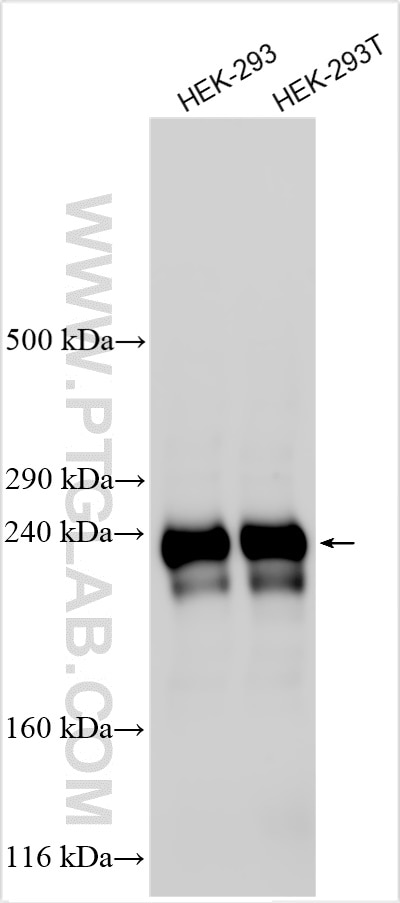
32231-1-PBS targets WNK3 in WB, Indirect ELISA applications and shows reactivity with human samples.
| Tested Reactivity | human |
| Host / Isotype | Rabbit / IgG |
| Class | Polyclonal |
| Type | Antibody |
| Immunogen |
CatNo: Ag37713 Product name: Recombinant human WNK3 protein Source: e coli.-derived, PGEX-4T Tag: GST Domain: 500-650 aa of NM_001002838 Sequence: AGCLEERRDSQCKSMGNVFPQPQNTTLPLAPAQQTGAECEETEVDQHVRQQLLQRKPQQHCSSVTGDNLSEAGAASVIHSDTSSQPSVAYSSNQTMGSQMVSNIPQAEVNVPGQIYSSQQLVGHYQQVSGLQKHSKLTQPQILPLVQGQST Predict reactive species |
| Full Name | WNK lysine deficient protein kinase 3 |
| Calculated Molecular Weight | 1800aa, 198 kDa |
| Observed Molecular Weight | 230 kDa |
| GenBank Accession Number | NM_001002838 |
| Gene Symbol | WNK3 |
| Gene ID (NCBI) | 65267 |
| RRID | AB_3742549 |
| Conjugate | Unconjugated |
| Form | Liquid |
| Purification Method | Antigen affinity Purification |
| UNIPROT ID | Q9BYP7 |
| Storage Buffer | PBS only, pH 7.3. |
| Storage Conditions | Store at -80°C. |
Background Information
WNK3, is a member of the WNK (With No Lysine [K]) kinase family. It is a serine/threonine kinase that plays important roles in various physiological processes. WNK3 is expressed in brain, lung, kidney, liver and pancreas, and in fetal tissues including placenta, fetal brain, lung and kidney. Very low levels of expression were also detected in fetal heart, thymus, liver and spleen. Isoform 1 is brain-specific. Isoform 3 is kidney-specific. Endogenous WNK3 protein is an active protein kinase when immunoprecipitated from cells and its overexpression increases the survival of HeLa cells by delaying the onset of apoptosis (PMID:16501604).


