
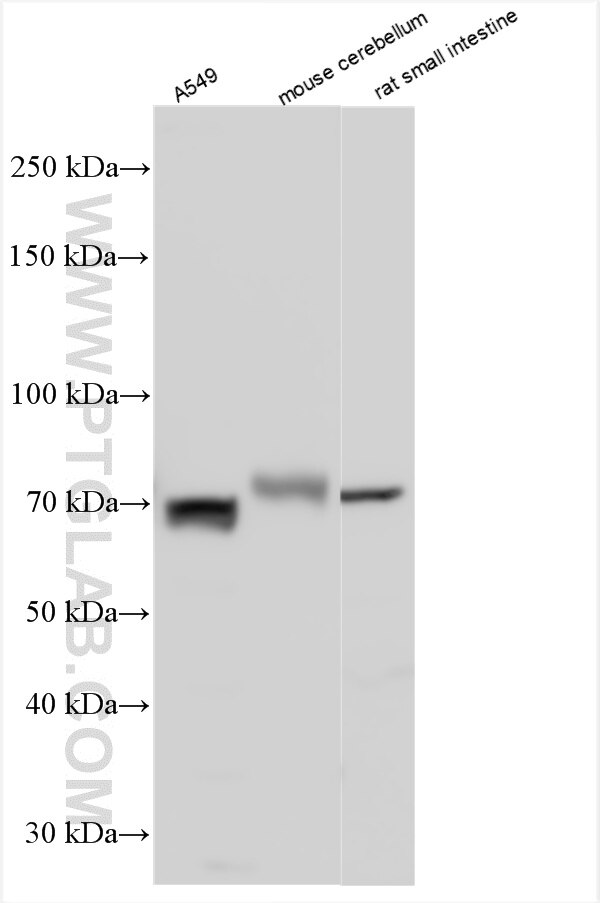

Tested Applications
| Positive WB detected in | A549 cells, mouse cerebellum tissue, rat small intestine tissue |
Recommended dilution
| Application | Dilution |
|---|---|
| Western Blot (WB) | WB : 1:500-1:2000 |
| It is recommended that this reagent should be titrated in each testing system to obtain optimal results. | |
| Sample-dependent, Check data in validation data gallery. | |
Product Information
32981-1-AP targets XKR4 in WB, ELISA applications and shows reactivity with human, mouse, rat samples.
| Tested Reactivity | human, mouse, rat |
| Host / Isotype | Rabbit / IgG |
| Class | Polyclonal |
| Type | Antibody |
| Immunogen |
CatNo: Ag38049 Product name: Recombinant human XKR4 protein Source: e coli.-derived, PGEX-4T Tag: GST Domain: 508-650 aa of NM_052898 Sequence: MYYAFFHPNGPRFGQSPSCACEDPAAAFTLPPDVATSTLRSISNNRSVVSDRDQKFAERDGCVPVFQVRPTAPSTPSSRPPRIEESVIKIDLFRNRYPAWERHVLDRSLRKAILAFECSPSPPRLQYKDDALIQERLEYETTL Predict reactive species |
| Full Name | XK, Kell blood group complex subunit-related family, member 4 |
| Calculated Molecular Weight | 650aa, 72 kDa |
| Observed Molecular Weight | 71 kDa |
| GenBank Accession Number | NM_052898 |
| Gene Symbol | XKR4 |
| Gene ID (NCBI) | 114786 |
| RRID | AB_3742811 |
| Conjugate | Unconjugated |
| Form | Liquid |
| Purification Method | Antigen affinity Purification |
| UNIPROT ID | Q5GH76 |
| Storage Buffer | PBS with 0.02% sodium azide and 50% glycerol, pH 7.3. |
| Storage Conditions | Store at -20°C. Stable for one year after shipment. Aliquoting is unnecessary for -20oC storage. 20ul sizes contain 0.1% BSA. |
Background Information
XKR4 (XK-related protein 4) is a protein-coding gene located on human chromosome 8q12.2 that belongs to the XK family of membrane transporters . The encoded protein is predicted to function as a membrane transporter involved in the translocation of phospholipids and other substrates, though its precise physiological role remains incompletely characterized . XKR4 is widely expressed, with highest levels detected in the brain, testis, and adipose tissues . Genetic variants in XKR4 have been robustly associated with body weight regulation, obesity risk, and fat distribution in genome-wide association studies, and it has also been implicated in satiety signaling and feeding behavior . Additionally, mutations in this gene have been linked to altered adipogenesis and energy homeostasis, making it a relevant target for metabolic research .
Protocols
| Product Specific Protocols | |
|---|---|
| WB protocol for XKR4 antibody 32981-1-AP | Download protocol |
| Standard Protocols | |
|---|---|
| Click here to view our Standard Protocols |


