
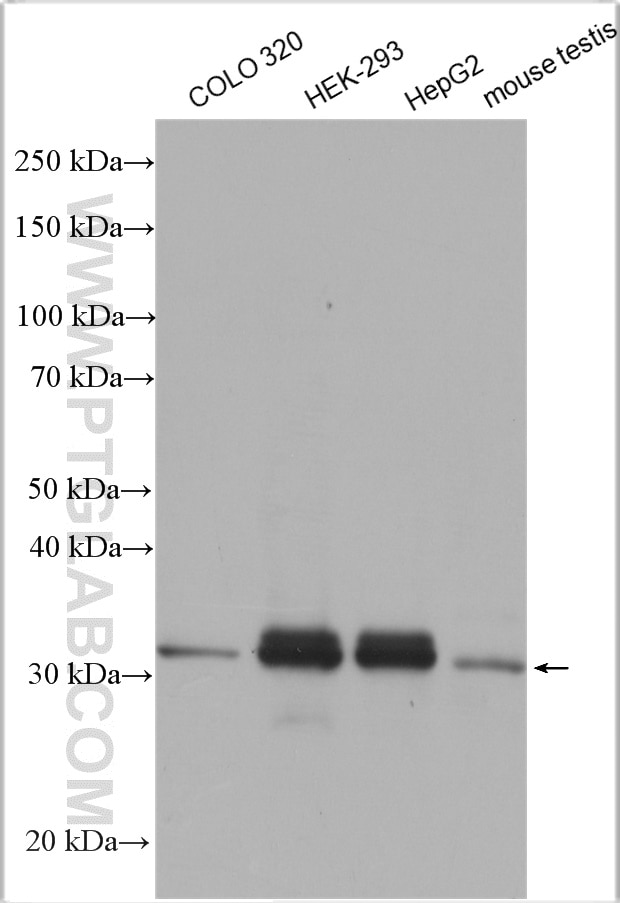
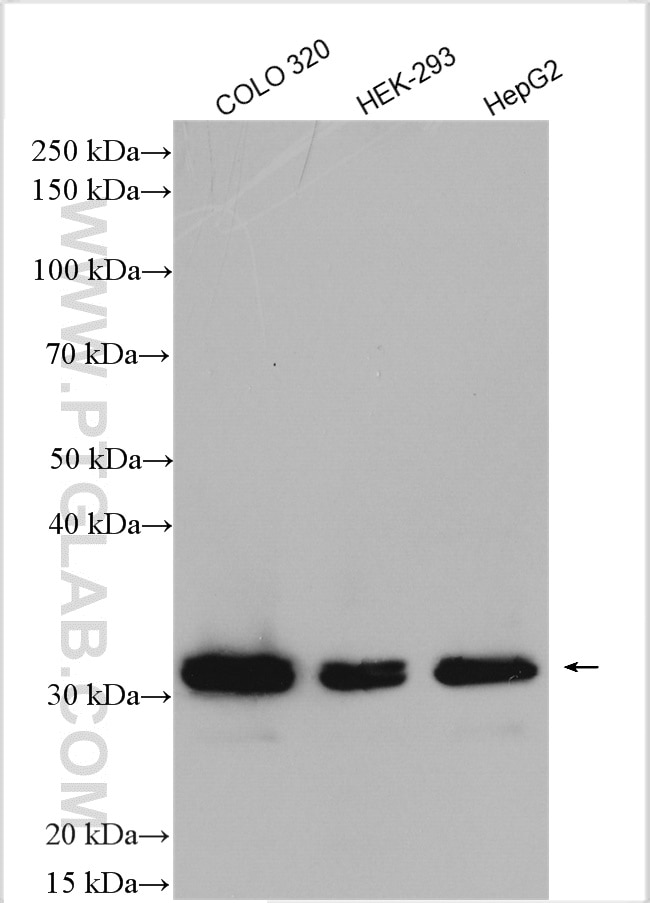
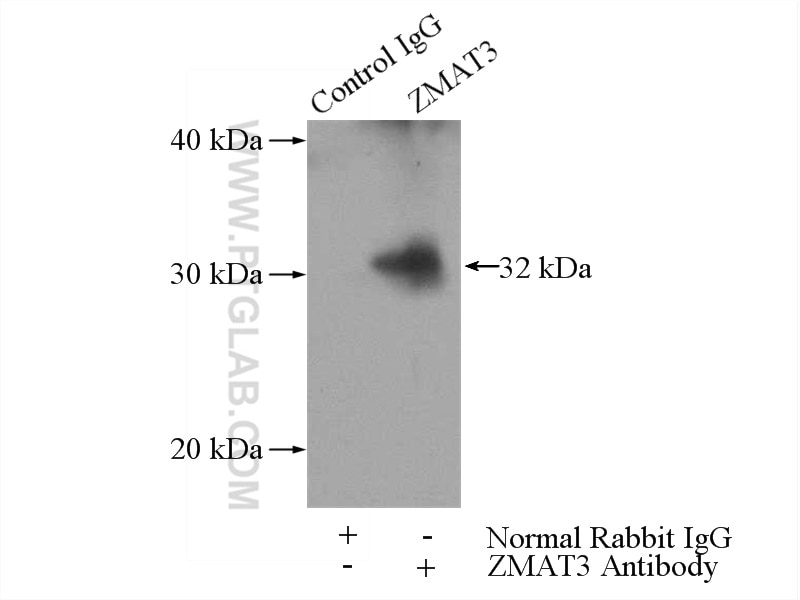

Tested Applications
| Positive WB detected in | COLO 320 cells, rat testis tissue, HEK-293 cells, HepG2 cells, mouse testis tissue |
| Positive IP detected in | mouse testis tissue |
Recommended dilution
| Application | Dilution |
|---|---|
| Western Blot (WB) | WB : 1:2000-1:16000 |
| Immunoprecipitation (IP) | IP : 0.5-4.0 ug for 1.0-3.0 mg of total protein lysate |
| It is recommended that this reagent should be titrated in each testing system to obtain optimal results. | |
| Sample-dependent, Check data in validation data gallery. | |
Product Information
10504-1-AP targets ZMAT3 in WB, IHC, IF, IP, ELISA applications and shows reactivity with human, mouse, rat samples.
| Tested Reactivity | human, mouse, rat |
| Cited Reactivity | human, mouse, rat |
| Host / Isotype | Rabbit / IgG |
| Class | Polyclonal |
| Type | Antibody |
| Immunogen |
CatNo: Ag0780 Product name: Recombinant human ZMAT3 protein Source: e coli.-derived, PGEX-4T Tag: GST Domain: 1-289 aa of BC002896 Sequence: MILLQHAVLPPPKQPSPSPPMSVATRSTGTLQLPPQKPFGQEASLPLAGEEELSKGGEQDCALEELCKPLYCKLCNVTLNSAQQAQAHYQGKNHGKKLRNYYAANSCPPPARMSNVVEPAATPVVPVPPQMGSFKPGGRVILATENDYCKLCDASFSSPAVAQAHYQGKNHAKRLRLAEAQSNSFSESSELGQRRARKEGNEFKMMPNRRNMYTVQNNSAGPYFNPRSRQRIPRDLAMCVTPSGQFYCSMCNVGAGEEMEFRQHLESKQHKSKVSEQRYRNEMENLGYV Predict reactive species |
| Full Name | zinc finger, matrin type 3 |
| Calculated Molecular Weight | 32 kDa |
| Observed Molecular Weight | 32 kDa |
| GenBank Accession Number | BC002896 |
| Gene Symbol | ZMAT3 |
| Gene ID (NCBI) | 64393 |
| RRID | AB_2217579 |
| Conjugate | Unconjugated |
| Form | Liquid |
| Purification Method | Antigen affinity purification |
| UNIPROT ID | Q9HA38 |
| Storage Buffer | PBS with 0.02% sodium azide and 50% glycerol, pH 7.3. |
| Storage Conditions | Store at -20°C. Stable for one year after shipment. Aliquoting is unnecessary for -20oC storage. 20ul sizes contain 0.1% BSA. |
Background Information
ZMAT3 is a p53-induced zinc finger protein, and a role in the TP53-dependent growth regulatory pathway, contribute to TP53-mediated apoptosis by regulation of TP53 expression and translocation to the nucleus and nucleolus. Acts as a bona fide target gene of p53/TP53.
Protocols
| Product Specific Protocols | |
|---|---|
| IP protocol for ZMAT3 antibody 10504-1-AP | Download protocol |
| WB protocol for ZMAT3 antibody 10504-1-AP | Download protocol |
| Standard Protocols | |
|---|---|
| Click here to view our Standard Protocols |
Publications
What published studies show
Anti-WIG1 (ZMAT3) antibody, catalog number 10504-1-AP, has 11 total citations. These appear in journals including Molecular Cell, Cell Death & Disease, PNAS, Cell Reports, Aging Cell, Scientific Reports, J Cell Mol Med, J Physiol Sci, FEBS Letters, Int J Gen Med, and Cancer Biother Radiopharm. Research fields span tumor suppression, apoptosis, RNA splicing regulation, autoimmune disease, and cancers including breast, lung, thyroid, and cholangiocarcinoma.
| Species | Application | Title |
|---|---|---|
Cell Death Dis MicroRNA-184 promotes apoptosis of trophoblast cells via targeting WIG1 and induces early spontaneous abortion. | ||
Proc Natl Acad Sci U S A Covalent inhibitors of human papillomavirus type 16 E6 protein restore p53 function and suppress growth of HPV-driven tumors in vivo. | ||
Cell Rep The ribosomal protein L22 binds the MDM4 pre-mRNA and promotes exon skipping to activate p53 upon nucleolar stress | ||
Aging Cell Perp Deficiency Induces Defective Negative Selection and Autoimmune Arthritis in Aged Mice. | ||
Sci Rep FN1 shapes the behavior of papillary thyroid carcinoma through alternative splicing of EDB region |




