
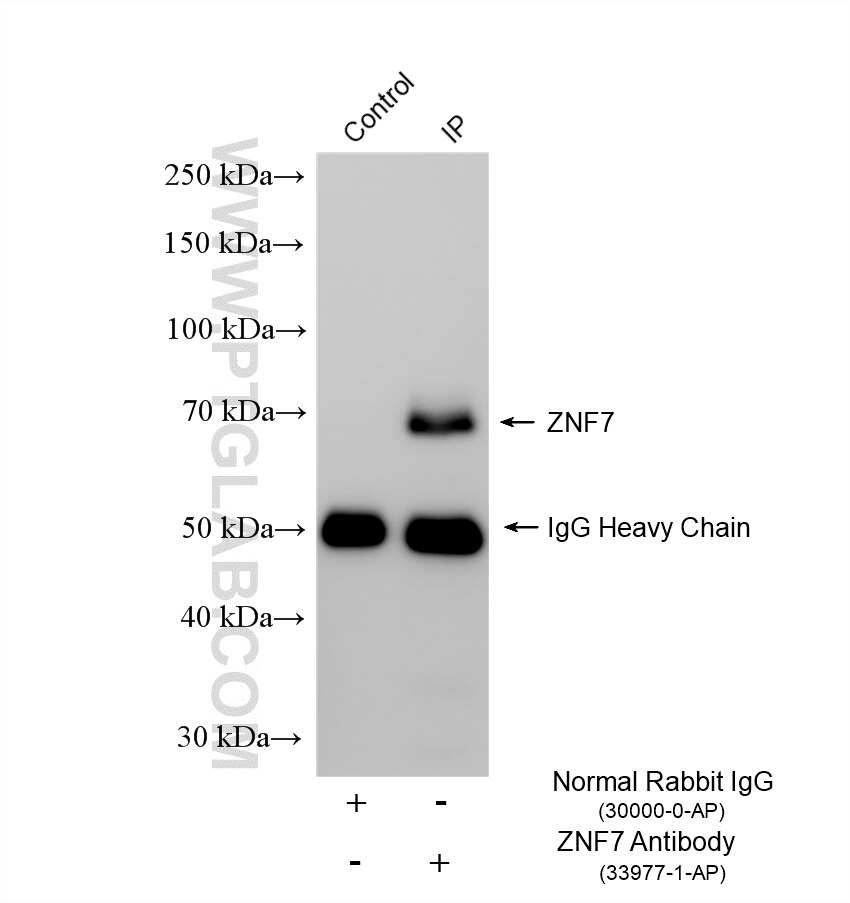
Tested Applications
| Positive IP detected in | HL-60 cells |
Recommended dilution
| Application | Dilution |
|---|---|
| Immunoprecipitation (IP) | IP : 0.5-4.0 ug for 1.0-3.0 mg of total protein lysate |
| It is recommended that this reagent should be titrated in each testing system to obtain optimal results. | |
| Sample-dependent, Check data in validation data gallery. | |
Product Information
33977-1-AP targets ZNF7 in IP, ELISA applications and shows reactivity with human samples.
| Tested Reactivity | human |
| Host / Isotype | Rabbit / IgG |
| Class | Polyclonal |
| Type | Antibody |
| Immunogen |
CatNo: Ag40665 Product name: Recombinant human ZNF7 protein Source: e coli.-derived, PGEX-4T Tag: GST Domain: 1-150 aa of BC058923 Sequence: MEVVTFGDVAVHFSREEWQCLDPGQRALYREVMLENHSSVAGLAGFLVFKPELISRLEQGEEPWVLDLQGAEGTEAPRTSKTDSTIRTENEQACEDMDILKSESYGTVVRISPQDFPQNPGFGDVSDSEVWLDSHLGSPGLKVTGFTFQN Predict reactive species |
| Full Name | zinc finger protein 7 |
| Calculated Molecular Weight | 686 aa, 78 kDa |
| Observed Molecular Weight | 68 kDa |
| GenBank Accession Number | BC058923 |
| Gene Symbol | ZNF7 |
| Gene ID (NCBI) | 7553 |
| RRID | AB_3743130 |
| Conjugate | Unconjugated |
| Form | Liquid |
| Purification Method | Antigen affinity Purification |
| UNIPROT ID | P17097 |
| Storage Buffer | PBS with 0.02% sodium azide and 50% glycerol, pH 7.3. |
| Storage Conditions | Store at -20°C. Stable for one year after shipment. Aliquoting is unnecessary for -20oC storage. 20ul sizes contain 0.1% BSA. |
Background Information
Zinc Finger Protein 7 (ZNF7) is a key member of the human zinc finger protein (KRAB-ZFP) family. This protein contains a typical KRAB domain and tandem C2H2-type zinc finger motifs, enabling it to specifically bind to DNA sequences in the promoter regions of target genes. As a nuclear transcription regulator, ZNF7 recruits epigenetic modification complexes, such as histone deacetylases, to suppress downstream gene expression, thereby playing a role in maintaining genomic stability and chromatin remodeling. Research indicates that ZNF7 plays a crucial role in cell cycle regulation, DNA damage response, and embryonic development. Abnormal expression of ZNF7 is associated with the progression of various cancers, such as hepatocellular carcinoma and prostate cancer, and it may contribute to tumorigenesis by influencing oncogene or tumor suppressor gene networks. It is considered a promising target for epigenetic regulation research.
Protocols
| Product Specific Protocols | |
|---|---|
| IP protocol for ZNF7 antibody 33977-1-AP | Download protocol |
| Standard Protocols | |
|---|---|
| Click here to view our Standard Protocols |


