
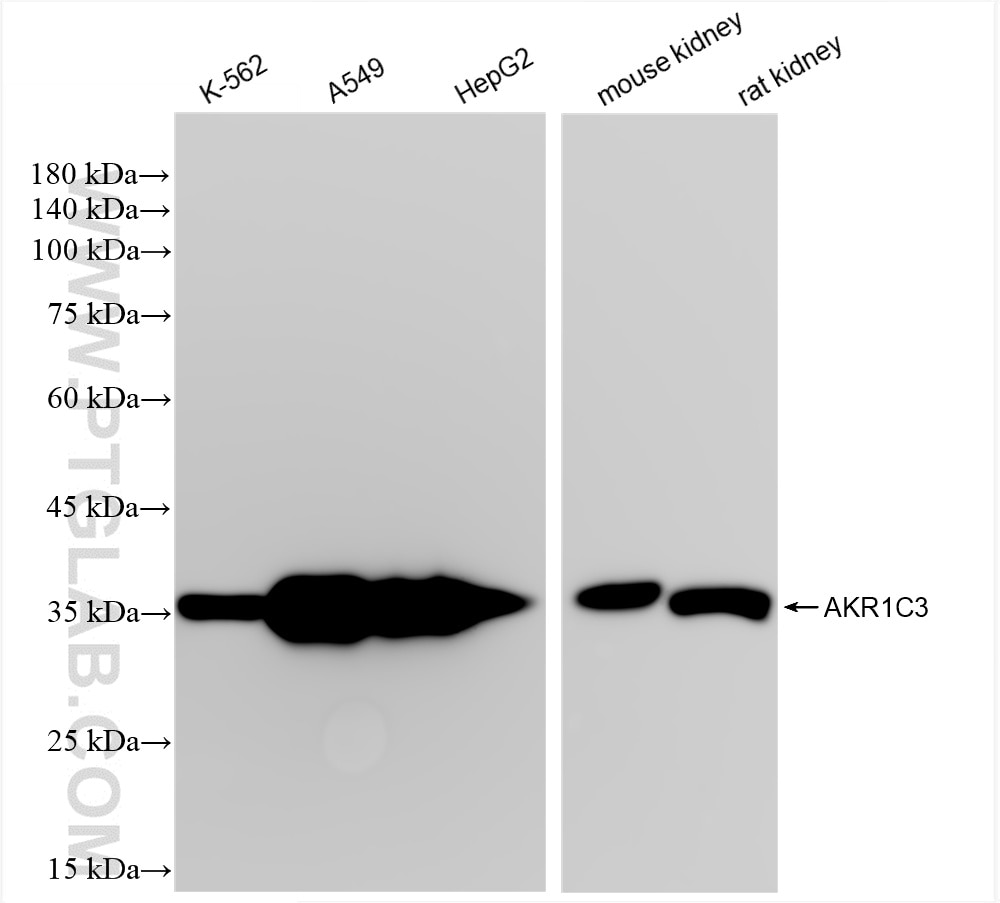



Tested Applications
| Positive WB detected in | K-562 cells, A549 cells, HepG2 cells, mouse kidney tissue, rat kidney tissue |
| Positive IHC detected in | human prostate cancer tissue Note: suggested antigen retrieval with TE buffer pH 9.0; (*) Alternatively, antigen retrieval may be performed with citrate buffer pH 6.0 |
| Positive IF/ICC detected in | HepG2 cells |
Recommended dilution
| Application | Dilution |
|---|---|
| Western Blot (WB) | WB : 1:5000-1:50000 |
| Immunohistochemistry (IHC) | IHC : 1:200-1:800 |
| Immunofluorescence (IF)/ICC | IF/ICC : 1:50-1:500 |
| It is recommended that this reagent should be titrated in each testing system to obtain optimal results. | |
| Sample-dependent, Check data in validation data gallery. | |
Product Information
84872-5-RR targets AKR1C3 in WB, IHC, IF/ICC, ELISA applications and shows reactivity with human, mouse, rat samples.
| Tested Reactivity | human, mouse, rat |
| Cited Reactivity | human |
| Host / Isotype | Rabbit / IgG |
| Class | Recombinant |
| Type | Antibody |
| Immunogen |
CatNo: Ag1674 Product name: Recombinant human AKR1C3 protein Source: e coli.-derived, PGEX-4T Tag: GST Domain: 1-323 aa of BC019230 Sequence: MDSKHQCVKLNDGHFMPVLGFGTYAPPEVPRSKALEVTKLAIEAGFRHIDSAHLYNNEEQVGLAIRSKIADGSVKREDIFYTSKLWSTFHRPELVRPALENSLKKAQLDYVDLYLIHSPMSLKPGEELSPTDENGKVIFDIVDLCTTWEAMEKCKDAGLAKSIGVSNFNRRQLEMILNKPGLKYKPVCNQVECHPYFNRSKLLDFCKSKDIVLVAYSALGSQRDKRWVDPNSPVLLEDPVLCALAKKHKRTPALIALRYQLQRGVVVLAKSYNEQRIRQNVQVFEFQLTAEDMKAIDGLDRNLHYFNSDSFASHPNYPYSDEY Predict reactive species |
| Full Name | aldo-keto reductase family 1, member C3 (3-alpha hydroxysteroid dehydrogenase, type II) |
| Calculated Molecular Weight | 323 aa, 37 kDa |
| Observed Molecular Weight | 35 kDa |
| GenBank Accession Number | BC019230 |
| Gene Symbol | AKR1C3 |
| Gene ID (NCBI) | 8644 |
| RRID | AB_3696588 |
| Conjugate | Unconjugated |
| Form | Liquid |
| Purification Method | Protein A purification |
| UNIPROT ID | P42330 |
| Storage Buffer | PBS with 0.02% sodium azide and 50% glycerol, pH 7.3. |
| Storage Conditions | Store at -20°C. Stable for one year after shipment. Aliquoting is unnecessary for -20oC storage. 20ul sizes contain 0.1% BSA. |
Background Information
AKR1C3(Aldo-keto reductase family 1 member C3) is also named as DDH1, HSD17B5, KIAA0119, PGFS and belongs to AKR1C family. .In humans, at least four AKR1C isoforms exist: AKR1C1, AKR1C2, AKR1C3, AKR1C4 and AKR1C3 shares >86% sequence identity with these three highly related human AKRs(PMID:18574251). It catalyzes the conversion of aldehydes and ketones to alcohols and androgen, estrogen, PG, xenobiotics metabolism.
Protocols
| Product Specific Protocols | |
|---|---|
| IF protocol for AKR1C3 antibody 84872-5-RR | Download protocol |
| IHC protocol for AKR1C3 antibody 84872-5-RR | Download protocol |
| WB protocol for AKR1C3 antibody 84872-5-RR | Download protocol |
| Standard Protocols | |
|---|---|
| Click here to view our Standard Protocols |
Publications
What published studies show
The AKR1C3 Recombinant monoclonal antibody (242222A11), catalog number 84872-5-RR, has 1 citation to date. The cited publication appeared in Human Mutation (2026), using WB in human samples. The research focuses on xenobiotic metabolism genes driving progression from liver cirrhosis to hepatocellular carcinoma, placing it in the fields of liver disease, hepatocarcinogenesis, and drug metabolism.
| Species | Application | Title |
|---|---|---|
Hum Mutat Integrated Bulk and Single-Cell Transcriptomic Analysis Reveals Xenobiotic Metabolism Genes Drive Progression From Liver Cirrhosis to Hepatocellular Carcinoma. |



