
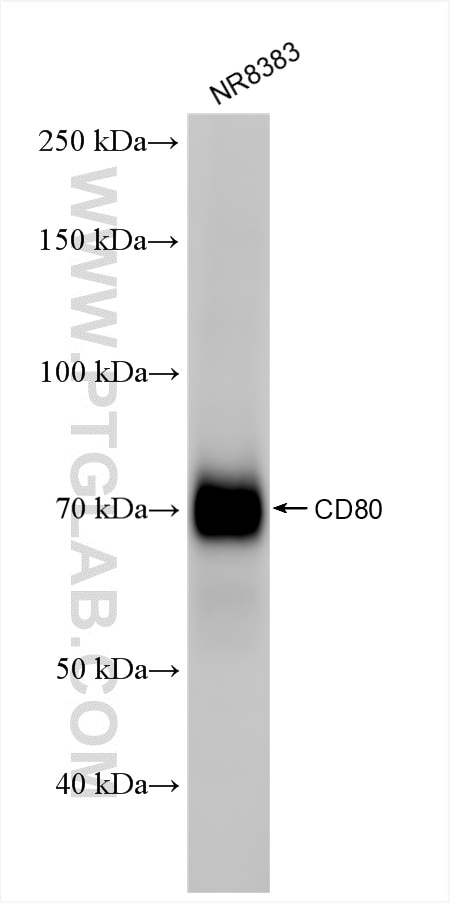
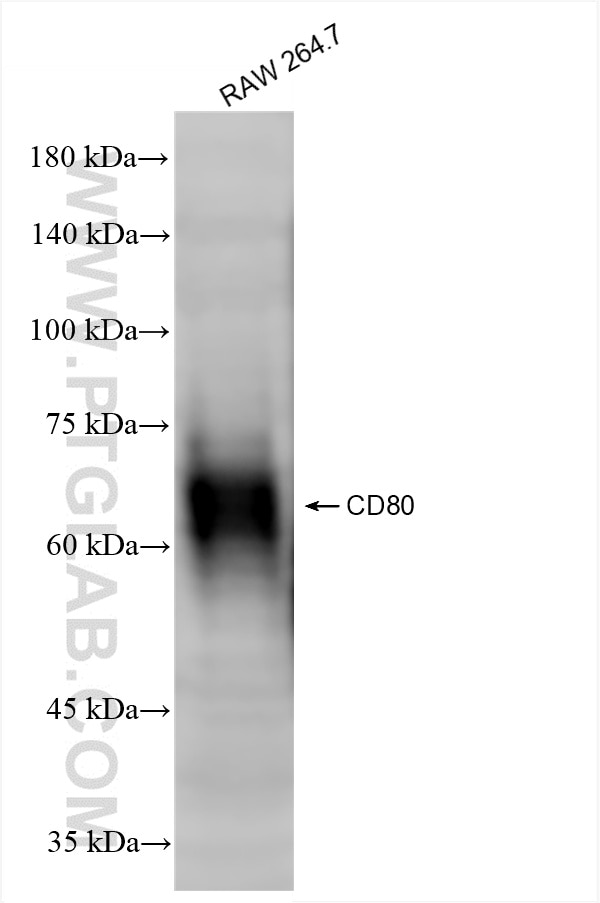
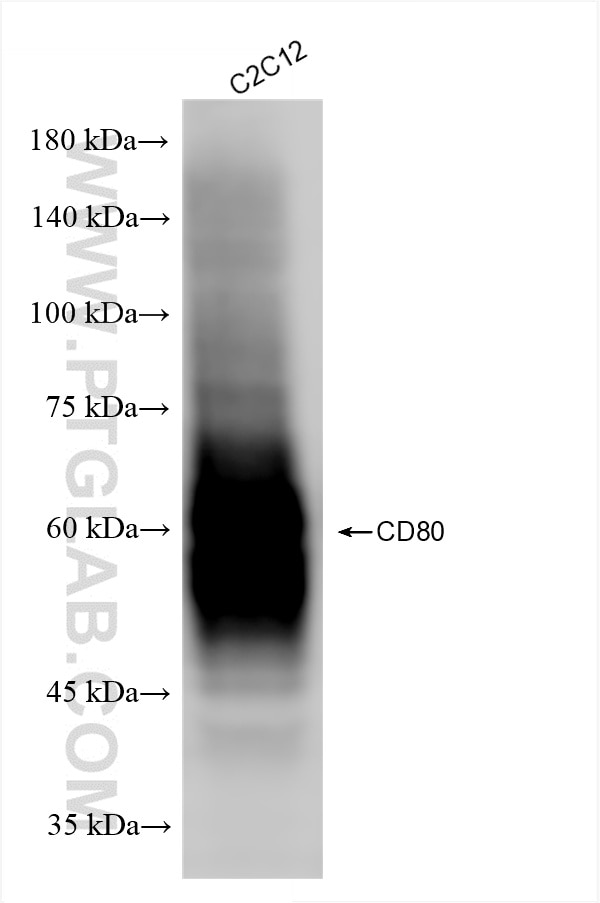
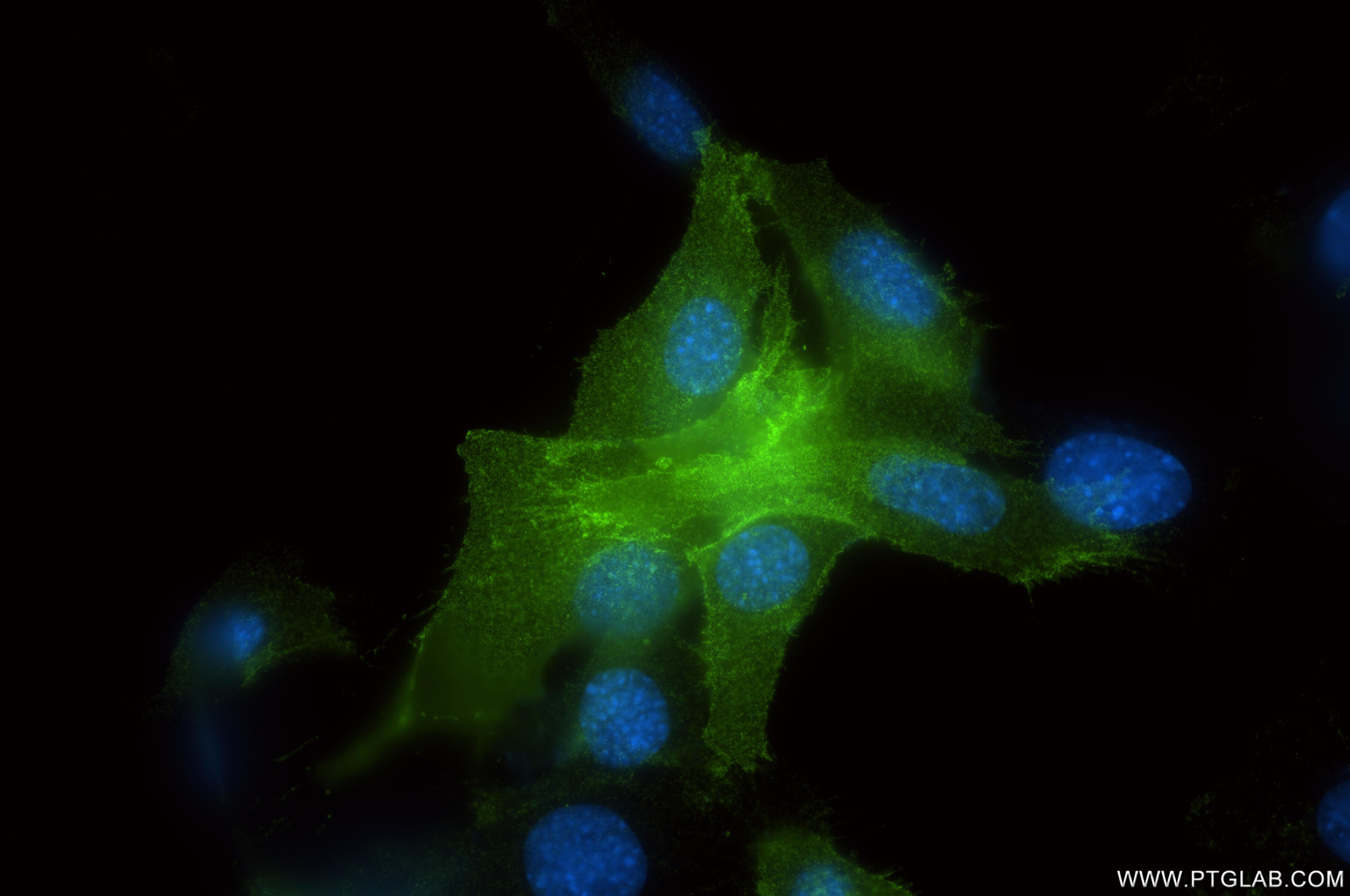

Tested Applications
| Positive WB detected in | NR8383 cells, C2C12 cells, RAW 264.7 cells |
| Positive IF/ICC detected in | C2C12 cells |
Recommended dilution
| Application | Dilution |
|---|---|
| Western Blot (WB) | WB : 1:1000-1:6000 |
| Immunofluorescence (IF)/ICC | IF/ICC : 1:200-1:800 |
| It is recommended that this reagent should be titrated in each testing system to obtain optimal results. | |
| Sample-dependent, Check data in validation data gallery. | |
Product Information
86532-1-RR targets CD80 in WB, IHC, IF/ICC, ELISA applications and shows reactivity with mouse, rat samples.
| Tested Reactivity | mouse, rat |
| Cited Reactivity | rat |
| Host / Isotype | Rabbit / IgG |
| Class | Recombinant |
| Type | Antibody |
| Immunogen |
CatNo: Eg3841 Product name: Recombinant Rat CD80 protein (rFc Tag) (HPLC verified) Source: mammalian cells-derived, pHZ-KIsec-C-rFc Tag: C-rFc Sequence: IVGQVSKSVREKALLSCDYKFCSEEQSIHRIYWQKHDKMVLSVISGVPEVWPEYKNRTVYDIANNYSFSLLGLILSDRGTYTCVVQRYEGGSYVVKHLTTVELSVRADFPTPNITESGNPSADIKRITCFASGGFPKPRLSWLENGRELNGINTTISQDPESELYTISSQLDFNTTYDHFIDCFIEYGDAHVSQNFTWEKPPEDPPDEKQ Predict reactive species |
| Full Name | Cd80 molecule |
| Calculated Molecular Weight | 33 kDa |
| Observed Molecular Weight | 60-70 kDa |
| Gene Symbol | CD80 |
| Gene ID (NCBI) | 25408 |
| RRID | AB_3744949 |
| Conjugate | Unconjugated |
| Form | Liquid |
| Purification Method | Protein A purification |
| UNIPROT ID | Q62680 |
| Storage Buffer | PBS with 0.02% sodium azide and 50% glycerol, pH 7.3. |
| Storage Conditions | Store at -20°C. Stable for one year after shipment. Aliquoting is unnecessary for -20oC storage. 20ul sizes contain 0.1% BSA. |
Background Information
CD80 (also known as B7-1) is a type I membrane protein that is a member of the immunoglobulin superfamily, with an extracellular immunoglobulin constant-like domain and a variable-like domain required for receptor binding. It is expressed on antigen-presenting cells (APCs), including B cells, dendritic cells, monocytes, and macrophages. CD80 is the receptor for the proteins CD28 and CTLA-4 found on the surface of T-cells. It is involved in the costimulatory signal essential for T-lymphocyte activation. T-cell proliferation and cytokine production is induced by the binding of CD28, binding to CTLA-4 has opposite effects and inhibits T-cell activation. CD80 also acts as a cellular attachment receptor for adenovirus subgroup B. (PMID: 7545666; 12015893; 16920215)
Protocols
| Product Specific Protocols | |
|---|---|
| IF protocol for CD80 antibody 86532-1-RR | Download protocol |
| WB protocol for CD80 antibody 86532-1-RR | Download protocol |
| Standard Protocols | |
|---|---|
| Click here to view our Standard Protocols |
Publications
What published studies show
The CD80 Recombinant monoclonal antibody (250725H4), catalog number 86532-1-RR, has a total of 3 citations. These citations appear in Frontiers in Immunology, Biochemical and Biophysical Research Communications, and Cureus. The associated research fields include diabetic wound healing and inflammation, bone repair and macrophage polarization, and knee osteoarthritis with fibrosis. All cited studies were conducted in rat models using IF or IHC applications.
| Species | Application | Title |
|---|---|---|
Front Immunol Hydrogen sulfide as a therapeutic agent for diabetic wounds: effects on inflammation and fibroblast pyroptosis. | ||
Biochem Biophys Res Commun PLCγ1 knockdown in BMSCs enhances bone repair via IL-4-JAK2-STAT3-mediated reparative macrophage polarization. | ||
Cureus Effect of Low-Intensity Pulsed Ultrasound on Macrophage Properties and Fibrosis in the Infrapatellar Fat Pad in a Carrageenan-Induced Knee Osteoarthritis Rat Model. |





