
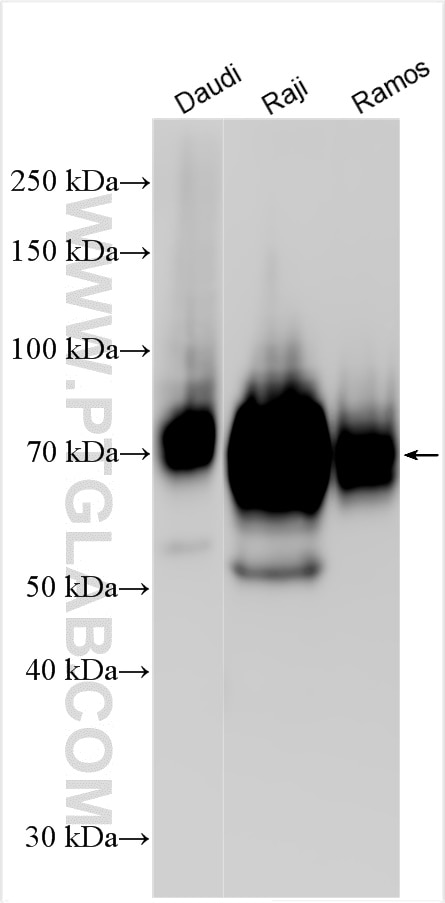


Tested Applications
| Positive WB detected in | Daudi cells, Raji cells, Ramos cells |
| Positive IF/ICC detected in | Raji cells |
Recommended dilution
| Application | Dilution |
|---|---|
| Western Blot (WB) | WB : 1:1000-1:4000 |
| Immunofluorescence (IF)/ICC | IF/ICC : 1:50-1:500 |
| It is recommended that this reagent should be titrated in each testing system to obtain optimal results. | |
| Sample-dependent, Check data in validation data gallery. | |
Product Information
83523-4-RR targets CD86 in WB, IHC, IF/ICC, ELISA applications and shows reactivity with human samples.
| Tested Reactivity | human |
| Cited Reactivity | human, mouse, rat |
| Host / Isotype | Rabbit / IgG |
| Class | Recombinant |
| Type | Antibody |
| Immunogen |
CatNo: Eg0966 Product name: Recombinant Human CD86 protein (His Tag) Source: mammalian cells-derived, pHZ-KIsec-C-6*HIS Tag: C-6*HIS Domain: 26-247 aa of NM_175862 Sequence: LKIQAYFNETADLPCQFANSQNQSLSELVVFWQDQENLVLNEVYLGKEKFDSVHSKYMGRTSFDSDSWTLRLHNLQIKDKGLYQCIIHHKKPTGMIRIHQMNSELSVLANFSQPEIVPISNITENVYINLTCSSIHGYPEPKKMSVLLRTKNSTIEYDGVMQKSQDNVTELYDVSISLSVSFPDVTSNMTIFCILETDKTRLLSSPFSIELEDPQPPPDHIP Predict reactive species |
| Full Name | CD86 molecule |
| Calculated Molecular Weight | 329 aa, 38 kDa |
| Observed Molecular Weight | 70 kDa |
| GenBank Accession Number | NM_175862 |
| Gene Symbol | CD86 |
| Gene ID (NCBI) | 942 |
| ENSEMBL Gene ID | ENSG00000114013 |
| RRID | AB_3671150 |
| Conjugate | Unconjugated |
| Form | Liquid |
| Purification Method | Protein A purfication |
| UNIPROT ID | P42081 |
| Storage Buffer | PBS with 0.02% sodium azide and 50% glycerol, pH 7.3. |
| Storage Conditions | Store at -20°C. Stable for one year after shipment. Aliquoting is unnecessary for -20oC storage. 20ul sizes contain 0.1% BSA. |
Background Information
CD86 (also known as B7.2) is a costimulatory molecule belonging to the immunoglobulin superfamily. Primarily expressed on antigen-presenting cells (APCs), including B cells, dendritic cells, and macrophages, CD86 is the ligand for two proteins at the cell surface of T cells, CD28 antigen and cytotoxic T-lymphocyte-associated protein 4. Binding of CD86 with CD28 antigen is a costimulatory signal for activation of the T-cell. Binding of CD86 with cytotoxic T-lymphocyte-associated protein 4 negatively regulates T-cell activation and diminishes the immune response.
Protocols
| Product Specific Protocols | |
|---|---|
| IF protocol for CD86 antibody 83523-4-RR | Download protocol |
| WB protocol for CD86 antibody 83523-4-RR | Download protocol |
| Standard Protocols | |
|---|---|
| Click here to view our Standard Protocols |
Publications
What published studies show
CD86 Recombinant monoclonal antibody (240429G12), catalog #83523-4-RR, has 21 citations published in journals including J Adv Res, J Nanobiotechnology, Cell Death Dis, Mater Today Bio, Apoptosis, Front Immunol, Comput Biol Med, Int J Mol Sci, Cell Signal, Biomedicines, Exp Cell Res, Front Oncol, Cancer Biol Med, Adv Mater, and ACS Biomater Sci Eng. Research fields encompass macrophage polarization, tumor immunology (colorectal, bladder, gastric, ovarian, breast, hepatocellular cancers), immune escape, renal inflammation, neuroinflammation, diabetic wound healing, periodontitis, and pulmonary arterial hypertension.
| Species | Application | Title |
|---|---|---|
J Adv Res Podocyte-derived exosomes instruct dendritic cell-dependent CD8(+) T cell activation and proliferation in renal inflammation. | ||
J Nanobiotechnology Mechano-reprogramming of tumor-associated macrophages by engineering nanogel stiffness for suppression of tumor development. | ||
Cell Death Dis Multi-omics reveals CXCR4 drives immune escape in colorectal cancer via metabolic reprogramming and immune microenvironment remodeling. | ||
Mater Today Bio Nano-bionic bacteria armed adoptive macrophage therapy against bladder cancer. | ||
Apoptosis ILF2 cooperates with ILF3/KLF16 to drive colorectal cancer progression via modulating the behaviors of both tumor cells and M2 macrophages. | ||
World J Gastroenterol ICAM2 loss drives 5-fluorouracil resistance via TGF-β/Smad/SP1/PTN-dependent apoptosis evasion and macrophage remodeling in gastric cancer. |




