

Tested Applications
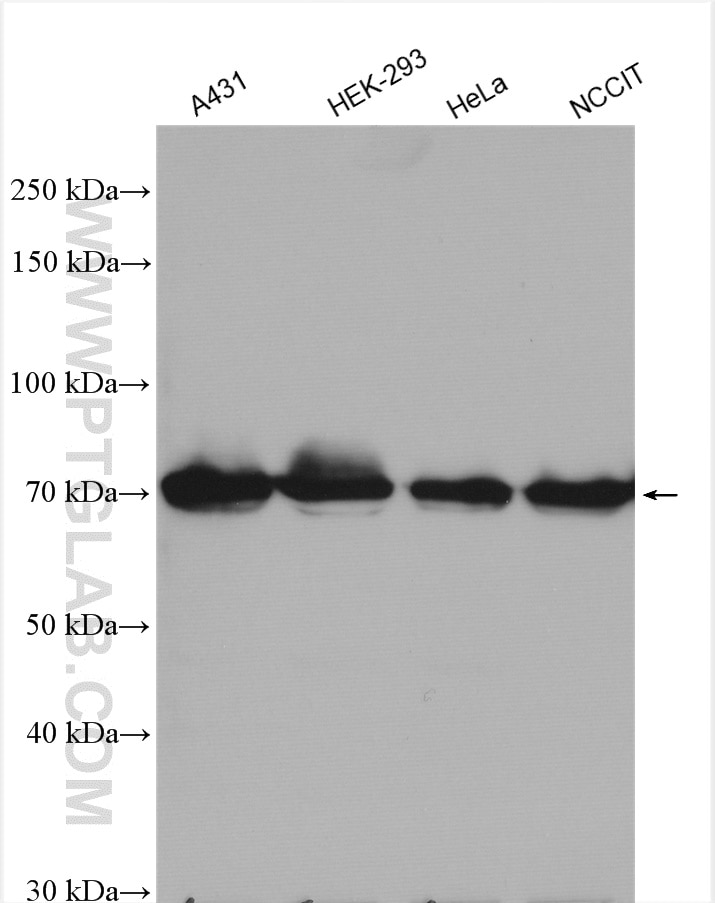
| Positive WB detected in | A431 cells, HEK-293 cells, HeLa cells, NCCIT cells |
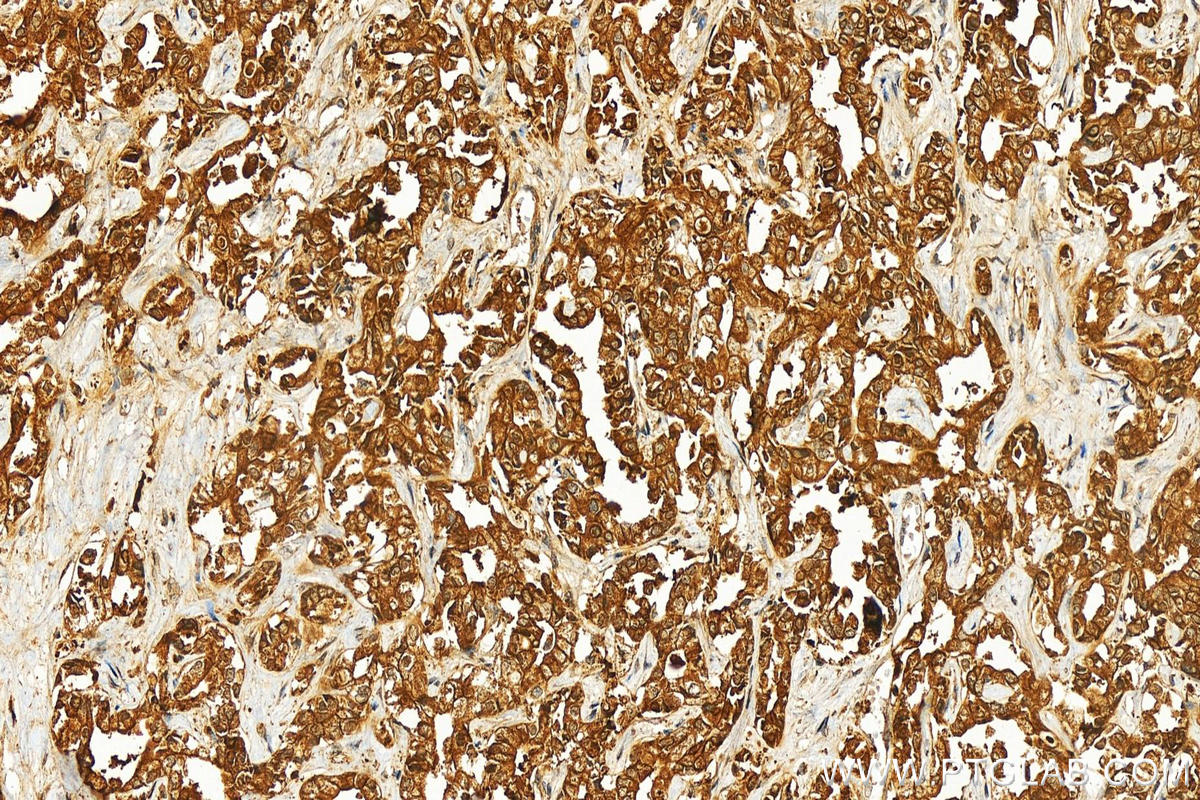
| Positive IHC detected in | human intrahepatic cholangiocarcinoma tissue Note: suggested antigen retrieval with TE buffer pH 9.0; (*) Alternatively, antigen retrieval may be performed with citrate buffer pH 6.0 |
Recommended dilution
| Application | Dilution |
|---|---|
| Western Blot (WB) | WB : 1:500-1:1000 |
| Immunohistochemistry (IHC) | IHC : 1:50-1:500 |
| It is recommended that this reagent should be titrated in each testing system to obtain optimal results. | |
| Sample-dependent, Check data in validation data gallery. | |
Product Information
11236-2-AP targets FLCN in WB, IHC, IF, IP, ELISA applications and shows reactivity with human, mouse, rat samples.
| Tested Reactivity | human, mouse, rat |
| Cited Reactivity | human, mouse, rat |
| Host / Isotype | Rabbit / IgG |
| Class | Polyclonal |
| Type | Antibody |
| Immunogen |
CatNo: Ag1746 Product name: Recombinant human FLCN protein Source: e coli.-derived, PGEX-4T Tag: GST Domain: 1-342 aa of BC015687 Sequence: MNAIVALCHFCELHGPRTLFCTEVLHAPLPQGDGNEDSPGQGEQAEEEEGGIQMNSRMRAHSPAEGASVESSSPGPKKSDMCEGCRSLAAGHPGYISHDKETSIKYVSHQHPSHPQLFSIVRQACVRSLSCEVCPGREGPIFFGDEQHGFVFSHTFFIKDSLARGFQRWYSIITIMMDRIYLINSWPFLLGKVRGIIDELQGKALKVFEAEQFGCPQRAQRMNTAFTPFLHQRNGNAARSLTSLTSDDNLWACLHTSFAWLLKACGSRLTEKLLEGAPTEDTLVQMEKLAGEAGVLLPGPWPGWPWGGTSCLLSWQESLREGNAALNQPRTSLREAHPPISV Predict reactive species |
| Full Name | folliculin |
| Calculated Molecular Weight | 65 kDa |
| Observed Molecular Weight | 64-75 kDa |
| GenBank Accession Number | BC015687 |
| Gene Symbol | FLCN |
| Gene ID (NCBI) | 201163 |
| RRID | AB_2103285 |
| Conjugate | Unconjugated |
| Form | Liquid |
| Purification Method | Antigen affinity purification |
| UNIPROT ID | Q8NFG4 |
| Storage Buffer | PBS with 0.02% sodium azide and 50% glycerol, pH 7.3. |
| Storage Conditions | Store at -20°C. Stable for one year after shipment. Aliquoting is unnecessary for -20oC storage. 20ul sizes contain 0.1% BSA. |
Background Information
FLCN, also named as BHD, belongs to the folliculin family. It may play a role in the pathogenesis of an uncommon form of kidney cancer through its association with an inherited disorder of the hair follicle (fibrofolliculomas). FLCN may be a tumor suppressor. It is involved in colorectal tumorigenesis. It may be involved in energy and/or nutrient sensing through the AMPK and mTOR signaling pathways. Mutation of FLCN may cause the BHD(Birt-Hogg-Dube syndrome ) or (PSP) primary spontaneous pneumothorax. And it may be involved in renal cell carcinoma.
Protocols
| Product Specific Protocols | |
|---|---|
| IHC protocol for FLCN antibody 11236-2-AP | Download protocol |
| WB protocol for FLCN antibody 11236-2-AP | Download protocol |
| Standard Protocols | |
|---|---|
| Click here to view our Standard Protocols |
Publications
What published studies show
FLCN Polyclonal antibody (Cat# 11236-2-AP) has 8 citations published in journals including Acta Pharmacologica Sinica, Scientific Reports, Frontiers in Molecular Biosciences, FASEB Journal, Journal of Trace Elements in Medicine and Biology, DNA Repair, Current Research in Neurobiology, and Biochemical and Biophysical Research Communications. Research fields span cardiac fibrosis, lysosomal biogenesis, renal cell carcinoma, AMPK/mTOR signaling, autophagy, apoptosis, and neurodegenerative disease.
| Species | Application | Title |
|---|---|---|
Acta Pharmacol Sin YTHDF3-mediated FLCN/cPLA2 axis improves cardiac fibrosis via suppressing lysosomal function | ||
Sci Rep A novel uORF regulates folliculin to promote cell growth and lysosomal biogenesis during cardiac stress | ||
Front Mol Biosci FLCN Regulates HIF2α Nuclear Import and Proliferation of Clear Cell Renal Cell Carcinoma. | ||
FASEB J AMPK promotes induction of the tumor suppressor FLCN through activation of TFEB independently of mTOR. | ||
J Trace Elem Med Biol Methionine-chelated Zn promotes anabolism by integrating mTOR signal and autophagy pathway in juvenile yellow catfish. | ||
DNA Repair (Amst) Activation of AMP-activated protein kinase by MAPO1 and FLCN induces apoptosis triggered by alkylated base mismatch in DNA.
|



