
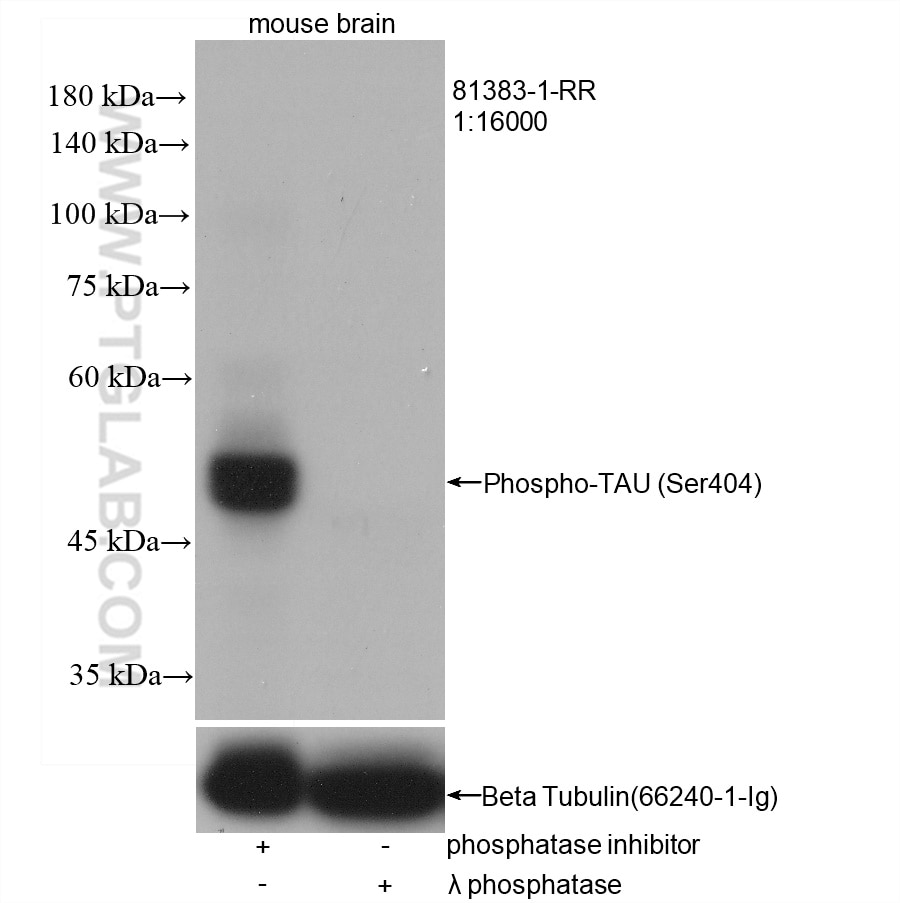
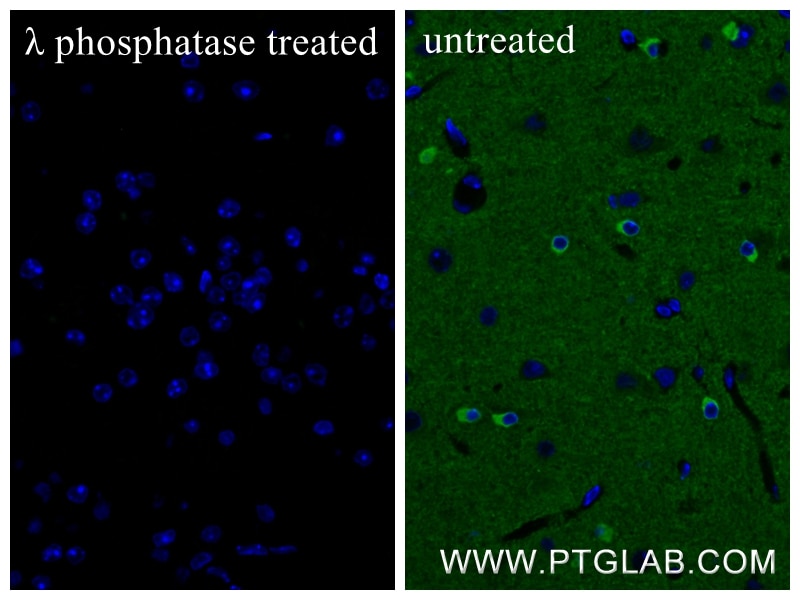
Tested Applications
| Positive WB detected in | mouse brain tissue |
| Positive IF-P detected in | mouse brain tissue |
Recommended dilution
| Application | Dilution |
|---|---|
| Western Blot (WB) | WB : 1:5000-1:50000 |
| Immunofluorescence (IF)-P | IF-P : 1:200-1:800 |
| It is recommended that this reagent should be titrated in each testing system to obtain optimal results. | |
| Sample-dependent, Check data in validation data gallery. | |
Product Information
81383-1-RR targets Phospho-TAU (Ser404) in WB, IF-P, ELISA applications and shows reactivity with human, mouse samples.
| Tested Reactivity | human, mouse |
| Cited Reactivity | human, mouse |
| Host / Isotype | Rabbit / IgG |
| Class | Recombinant |
| Type | Antibody |
| Immunogen |
Peptide Predict reactive species |
| Full Name | microtubule-associated protein tau |
| Calculated Molecular Weight | 37-46, 79-81 kDa |
| Observed Molecular Weight | 45-55 kDa |
| GenBank Accession Number | BC000558 |
| Gene Symbol | TAU |
| Gene ID (NCBI) | 4137 |
| RRID | AB_2935426 |
| Conjugate | Unconjugated |
| Form | Liquid |
| Purification Method | Protein A purification |
| UNIPROT ID | P10636 |
| Storage Buffer | PBS with 0.02% sodium azide and 50% glycerol, pH 7.3. |
| Storage Conditions | Store at -20°C. Stable for one year after shipment. Aliquoting is unnecessary for -20oC storage. 20ul sizes contain 0.1% BSA. |
Background Information
Tau (tubulin-associated unit) is a microtubule-associated protein (also known as MAPT), expressed mainly in neurons of the central nervous system. Its primary function is to modulate microtubule dynamics for maintaining axonal cytoskeleton. The Tau protein has six isoforms produced from a single gene through alternative RNA splicing. Isoforms differ in number of inserts at the N-terminal half and the number of repeats at the C-terminal half (3 repeat-3R; 4 repeat-4R). Tau is hyperphosphorylated during aging and in age-related neurodegenerative diseases such as Alzheimer's disease (AD) and fronto-temporal dementia. Hyperphosphorylation of Tau leads to the formation of neurofibrillary tangles (NFT) in the neurons and glia cells, which is one of the hallmarks of AD.
Protocols
| Product Specific Protocols | |
|---|---|
| IF protocol for Phospho-TAU (Ser404) antibody 81383-1-RR | Download protocol |
| WB protocol for Phospho-TAU (Ser404) antibody 81383-1-RR | Download protocol |
| Standard Protocols | |
|---|---|
| Click here to view our Standard Protocols |
Publications
What published studies show
| Species | Application | Title |
|---|---|---|
Neuromolecular Med Lycium Barbarum Polysaccharides Improves Cognitive Functions in ICV-STZ-Induced Alzheimer's Disease Mice Model by Improving the Synaptic Structural Plasticity and Regulating IRS1/PI3K/AKT Signaling Pathway | ||
Foods Comparative Analysis of Egg Yolk Phospholipid Unsaturation and Its Impact on Neural Health in Alzheimer Disease Mice | ||
Endokrynol Pol The role and clinical diagnostic value of the lncRNA NEAT1//miR-30e-5p/FLT1 axis in diabetic cognitive dysfunction. | ||
J Med Chem Discovery of Effective Dual PROTAC Degraders for Neurodegenerative Disease-Associated Aggregates | ||
Redox Biol Absence of astrocytic ceruloplasmin reverses the senescence process with aging of learning and memory abilities | ||
Alzheimers Res Ther ISX9 activates the Wnt/β-catenin signaling pathway and exerts neuroprotective effects in Alzheimer's disease. |
Reviews
What customers say
The reviews below have been submitted by verified Proteintech customers who received an incentive for providing their feedback.
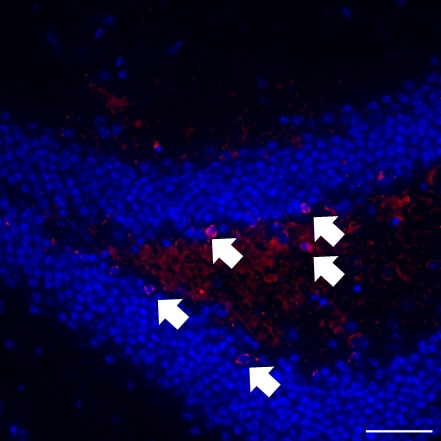
Marion (Verified Customer) (12-09-2024) | DAPI (blue) & pTau Ser404 (red) This antibody was tested to reveal Tau phosporylation in a murine AD model. The antibody works fine for IF on mouse tissue.
 |



