Anticorps Monoclonal anti-CD71
CD71 Monoclonal Antibody for FC
Hôte / Isotype
Mouse / IgG1, kappa
Réactivité testée
Humain et plus (1)
Applications
WB, FC
Conjugaison
Non conjugué
CloneNo.
OKT9
N° de cat : 65235-1-Ig
Synonymes
Galerie de données de validation
Filter:
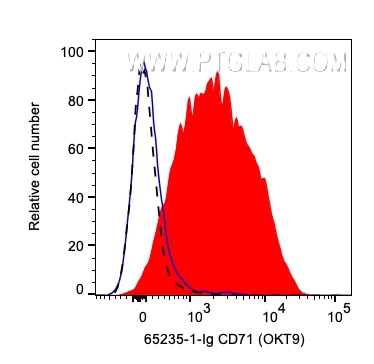
Applications testées
| Résultats positifs en cytométrie | PHA treated human PBMCs, |
Dilution recommandée
| Application | Dilution |
|---|---|
| This reagent has been tested for flow cytometric analysis. It is recommended that this reagent should be titrated in each testing system to obtain optimal results. | |
| Sample-dependent, check data in validation data gallery | |
Applications publiées
| WB | See 1 publications below |
Informations sur le produit
65235-1-Ig cible CD71 dans les applications de WB, FC et montre une réactivité avec des échantillons Humain
| Réactivité | Humain |
| Réactivité citée | souris |
| Hôte / Isotype | Mouse / IgG1, kappa |
| Clonalité | Monoclonal |
| Type | Anticorps |
| Immunogène | Human T-cell acute lymphoblastic leukemia cells |
| Nom complet | transferrin receptor (p90, CD71) |
| Masse moléculaire calculée | 85 kDa |
| Numéro d’acquisition GenBank | BC001188 |
| Symbole du gène | CD71 |
| Identification du gène (NCBI) | 7037 |
| Conjugaison | Non conjugué |
| Forme | Liquide |
| Méthode de purification | Purification par affinité |
| Tampon de stockage | PBS with 0.09% sodium azide |
| Conditions de stockage | Store at 2-8°C. Stable for one year after shipment. |
Informations générales
CD71, also known as transferrin receptor protein 1 (TfR1), is a transmembrane glycoprotein composed of two disulfide-linked monomers, each of 90 kDa molecular weight. Each monomer binds one holo-transferrin molecule creating an iron-Tf-TfR complex that enters the cell by endocytosis. CD71 is present on actively proliferating cells and is essential for iron transport into proliferating cells.
Protocole
| Product Specific Protocols | |
|---|---|
| FC protocol for CD71 antibody 65235-1-Ig | Download protocol |
| Standard Protocols | |
|---|---|
| Click here to view our Standard Protocols |

