
Overcoming FGF-10 Instability in Cell and Organoid Cultures
Written by Matthew Ross, PhD, Senior Scientist at Proteintech
Summary
-
FGF-10 is an important growth factor for cell and organoid differentiation but is inherently highly unstable.
-
HumanKine® FGF-10 Heat Stable from Proteintech was engineered for enhanced thermostability and long-term biological activity while maintaining >95% sequence identity with native human FGF-10.
-
HumanKine FGF-10 Heat Stable maintains full biological activity after 9 days in culture media at 37°C and demonstrates greater bioactivity than unmodified FGF-10.
-
Enhanced FGF-10 stability supports sustained growth factor signaling in long-term cell and organoid differentiation workflows.
Introduction
Fibroblast growth factor 10 (FGF-10) is a morphoregulatory protein that drives critical functions during development. Through signaling resultant from FGF-10 binding to fibroblast growth factor receptor 1b and/or 2b (FGFR1b and FGFR2b, respectively), FGF-10 regulates a myriad of developmental pathways involved in the formation of tissues and organs such as the inner ear, lung, brain, pancreas, and limbs.
Given its central role in developmental signaling, recombinant FGF-10 is a strictly required component for many in vitro cell, organoid, and tumoroid differentiation medias. Despite its biological importance, FGF-10 presents a challenge in vitro due to its inherent instability under standard cell culture conditions. Loss of FGF-10 activity is problematic for the long-term maintenance of cell and organoid cultures that depend on sustained growth factor signaling for guiding cell proliferation, differentiation, and tissue development.
The Problem: FGF-10 Instability in Culture
As FGF-10 loses activity over time, the effective concentration available to cells in culture decreases between media changes. Therefore, maintaining consistent FGF-10 signaling may require frequent media changes or repeatedly supplementing cultures with fresh FGF-10, adding both time and cost to differentiation workflows.
Improving the stability of FGF-10 would then overcome these limitations by maintaining its biological activity for longer in culture. To address this challenge, Proteintech scientists have now developed HumanKine® Recombinant Human FGF-10 Heat Stable Protein (Cat. No. HZ-1344), a highly thermostable and bioactive FGF-10 construct designed for prolonged activity in culture.
The Solution: Thermostable FGF-10
HumanKine FGF-10 Heat Stable was engineered via iterative rounds of computational design and analysis, expression screening, and activity assays to balance minimal sequence modification with maximum long-term thermostability and biological activity. The resulting FGF-10 Heat Stable construct shares >95% sequence identity with native human FGF-10 (Uniprot accession O15520) while demonstrating superior bioactivity compared to unmodified FGF-10 (Figure 1).
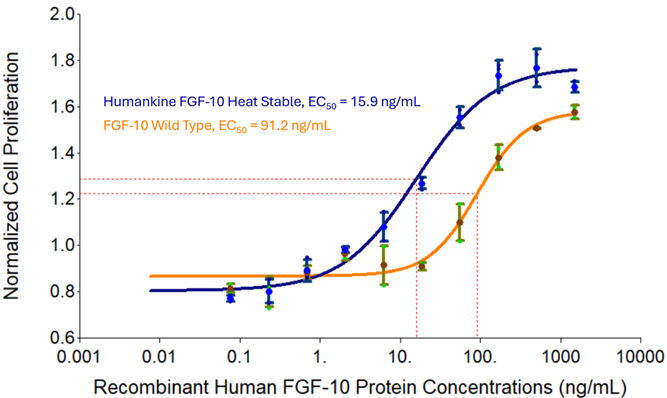
Figure 1. Humankine FGF-10 Heat Stable activity comparison to wild type FGF-10. HumanKine recombinant human FGF-10 Heat Stable protein stimulates dose-dependent proliferation of the MCF-7 human breast cancer cell line in serum free medium. Cell number was quantitatively assessed by PrestoBlue® Cell Viability Reagent. MCF-7 cells were treated with increasing concentrations of recombinant FGF-10 Heat Stable for 96 hours before cell number count. The EC50 was determined using a 4-parameter non-linear regression model. The EC50 range is 5-50 ng/mL.
Importantly, HumanKine FGF-10 Heat Stable maintained full biological activity even after pre-incubation in cell culture media for 9 days at 37°C, while competitor heat stable FGF-10 showed reduced activity (Figure 2). This prolonged activity will be particularly beneficial for long-term cell and organoid differentiation workflows that rely on sustained FGF-10 signaling.
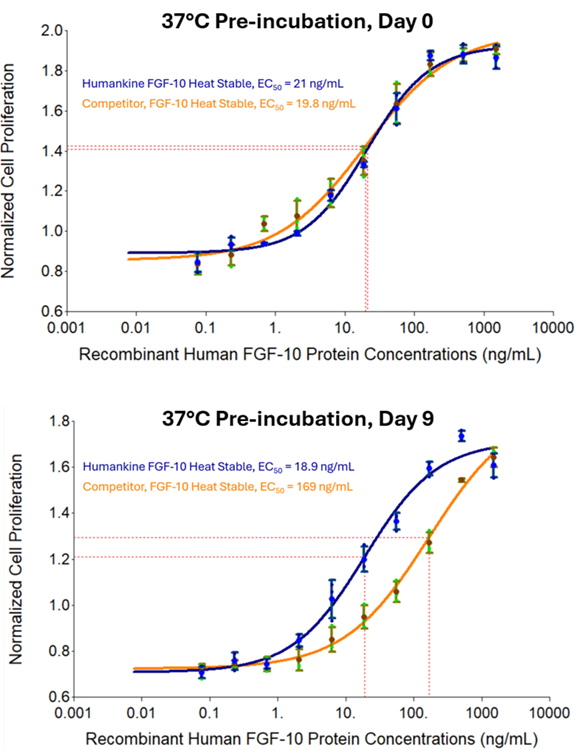
Figure 2. Humankine FGF-10 Heat Stable bioactivity comparison to competitor FGF-10 heat stable protein. Assay conditions were the same as in Figure 1, except each FGF-10 was pre-incubated in cell culture media for 0 days (top) or 9 days (bottom).
Trypsin digestion at 37°C confirmed the robust thermostability of HumanKine FGF-10 Heat Stable, which was not fully degraded even after 6 hours of incubation (Figure 3). In contrast, HEK-expressed mutant FGF-10 featuring a recently reported set of stabilizing mutations (V123I, L152F, Q175E, and N181D) was completely undetectable at the 6-hour timepoint.
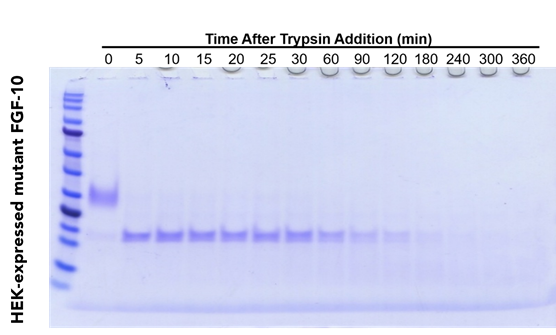
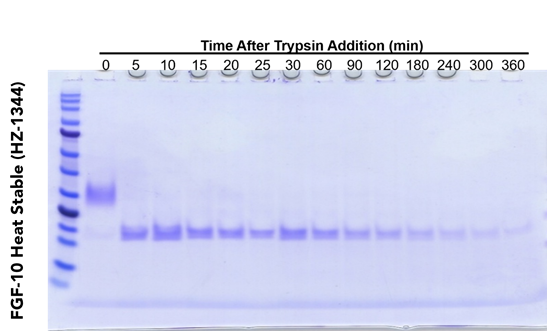
Figure 3. Trypsin digestion of FGF-10 heat stable constructs. Trypsin cleavage of HEK-expressed, mutant FGF-10 (top) and Proteintech FGF-10 Heat Stable (bottom) at pH 7.4, 37°C. Both FGF-10 constructs’ starting concentrations were 1 mg/mL; 2 μg trypsin added to each. The reactions were stopped by pulling aliquots and mixing with LDS and reducing agent, then heating at 95°C.
Conclusions
In summary, HumanKine FGF-10 Heat Stable from Proteintech provides a solution to the challenges associated with FGF-10 instability in culture, combining enhanced thermostability and long-term bioactivity with high sequence identity to native FGF-10.

FAQs
What organoid models commonly use the growth factor FGF-10?
FGF-10 is used in many differentiation protocols and is particularly important in epithelial development. Organoid models that commonly incorporate FGF-10 include lung, liver, thymic, pancreatic, intestinal, salivary gland, mammary, and prostate organoids.
Can I substitute FGF-10 with HumanKine FGF-10 Heat Stable directly in my protocol?
Yes, Proteintech’s bioassays support FGF-10 Heat Stable activation of the same pathways as native FGF-10. The minimal mutations incorporated into FGF-10 Heat Stable (reflected in the strongly conserved sequence identity with human FGF-10) are not expected to drive off-target effects. Moreover, stabilized FGF-10 mutants are regularly incorporated into organoid workflows in place of unmodified FGF-10, for example.
Why is growth factor stability particularly important for organoid culture?
Organoid differentiation depends on precisely timed developmental cues which guide cell fate and tissue organization. If a growth factor loses activity between media changes, cells may not receive a consistent level of signaling throughout the differentiation period, potentially affecting organoid development.
Does increased thermostability mean increased biological activity?
Increased thermostability of a growth factor does not necessarily translate to increased biological activity. Therefore, thermostability and bioactivity should be evaluated independently. For example, Proteintech’s HumanKine FGF-10 Heat Stable has been assessed using both a functional MCF-7 proliferation assay and a trypsin digestion assay, providing measures of both biological activity and resistance to protein degradation, respectively.
What expression system is used to manufacture Proteintech’s FGF-10 Heat Stable?
Proteintech’s HumanKine FGF-10 Heat Stable is expressed in human HEK293 cells. Human expression systems enable native protein folding and post-translational modifications, resulting in a growth factor that closely resembles the human protein as it exists in the body.

Related Content
HumanKine Cytokines and Growth Factors
Tips and tricks for iPSC culture | Proteintech Group
What do you get when you buy a GMP-grade product? | Proteintech Group
Support
Newsletter Signup
Stay up-to-date with our latest news and events. New to Proteintech? Get 10% off your first order when you sign up.
Able™