
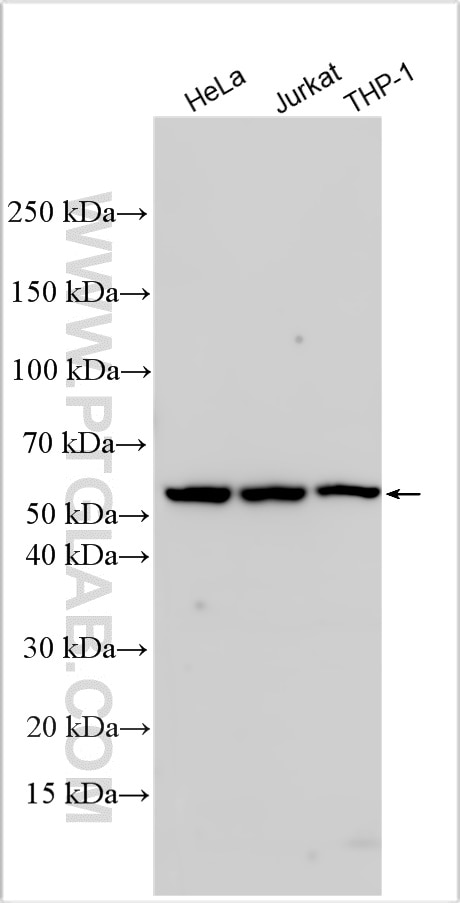
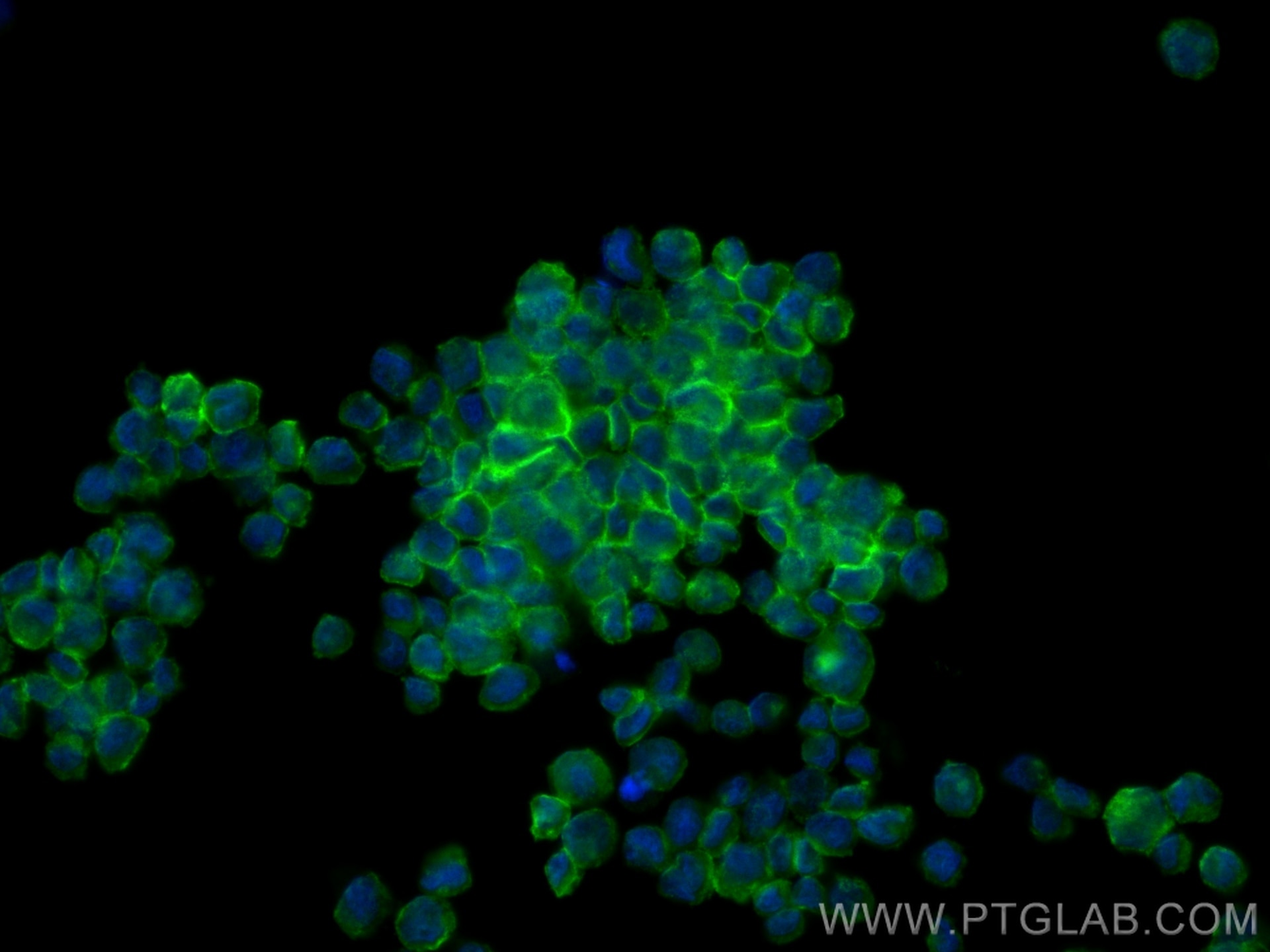

Tested Applications
| Positive WB detected in | HeLa cells, Jurkat cells, THP-1 cells |
| Positive IF/ICC detected in | THP-1 cells |
Recommended dilution
| Application | Dilution |
|---|---|
| Western Blot (WB) | WB : 1:500-1:3000 |
| Immunofluorescence (IF)/ICC | IF/ICC : 1:50-1:500 |
| It is recommended that this reagent should be titrated in each testing system to obtain optimal results. | |
| Sample-dependent, Check data in validation data gallery. | |
Product Information
14154-1-AP targets LILRB2/CD85d in WB, IF/ICC, ELISA applications and shows reactivity with human samples.
| Tested Reactivity | human |
| Cited Reactivity | human |
| Host / Isotype | Rabbit / IgG |
| Class | Polyclonal |
| Type | Antibody |
| Immunogen |
CatNo: Ag5336 Product name: Recombinant human LILRB2 protein Source: e coli.-derived, PGEX-4T Tag: GST Domain: 26-350 aa of BC036827 Sequence: GTIPKPTLWAEPDSVITQGSPVTLSCQGSLEAQEYRLYREKKSASWITRIRPELVKNGQFHIPSITWEHTGRYGCQYYSRARWSELSDPLVLVMTGAYPKPTLSAQPSPVVTSGGRVTLQCESQVAFGGFILCKEGEDEHPQCLNSQPHARGSSRAIFSVGPVSPNRRWSHRCYGYDLNSPYVWSSPSDLLELLVPGVSKKPSLSVQPGPVVAPGESLTLQCVSDVGYDRFVLYKEGERDLRQLPGRQPQAGLSQANFTLGPVSRSYGGQYRCYGAYNLSSEWSAPSDPLDILITGQIHGTPFISVQPGPTVASGENVTLLCQSWRQ Predict reactive species |
| Full Name | leukocyte immunoglobulin-like receptor, subfamily B (with TM and ITIM domains), member 2 |
| Calculated Molecular Weight | 598 aa, 65 kDa |
| Observed Molecular Weight | 60-65 kDa |
| GenBank Accession Number | BC036827 |
| Gene Symbol | LILRB2 |
| Gene ID (NCBI) | 10288 |
| RRID | AB_3669180 |
| Conjugate | Unconjugated |
| Form | Liquid |
| Purification Method | Antigen affinity purification |
| UNIPROT ID | Q8N423 |
| Storage Buffer | PBS with 0.02% sodium azide and 50% glycerol, pH 7.3. |
| Storage Conditions | Store at -20°C. Stable for one year after shipment. Aliquoting is unnecessary for -20oC storage. 20ul sizes contain 0.1% BSA. |
Background Information
LILRB2 (Leukocyte immunoglobulin-like receptor subfamily B member 2), also known as ILT4, CD85d or MIR10, is a type I transmembrane glycoprotein that contains four extracellular immunoglobulin domains, a transmembrane domain, and three cytoplasmic immunoreceptor tyrosine-based inhibitory motifs (ITIMs) (PMID: 33928233). LILRB2 is mainly expressed in immunocytes including monocytes, macrophages, and dendritic cells, and transduces negative signals by its association with SHP-1 phosphatase via the ITIMs (PMID: 35717259). LILRB2 can interact with various ligands such as HLA-A, HLA-B, HLA-C, HLA-G, HLA-F, CD1c, CD1d, angiopoietin-like proteins (ANGPTLs), and SEMA4A.
Protocols
| Product Specific Protocols | |
|---|---|
| IF protocol for LILRB2/CD85d antibody 14154-1-AP | Download protocol |
| WB protocol for LILRB2/CD85d antibody 14154-1-AP | Download protocol |
| Standard Protocols | |
|---|---|
| Click here to view our Standard Protocols |
Publications
What published studies show
The LILRB2/CD85d Polyclonal antibody (Cat# 14154-1-AP) has 2 total citations. These appear in International Immunopharmacology and Journal of Cellular Communication and Signaling. The research fields covered include glioma immune evasion involving neutrophil extracellular trap formation, and atherosclerosis progression through macrophage extracellular trap regulation via the PI3K-AKT signaling pathway. Both studies used the antibody for Western blot in human samples.
| Species | Application | Title |
|---|---|---|
Int Immunopharmacol A novel risk model incorporating MMP9, TLR8, and LILRB2 drives neutrophil extracellular trap formation and promotes immune evasion in glioma. | ||
J Cell Commun Signal Leukocyte immunoglobulin-like receptor B2 regulates atherosclerosis progression by modulating macrophage extracellular trap formation in foam macrophages through the PI3K-AKT signaling pathway.
|



