
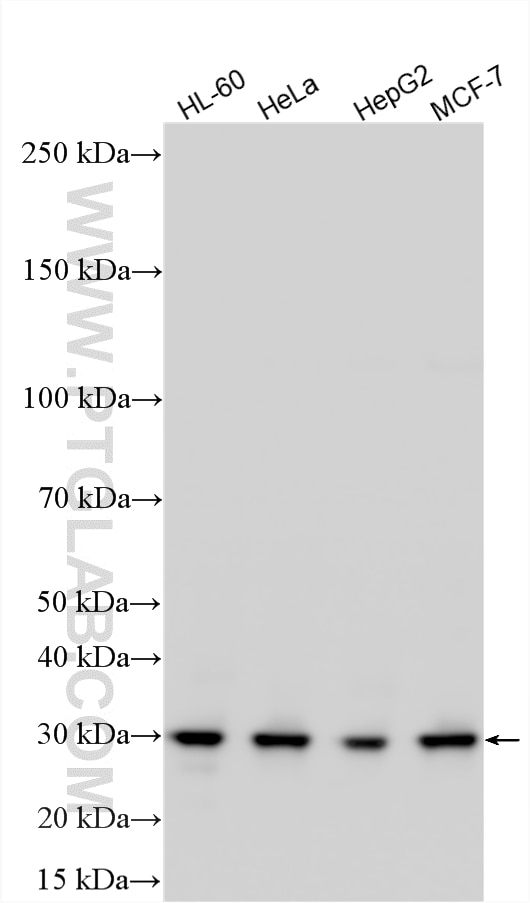



Tested Applications
| Positive WB detected in | HL-60 cells, mouse spleen tissue, HeLa cells, HepG2 cells, MCF-7 cells |
| Positive IP detected in | MCF-7 cells |
| Positive IHC detected in | human breast cancer tissue Note: suggested antigen retrieval with TE buffer pH 9.0; (*) Alternatively, antigen retrieval may be performed with citrate buffer pH 6.0 |
| Positive IF/ICC detected in | HeLa cells |
Recommended dilution
| Application | Dilution |
|---|---|
| Western Blot (WB) | WB : 1:2000-1:12000 |
| Immunoprecipitation (IP) | IP : 0.5-4.0 ug for 1.0-3.0 mg of total protein lysate |
| Immunohistochemistry (IHC) | IHC : 1:50-1:500 |
| Immunofluorescence (IF)/ICC | IF/ICC : 1:50-1:500 |
| It is recommended that this reagent should be titrated in each testing system to obtain optimal results. | |
| Sample-dependent, Check data in validation data gallery. | |
Product Information
14803-1-AP targets ARD1A in WB, IHC, IF/ICC, IP, CoIP, ELISA applications and shows reactivity with human, mouse, rat samples.
| Tested Reactivity | human, mouse, rat |
| Cited Reactivity | human, mouse, rat, yeast |
| Host / Isotype | Rabbit / IgG |
| Class | Polyclonal |
| Type | Antibody |
| Immunogen |
CatNo: Ag6519 Product name: Recombinant human ARD1A protein Source: e coli.-derived, PGEX-4T Tag: GST Domain: 1-235 aa of BC000308 Sequence: MNIRNARPEDLMNMQHCNLLCLPENYQMKYYFYHGLSWPQLSYIAEDENGKIVGYVLAKMEEDPDDVPHGHITSLAVKRSHRRLGLAQKLMDQASRAMIENFNAKYVSLHVRKSNRAALHLYSNTLNFQISEVEPKYYADGEDAYAMKRDLTQMADELRRHLELKEKGRHVVLGAIENKVESKGNSPPSSGEACREEKGLAAEDSGGDSKDLSEVSETTESTDVKDSSEASDSAS Predict reactive species |
| Full Name | ARD1 homolog A, N-acetyltransferase (S. cerevisiae) |
| Calculated Molecular Weight | 26 kDa |
| Observed Molecular Weight | 26 kDa |
| GenBank Accession Number | BC000308 |
| Gene Symbol | ARD1A |
| Gene ID (NCBI) | 8260 |
| RRID | AB_1557262 |
| Conjugate | Unconjugated |
| Form | Liquid |
| Purification Method | Antigen affinity purification |
| UNIPROT ID | P41227 |
| Storage Buffer | PBS with 0.02% sodium azide and 50% glycerol, pH 7.3. |
| Storage Conditions | Store at -20°C. Stable for one year after shipment. Aliquoting is unnecessary for -20oC storage. 20ul sizes contain 0.1% BSA. |
Protocols
| Product Specific Protocols | |
|---|---|
| IF protocol for ARD1A antibody 14803-1-AP | Download protocol |
| IHC protocol for ARD1A antibody 14803-1-AP | Download protocol |
| IP protocol for ARD1A antibody 14803-1-AP | Download protocol |
| WB protocol for ARD1A antibody 14803-1-AP | Download protocol |
| Standard Protocols | |
|---|---|
| Click here to view our Standard Protocols |
Publications
What published studies show
The ARD1A (NAA10) polyclonal antibody, catalog number 14803-1-AP, has 8 total citations. These appear in journals including Redox Biology, Science Advances, Journal of Translational Medicine, International Journal of Molecular Sciences, Journal of Diabetes Investigation, Yeast, Methods in Enzymology, and eLife. Research fields span cancer (ferroptosis, prostate cancer), ribosome biogenesis and autophagy, renal tubular injury, diagnostic biomarkers, yeast models, and proteomics.
| Species | Application | Title |
|---|---|---|
Redox Biol NSUN2 lactylation drives cancer cell resistance to ferroptosis through enhancing GCLC-dependent glutathione synthesis | ||
Sci Adv mTOR-NAA10-C7orf50 axis senses nutritional status to coordinate ribosome biogenesis and autophagy | ||
J Transl Med UBE2M promotes malignant phenotypes of prostate cancer through mediating NAA10 neddylation.
| ||
Int J Mol Sci Exploring Potential Diagnostic Biomarkers for Mechanical Asphyxia in the Heart Based on Proteomics Technology | ||
J Diabetes Investig NAA10 and BTRC drive CREBRF degradation in endoplasmic reticulum stress and renal tubular injury. | ||
Reviews
What customers say
Most reviewers report strong performance in Western Blot, with specific, clean bands at the expected molecular weight and minimal background. Three out of four reviews gave 5-star ratings, confirming reliable results at 1:1000 dilution in human cancer cell lines and HCT116 extracts. One reviewer rated it 3 stars at 1:1000 but suggested 1:500 may yield better results. Overall, the antibody is well-regarded for WB applications, with a slight recommendation to optimize dilution depending on the sample.
The reviews below have been submitted by verified Proteintech customers who received an incentive for providing their feedback.
Arunasalam (Verified Customer) (05-29-2026) | At 1:500 dilution this antibody gave a minimum background staining, specific for the target and worked well in western blotting.
|
Nathalie (Verified Customer) (03-05-2026) | not good try1:500 dilution next time need further test
|
Morgane (Verified Customer) (10-01-2025) | Band migrates at expected size, clean signal
 |
Zehua (Verified Customer) (07-09-2018) | Samples from Proteintech. Works very well for WB.
|



