
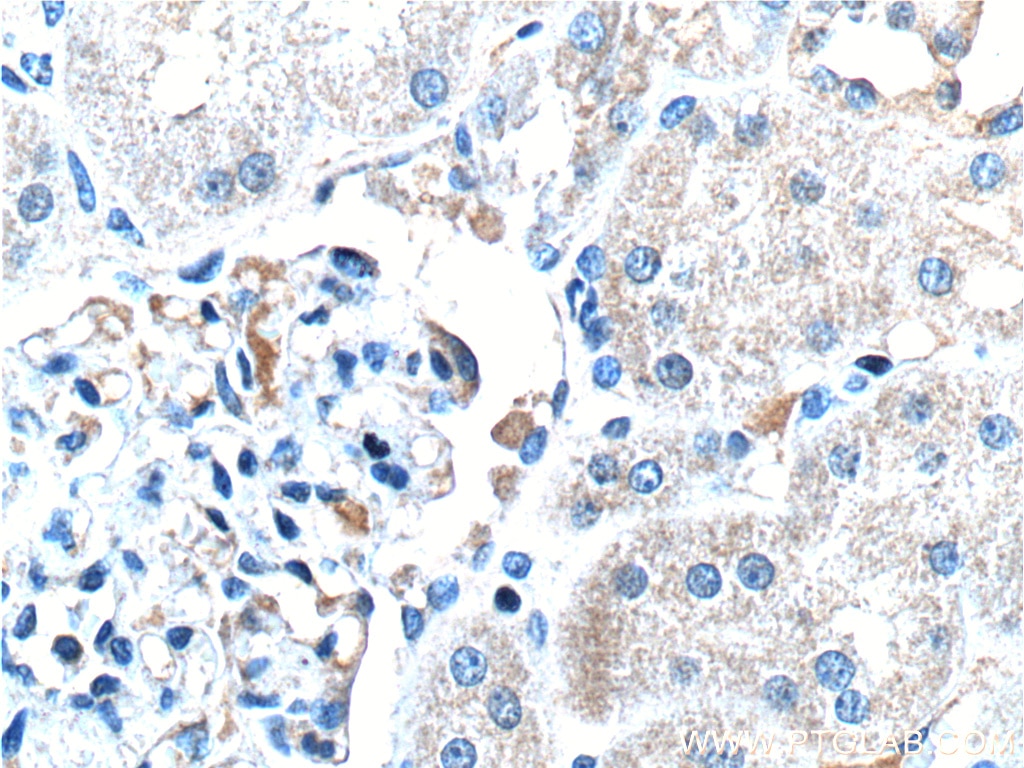
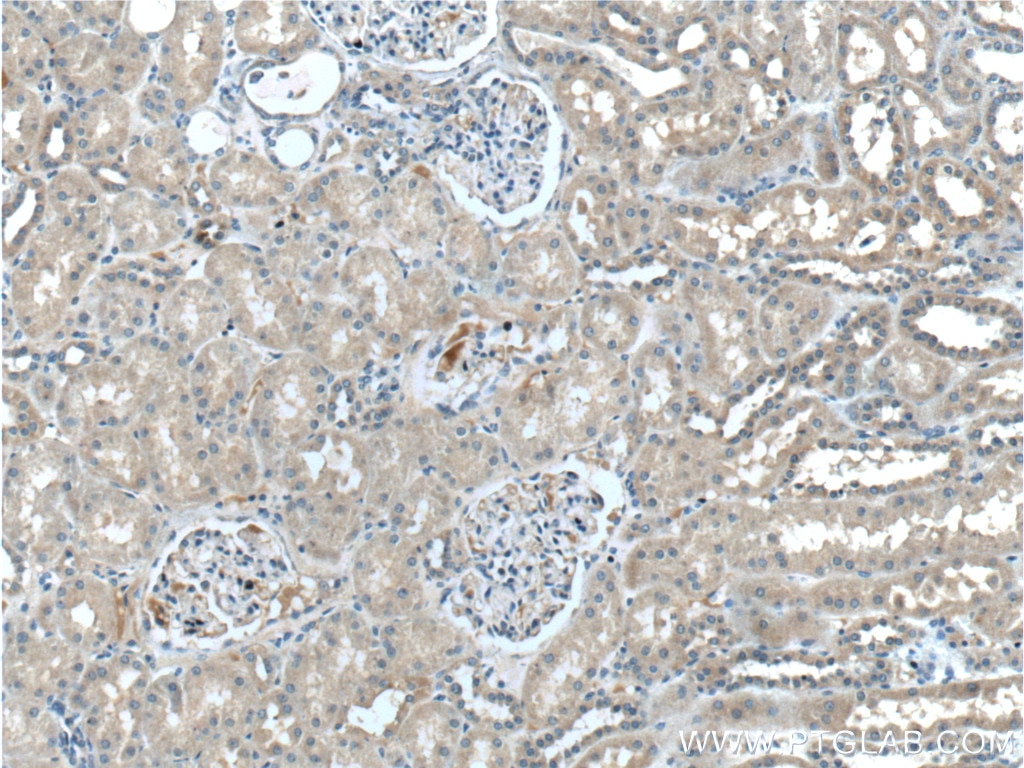

Tested Applications
| Positive IHC detected in | human kidney tissue Note: suggested antigen retrieval with TE buffer pH 9.0; (*) Alternatively, antigen retrieval may be performed with citrate buffer pH 6.0 |
Recommended dilution
| Application | Dilution |
|---|---|
| Immunohistochemistry (IHC) | IHC : 1:50-1:500 |
| It is recommended that this reagent should be titrated in each testing system to obtain optimal results. | |
| Sample-dependent, Check data in validation data gallery. | |
Product Information
17281-1-AP targets MT1M in WB, IHC, IF, ELISA applications and shows reactivity with human samples.
| Tested Reactivity | human |
| Cited Reactivity | human, mouse |
| Host / Isotype | Rabbit / IgG |
| Class | Polyclonal |
| Type | Antibody |
| Immunogen |
CatNo: Ag11048 Product name: Recombinant human MT1M protein Source: e coli.-derived, PGEX-4T Tag: GST Domain: 1-61 aa of BC028280 Sequence: MDPNCSCTTGVSCACTGSCKCKECKCTSCKKSCCSCCPVGCAKCAHGCVCKGTLENCSCCA Predict reactive species |
| Full Name | metallothionein 1M |
| Calculated Molecular Weight | 61 aa, 6 kDa |
| GenBank Accession Number | BC028280 |
| Gene Symbol | MT1M |
| Gene ID (NCBI) | 4499 |
| RRID | AB_2878376 |
| Conjugate | Unconjugated |
| Form | Liquid |
| Purification Method | Antigen affinity purification |
| UNIPROT ID | Q8N339 |
| Storage Buffer | PBS with 0.02% sodium azide and 50% glycerol, pH 7.3. |
| Storage Conditions | Store at -20°C. Stable for one year after shipment. Aliquoting is unnecessary for -20oC storage. 20ul sizes contain 0.1% BSA. |
Protocols
| Product Specific Protocols | |
|---|---|
| IHC protocol for MT1M antibody 17281-1-AP | Download protocol |
| Standard Protocols | |
|---|---|
| Click here to view our Standard Protocols |
Publications
What published studies show
The MT1M Polyclonal antibody (Cat# 17281-1-AP) has 8 citations across journals including Autophagy, ACS Nano, Environmental Pollution, Clinical Epigenetics, International Immunopharmacology, International Journal of Molecular Sciences, Journal of Integrative Medicine, and Discovery Oncology. Research fields span cancer progression and autophagy, spinal cord injury repair, environmental metal toxicity, hepatocellular carcinoma, kidney injury and pyroptosis, metallothionein response, lung squamous cell carcinoma, and breast cancer biomarker identification.
| Species | Application | Title |
|---|---|---|
Autophagy Therapeutic targeting of the USP2-E2F4 axis inhibits autophagic machinery essential for zinc homeostasis in cancer progression. | ||
ACS Nano Amplification of Metalloregulatory Proteins in Macrophages by Bioactive ZnMn@SF Hydrogels for Spinal Cord Injury Repair | ||
Environ Pollut Biotransformation of graphene oxide within lung fluids could intensify its synergistic biotoxicity effect with cadmium by inhibiting cellular efflux of cadmium. | ||
Clin Epigenetics Epigenetic reactivation of tumor suppressor genes with CRISPRa technologies as precision therapy for hepatocellular carcinoma | ||
Int J Mol Sci Specificity of the Metallothionein-1 Response by Cadmium-Exposed Normal Human Urothelial Cells. | ||
Int Immunopharmacol Colistin-induced acute kidney injury via zinc Dyshomeostasis-triggered GSDMD-executed Pyroptosis. |



