
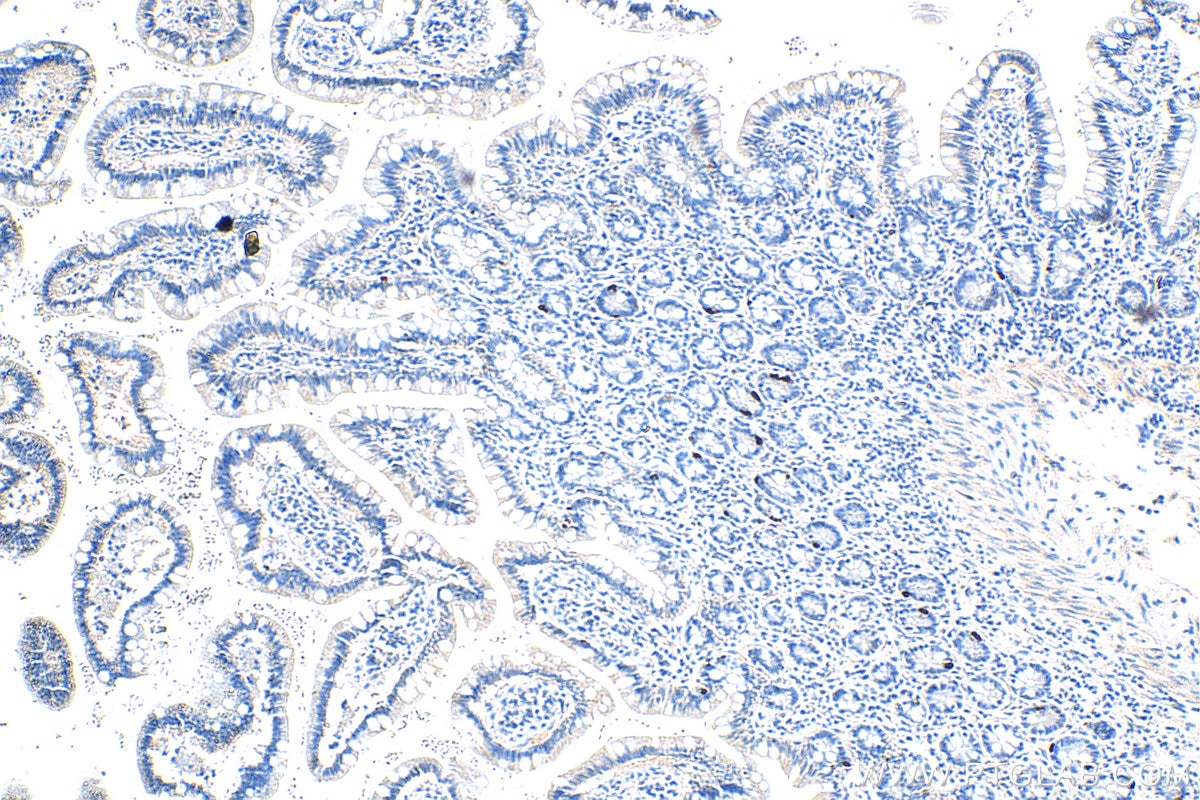
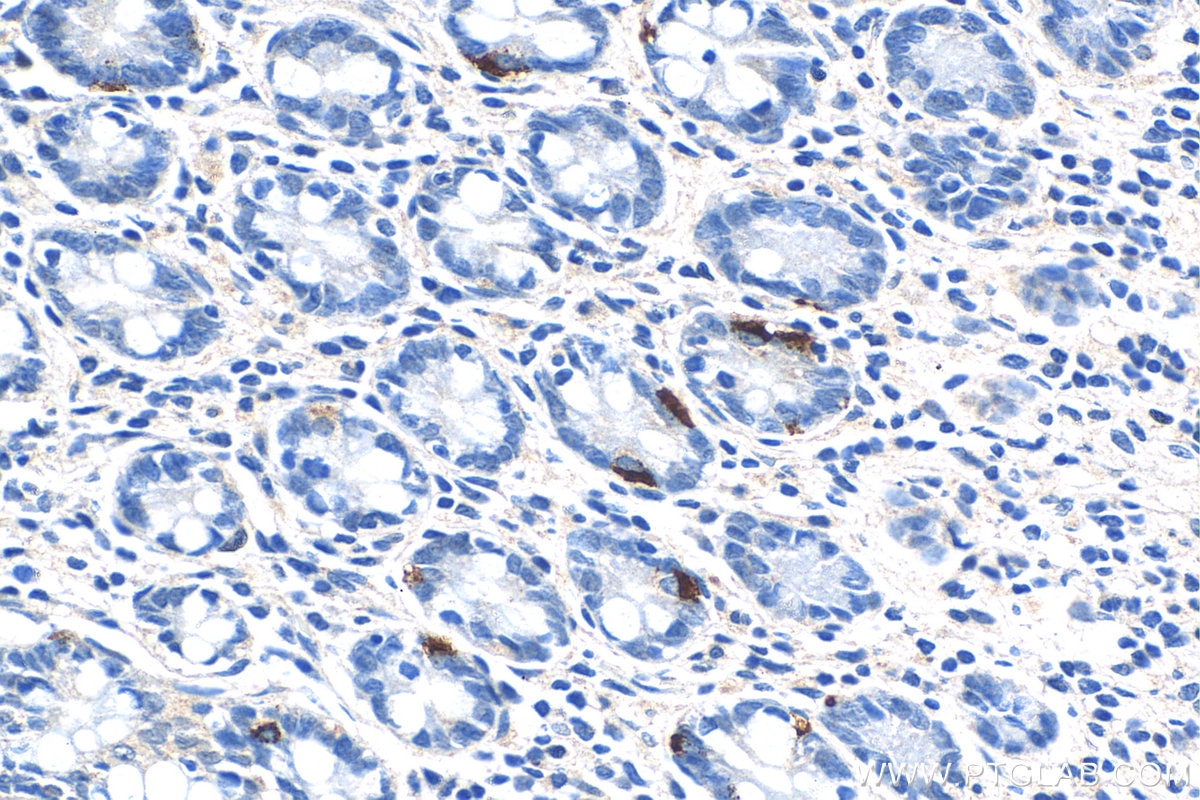
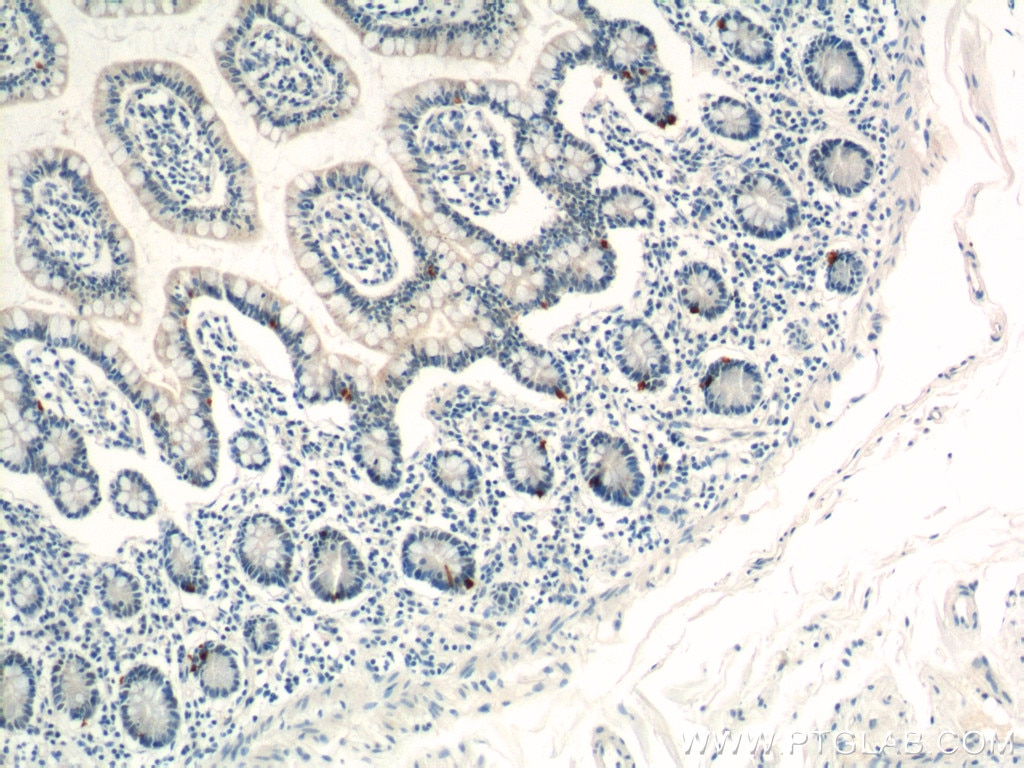
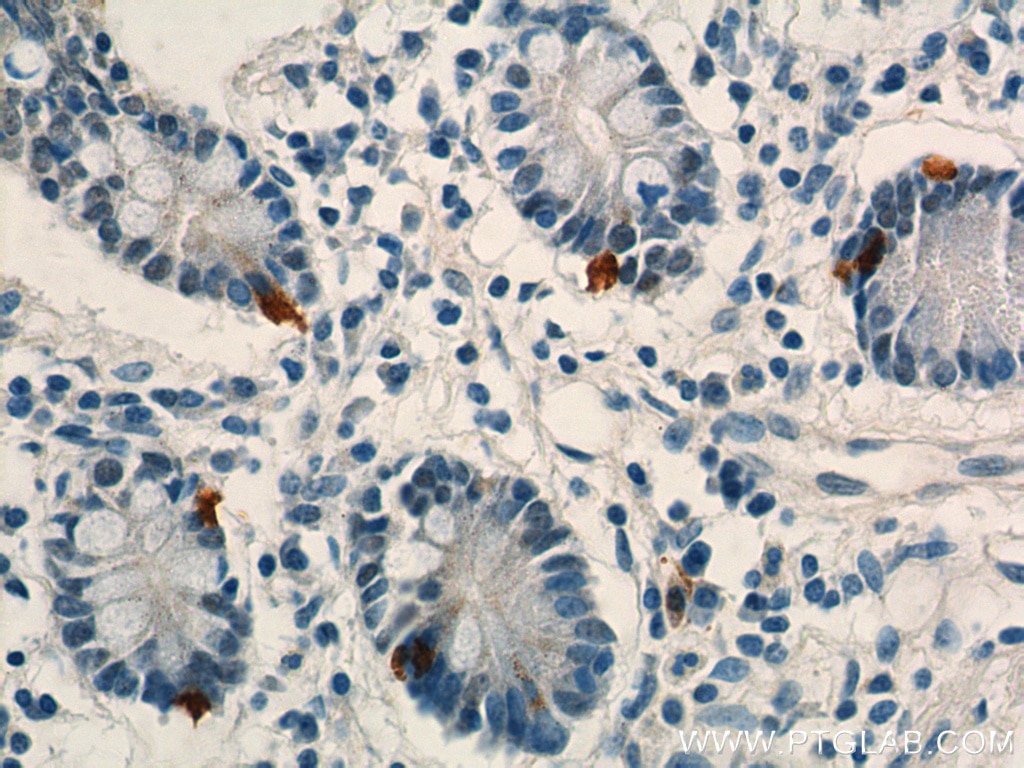

Tested Applications
| Positive IHC detected in | human small intestine tissue Note: suggested antigen retrieval with TE buffer pH 9.0; (*) Alternatively, antigen retrieval may be performed with citrate buffer pH 6.0 |
Recommended dilution
| Application | Dilution |
|---|---|
| Immunohistochemistry (IHC) | IHC : 1:1000-1:4000 |
| It is recommended that this reagent should be titrated in each testing system to obtain optimal results. | |
| Sample-dependent, Check data in validation data gallery. | |
Product Information
20150-1-AP targets LGR4 in WB, IHC, ELISA applications and shows reactivity with human, mouse, rat samples.
| Tested Reactivity | human, mouse, rat |
| Cited Reactivity | human, mouse, rat, pig |
| Host / Isotype | Rabbit / IgG |
| Class | Polyclonal |
| Type | Antibody |
| Immunogen |
CatNo: Ag13695 Product name: Recombinant human LGR4 protein Source: e coli.-derived, PGEX-4T Tag: GST Domain: 27-376 aa of BC033039 Sequence: PLCAAPCSCDGDRRVDCSGKGLTAVPEGLSAFTQALQLAGNDLSFIHPKALSGLKELKVLTLQNNQLKTVPSEAIRGLSALQSLRLDANHITSVPEDSFEGLVQLRHLWLDDNSLTEVPVHHLSNLPTLQALTLALNKISSIPDFAFTNLSSLVVLHLHNNKIRSLSQHCFDGLDNLETLDLNYNNLGEFPQAIKALPSLKELGFHSNSISVIPDGAFDGNPLLRTIHLYDNPLSFVGNSAFHNLSDLHSLVIRGASMVQQFPNLTGTVHLESLTLTGTKISSIPNNLCQEQKMLRTLDLSYNNIRDLPSFNGCHALEEISLQRNQIYQIKEGTFQGLISLRILDLSRNL Predict reactive species |
| Full Name | leucine-rich repeat-containing G protein-coupled receptor 4 |
| Calculated Molecular Weight | 104 kDa |
| GenBank Accession Number | BC033039 |
| Gene Symbol | LGR4 |
| Gene ID (NCBI) | 55366 |
| RRID | AB_2878648 |
| Conjugate | Unconjugated |
| Form | Liquid |
| Purification Method | Antigen affinity purification |
| UNIPROT ID | Q9BXB1 |
| Storage Buffer | PBS with 0.02% sodium azide and 50% glycerol, pH 7.3. |
| Storage Conditions | Store at -20°C. Stable for one year after shipment. Aliquoting is unnecessary for -20oC storage. 20ul sizes contain 0.1% BSA. |
Background Information
LGR4, also known as GPR48, is a membrane of the leucine-rich GPCR family. LGR4 is composed of a large NH2-terminal extracellular domain containing 18 LRRs, the seven membrane-spanning segments, and a COOH-terminal intracellular domain. LGR4 is a receptor for R-spondins that potentiates the canonical Wnt signaling pathway and is involved in the formation of various organs. It has also been shown that LGR4 regulates cyclic AMP/protein kinase A (PKA) signalling. (PMID: 23756652; 17178856; 24212090)
Protocols
| Product Specific Protocols | |
|---|---|
| IHC protocol for LGR4 antibody 20150-1-AP | Download protocol |
| Standard Protocols | |
|---|---|
| Click here to view our Standard Protocols |
Publications
What published studies show
The LGR4 Polyclonal antibody (Cat# 20150-1-AP) has 14 citations published in journals including Cell, Nature Cell Biology, Advanced Science, Cell Death & Disease, Arteriosclerosis Thrombosis and Vascular Biology, Molecular Therapy Oncolytics, International Immunopharmacology, Experimental Cell Research, American Journal of Cancer Research, Oncology Letters, In Vitro Cell & Developmental Biology, Cancer Biomarkers, and Exploration. Research fields span Wnt/β-catenin signaling, ovarian and breast cancer, atherosclerosis, intestinal stem cells, pancreatic β-cell biology, renal fibrosis, osteosarcoma, and skin wound regeneration.
| Species | Application | Title |
|---|---|---|
Cell Electromagnetic field-inducible in vivo gene switch for remote spatiotemporal control of gene expression. | ||
Exploration (Beijing) Peptide RL-QN15 Regulates Functions of Epidermal Stem Cells to Accelerate Skin Wound Regeneration via the FZD8/β-Catenin Axis. | ||
Nat Cell Biol LncGata6 maintains stemness of intestinal stem cells and promotes intestinal tumorigenesis. | ||
Adv Sci (Weinh) Deficiency of Leucine-Rich Repeat Containing G Protein-Coupled Receptor 4 in Pancreas Reduces β Cell Mass.
| ||
Cell Death Dis DNA methylation mediated RSPO2 to promote follicular development in mammals. | ||
Cell Death Dis Multi-omics analysis reveals that ALYREF-mediated m(5)C modification promotes platinum resistance in ovarian cancer via the NSUN2/ALYREF/LGR4 axis. |





