

Tested Applications
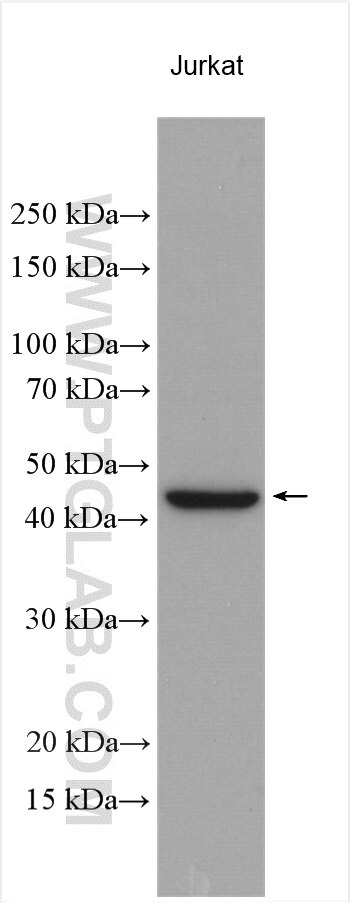
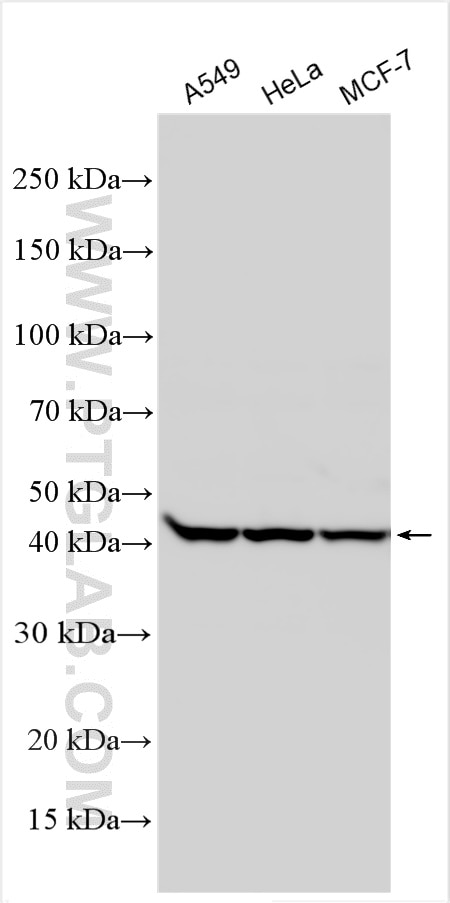
| Positive WB detected in | A549 cells, Jurkat cells, HeLa cells, MCF-7 cells |
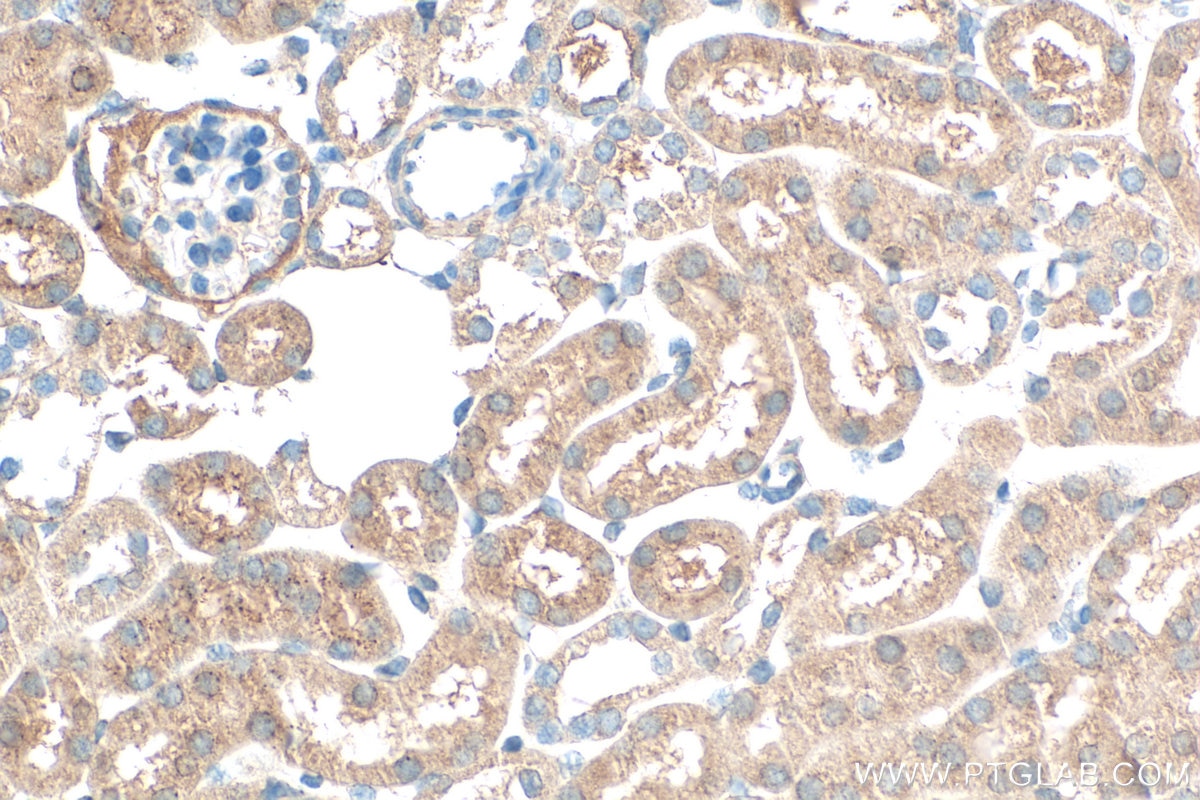
| Positive IHC detected in | mouse kidney tissue Note: suggested antigen retrieval with TE buffer pH 9.0; (*) Alternatively, antigen retrieval may be performed with citrate buffer pH 6.0 |
Recommended dilution
| Application | Dilution |
|---|---|
| Western Blot (WB) | WB : 1:1000-1:6000 |
| Immunohistochemistry (IHC) | IHC : 1:50-1:500 |
| It is recommended that this reagent should be titrated in each testing system to obtain optimal results. | |
| Sample-dependent, Check data in validation data gallery. | |
Product Information
20889-1-AP targets SLC16A4 in WB, IHC, ELISA applications and shows reactivity with human samples.
| Tested Reactivity | human |
| Cited Reactivity | human, mouse |
| Host / Isotype | Rabbit / IgG |
| Class | Polyclonal |
| Type | Antibody |
| Immunogen |
CatNo: Ag14190 Product name: Recombinant human SLC16A4 protein Source: e coli.-derived, PGEX-4T Tag: GST Domain: 1-70 aa of BC021664 Sequence: MLKREGKVQPYTKTLDGGWGWMIVIHFFLVNVFVMGMTKTFAIFFVVFQEEFEGTSEQIGWIGSIMSSLR Predict reactive species |
| Full Name | solute carrier family 16, member 4 (monocarboxylic acid transporter 5) |
| Calculated Molecular Weight | 487 aa, 54 kDa |
| Observed Molecular Weight | 45-50 kDa |
| GenBank Accession Number | BC021664 |
| Gene Symbol | SLC16A4 |
| Gene ID (NCBI) | 9122 |
| RRID | AB_2878757 |
| Conjugate | Unconjugated |
| Form | Liquid |
| Purification Method | Antigen affinity purification |
| UNIPROT ID | O15374 |
| Storage Buffer | PBS with 0.02% sodium azide and 50% glycerol, pH 7.3. |
| Storage Conditions | Store at -20°C. Stable for one year after shipment. Aliquoting is unnecessary for -20oC storage. 20ul sizes contain 0.1% BSA. |
Background Information
SLC16A4, also named as MCT5, is a proton-linked monocarboxylate transporter which can catalyze the rapid transport across the plasma membrane of many monocarboxylates. It has been reported that SLC16A4 is expressed in human intestine, liver and kidney. (PMID:18996437)
Protocols
| Product Specific Protocols | |
|---|---|
| IHC protocol for SLC16A4 antibody 20889-1-AP | Download protocol |
| WB protocol for SLC16A4 antibody 20889-1-AP | Download protocol |
| Standard Protocols | |
|---|---|
| Click here to view our Standard Protocols |
Publications
What published studies show
The SLC16A4 Polyclonal antibody (Cat# 20889-1-AP) has 6 citations published in journals including Cancer Research, International Journal of Surgery, Cell Signaling, International Journal of Biochemistry & Cell Biology, Arquivos Brasileiros de Cardiologia, and Clinical and Translational Medicine. Research fields span neuroendocrine differentiation in lung cancer, hepatocellular carcinoma prognosis, ferroptosis in cholangiocarcinoma, pancreatic cancer metabolism, cardiac hypertrophy, and carotid plaque vulnerability.
| Species | Application | Title |
|---|---|---|
Cancer Res Neuropeptide Precursor VGF Promotes Neuroendocrine Differentiation and Cancer-Associated Fibroblast Activation in Small Cell Lung Cancer. | ||
Int J Surg Decoding hepatocellular carcinoma prognosis: a machine learning-derived methylation signature integrating transcriptomic and tumor microenvironment insights. | ||
Cell Signal BACH1 promotes lactate metabolism by transcriptionally upregulating LDHA and MCT4 expression to inhibit ferroptosis in intrahepatic cholangiocarcinoma cells. | ||
Int J Biochem Cell Biol The CDK4/6 inhibitor PD0332991 stabilizes FBP1 by repressing MAGED1 expression in pancreatic ductal adenocarcinoma. | ||
Arq Bras Cardiol SLC26A4-AS1 Aggravates AngII-induced Cardiac Hypertrophy by Enhancing SLC26A4 Expression | ||
Clin Transl Med Multi-omics integration and machine learning identify an ACKR1(+) endothelial cell-based lactate-immune signature associated with carotid plaque vulnerability and progression. |




