
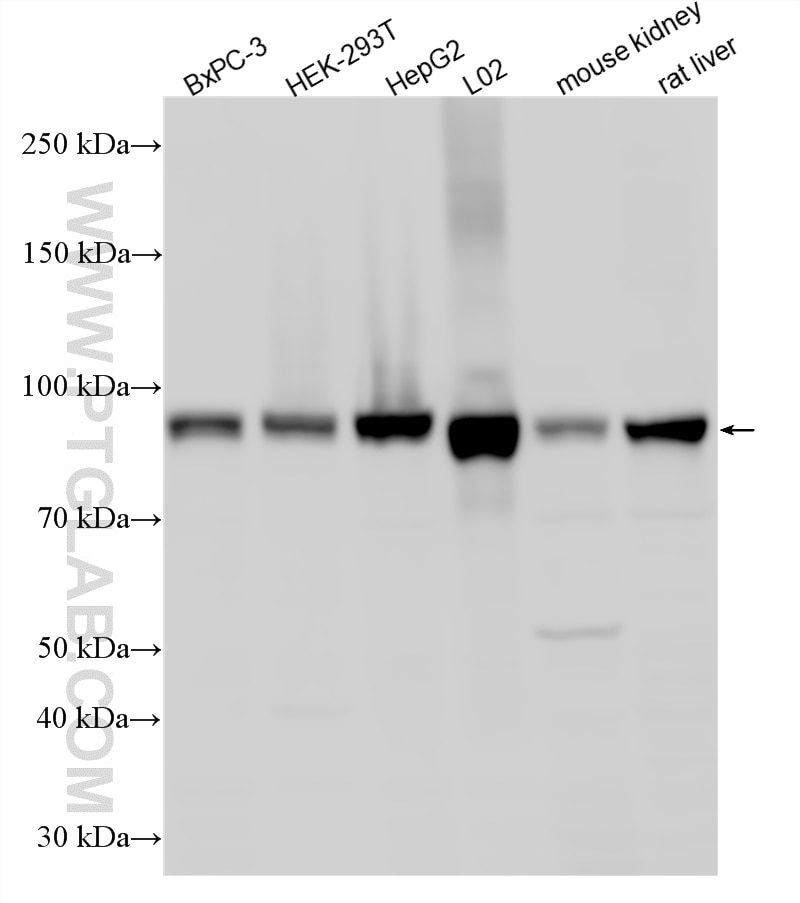



Tested Applications
| Positive WB detected in | BxPC-3 cells, HepG2 cells, mouse kidney tissue, rat liver tissue, HEK-293T cells, L02 cells |
| Positive IHC detected in | human intrahepatic cholangiocarcinoma tissue, human ovary cancer tissue Note: suggested antigen retrieval with TE buffer pH 9.0; (*) Alternatively, antigen retrieval may be performed with citrate buffer pH 6.0 |
Recommended dilution
| Application | Dilution |
|---|---|
| Western Blot (WB) | WB : 1:1000-1:6000 |
| Immunohistochemistry (IHC) | IHC : 1:50-1:500 |
| It is recommended that this reagent should be titrated in each testing system to obtain optimal results. | |
| Sample-dependent, Check data in validation data gallery. | |
Product Information
29801-1-AP targets SEL1L in WB, IHC, IP, ELISA applications and shows reactivity with human, mouse, rat samples.
| Tested Reactivity | human, mouse, rat |
| Cited Reactivity | human, mouse |
| Host / Isotype | Rabbit / IgG |
| Class | Polyclonal |
| Type | Antibody |
| Immunogen |
CatNo: Ag32178 Product name: Recombinant human SEL1L protein Source: e coli.-derived, PGEX-4T Tag: GST Domain: 22-225 aa of NM_005065 Sequence: SSDEEGSQDESLDSKTTLTSDESVKDHTTAGRVVAGQIFLDSEESELESSIQEEEDSLKSQEGESVTEDISFLESPNPENKDYEEPKKVRKPALTAIEGTAHGEPCHFPFLFLDKEYDECTSDGREDGRLWCATTYDYKADEKWGFCETEEEAAKRRQMQEAEMMYQTGMKILNGSNKKSQKREAYRYLQKAASMNHTKALERV Predict reactive species |
| Full Name | sel-1 suppressor of lin-12-like (C. elegans) |
| Calculated Molecular Weight | 89 kDa |
| Observed Molecular Weight | 89 kDa |
| GenBank Accession Number | NM_005065 |
| Gene Symbol | SEL1L |
| Gene ID (NCBI) | 6400 |
| RRID | AB_3086166 |
| Conjugate | Unconjugated |
| Form | Liquid |
| Purification Method | Antigen affinity purification |
| UNIPROT ID | Q9UBV2 |
| Storage Buffer | PBS with 0.02% sodium azide and 50% glycerol, pH 7.3. |
| Storage Conditions | Store at -20°C. Stable for one year after shipment. Aliquoting is unnecessary for -20oC storage. 20ul sizes contain 0.1% BSA. |
Background Information
SEL1L (Suppressor Enhancer Lin-12 Like) is an endoplasmic reticulum-resident transmembrane protein that plays a critical role in collagen metabolism. It has been identified as an intracellular rheostat controlling collagen turnover, which is the balance between collagen synthesis and degradation. The protein's luminal face contains a Fibronectin-2 (FN2) domain, which is known to bind collagen. SEL1L functions as a sensor of collagen biosynthesis and is necessary for the upregulation of MRC2 (mannose receptor, C-type 2), a collagen endocytic receptor that mediates the clearance of collagen.
Protocols
| Product Specific Protocols | |
|---|---|
| IHC protocol for SEL1L antibody 29801-1-AP | Download protocol |
| WB protocol for SEL1L antibody 29801-1-AP | Download protocol |
| Standard Protocols | |
|---|---|
| Click here to view our Standard Protocols |
Publications
What published studies show
The SEL1L Polyclonal antibody (Cat# 29801-1-AP) has 6 citations published in Cell, Nature Communications (×2), Cell Death & Disease, Burns Trauma, and iScience. Research fields span ERAD-mediated protein degradation, gastrointestinal and colorectal cancer progression, breast cancer EMT and drug resistance, STING signaling, dendritic cell immune responses in sepsis, and the HRD1 ubiquitin ligase complex. Applications cited include WB, IP, and IHC in human and mouse samples.
| Species | Application | Title |
|---|---|---|
Nat Commun Stenotrophomonas promotes gastrointestinal tumor progression via STING degradation in tumour cells and mitigated immune response. | ||
Cell Death Dis SEL1L3 suppresses colorectal cancer cell growth and metastasis by preventing endoplasmic reticulum-associated degradation of STING. | ||
Burns Trauma Tripartite motif 13 orchestrates endoplasmic reticulum-associated degradation and endoplasmic reticulum-phagy to modulate dendritic cell-mediated immune responses in sepsis. | ||
iScience SEL1L confers reduced EMT and drug resistance to breast cancer cells by promoting Shh degradation. |



