
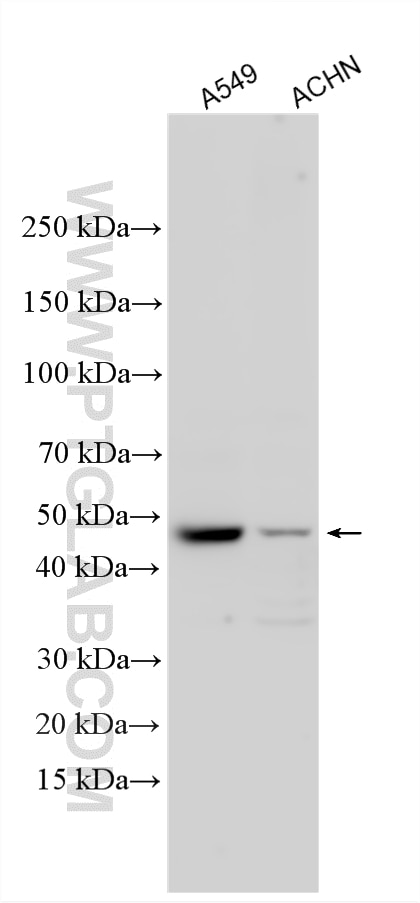

Tested Applications
| Positive WB detected in | A549 cells, ACHN cells |
Recommended dilution
| Application | Dilution |
|---|---|
| Western Blot (WB) | WB : 1:1000-1:5000 |
| It is recommended that this reagent should be titrated in each testing system to obtain optimal results. | |
| Sample-dependent, Check data in validation data gallery. | |
Product Information
29864-1-AP targets ADRB2 in WB, IHC, IF, ELISA applications and shows reactivity with human samples.
| Tested Reactivity | human |
| Cited Reactivity | human, pig |
| Host / Isotype | Rabbit / IgG |
| Class | Polyclonal |
| Type | Antibody |
| Immunogen |
CatNo: Ag32313 Product name: Recombinant human ADRB2 protein Source: e coli.-derived, PGEX-4T Tag: GST Domain: 330-413 aa of BC012481 Sequence: PDFRIAFQELLCLRRSSLKAYGNGYSSNGNTGEQSGYHVEQEKENKLLCEDLPGTEDFVGHQGTVPSDNIDSPGRNCSTNDSLL Predict reactive species |
| Full Name | adrenergic, beta-2-, receptor, surface |
| Calculated Molecular Weight | 46 kDa |
| Observed Molecular Weight | 46-48 kDa |
| GenBank Accession Number | BC012481 |
| Gene Symbol | ADRB2 |
| Gene ID (NCBI) | 154 |
| RRID | AB_2923616 |
| Conjugate | Unconjugated |
| Form | Liquid |
| Purification Method | Antigen affinity purification |
| UNIPROT ID | P07550 |
| Storage Buffer | PBS with 0.02% sodium azide and 50% glycerol, pH 7.3. |
| Storage Conditions | Store at -20°C. Stable for one year after shipment. Aliquoting is unnecessary for -20oC storage. 20ul sizes contain 0.1% BSA. |
Background Information
Beta-2 adrenergic receptor (ADRB2), a member of the G protein-coupled receptor (GPCR) family, binds epinephrine with an approximately 30-fold greater affinity than it does norepinephrine. ADRB2 is directly linked to one of its final effectors, the class C L-type Ca2+ channel, Cav1.2 (PMID: 11441182). This receptor-channel complex also contains a G protein, an adenylyl cyclase, cyclic adenosine monophosphate-dependent protein kinase (PKA), and a counteracting phosphatase, PP2A. Different polymorphic forms, point mutations, and/or downregulation of the gene of ADRB2 are associated with nocturnal asthma, obesity, and type 2 diabetes. This antibody detects ADRB2 with a molecular weight of 46-48 kDa, as has been shown by some researches (PMID: 30542705; 35075132).
Protocols
| Product Specific Protocols | |
|---|---|
| WB protocol for ADRB2 antibody 29864-1-AP | Download protocol |
| Standard Protocols | |
|---|---|
| Click here to view our Standard Protocols |
Publications
What published studies show
The ADRB2 Polyclonal antibody (Cat# 29864-1-AP) has 16 citations published in journals including Nature Cell Biology, Nature Communications, Advanced Science, J Immunother Cancer, iScience, Biochem Pharmacol, Front Pharmacol, Chem Res Toxicol, PLoS One, and others. Research fields span oncology (pancreatic, breast, lung, prostate cancer), stress biology, immunology, cardiology, bone biology, psoriasis, and osteoarthritis. Cited applications include WB, IHC, and IF in human and pig samples.
| Species | Application | Title |
|---|---|---|
Nat Cell Biol Psychological stress-induced ALKBH5 deficiency promotes tumour innervation and pancreatic cancer via extracellular vesicle transfer of RNA | ||
Nat Commun An artificial cell capable of signal transduction mediated by ADRB2 for the regulation of glycogenolysis. | ||
Adv Sci (Weinh) Chronic Stress-Induced and Tumor Derived SP1+ Exosomes Polarizing IL-1β+ Neutrophils to Increase Lung Metastasis of Breast Cancer | ||
J Immunother Cancer ADRB2 inhibition suppresses cancer immune evasion by regulating tumor SOX10-PD-L1 axis and T cell function | ||
Chin Med J (Engl) Skin-localized sympathetic nerve-keratinocyte crosstalk fuels psoriatic inflammation via neutrophil recruitment. | ||
Int J Biol Macromol SETD5 regulates chronic stress-induced cancer stemness and M2 macrophage polarization via ferroptosis in non-small cell lung cancer. |
Reviews
What customers say
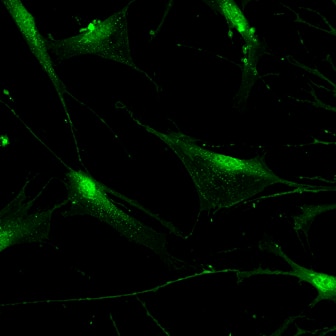
The product received a 5-star rating from a user who performed immunofluorescence on human airway smooth muscle cells. They used a 1:100 dilution of the primary antibody with 3% BSA for 30 minutes, followed by overnight incubation, and a secondary antibody (Alexa Fluor 488) at 1:400 for 40 minutes at room temperature. The reviewer reported successful staining, indicating reliable performance for IF applications.
The reviews below have been submitted by verified Proteintech customers who received an incentive for providing their feedback.
Elham (Verified Customer) (11-24-2025) | 3% BSA for 30m, followed by overnight incubation with DBR2 antibody 1:100 dilution. Con Secondary Alex Fluor 488 1:400 dilution for 40m at room temperature
 |


