
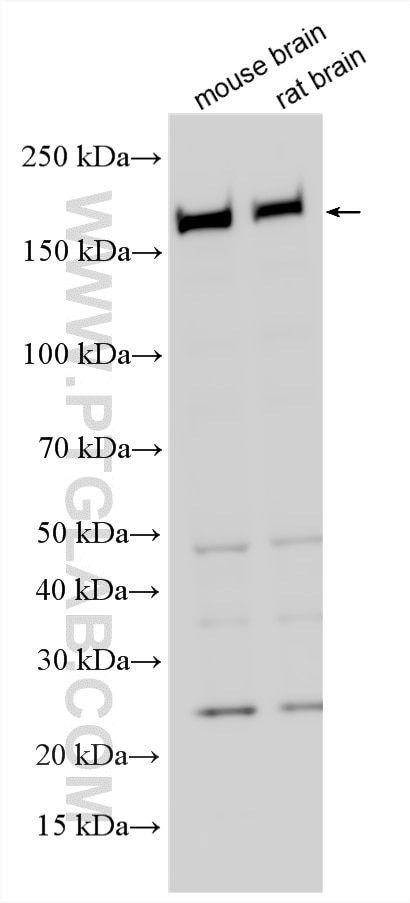



Tested Applications
| Positive WB detected in | mouse brain tissue, human brain tissue, mouse kidney tissue, rat brain tissue |
Recommended dilution
| Application | Dilution |
|---|---|
| Western Blot (WB) | WB : 1:1000-1:4000 |
| It is recommended that this reagent should be titrated in each testing system to obtain optimal results. | |
| Sample-dependent, Check data in validation data gallery. | |
Product Information
55048-1-AP targets MAGI1 in WB, ELISA applications and shows reactivity with human, mouse, rat samples.
| Tested Reactivity | human, mouse, rat |
| Cited Reactivity | human, mouse |
| Host / Isotype | Rabbit / IgG |
| Class | Polyclonal |
| Type | Antibody |
| Immunogen |
Peptide Predict reactive species |
| Full Name | membrane associated guanylate kinase, WW and PDZ domain containing 1 |
| Calculated Molecular Weight | 165 kDa |
| Observed Molecular Weight | 160-170 kDa |
| GenBank Accession Number | NM_004742 |
| Gene Symbol | MAGI1 |
| Gene ID (NCBI) | 9223 |
| RRID | AB_10858485 |
| Conjugate | Unconjugated |
| Form | Liquid |
| Purification Method | Antigen affinity purification |
| UNIPROT ID | Q96QZ7 |
| Storage Buffer | PBS with 0.02% sodium azide and 50% glycerol, pH 7.3. |
| Storage Conditions | Store at -20°C. Stable for one year after shipment. Aliquoting is unnecessary for -20oC storage. 20ul sizes contain 0.1% BSA. |
Background Information
MAGI1, also named as AIP3, BAIAP1, BAP1 and TNRC19, may play a role as scaffolding protein at cell-cell junctions. MAGI1 regulates acid-induced ACCN3 currents by modulating its expression at the cell surface. The antibody is specific to MAGI1. The antibody can recognize all the isoform of MAGI1.
Protocols
| Product Specific Protocols | |
|---|---|
| WB protocol for MAGI1 antibody 55048-1-AP | Download protocol |
| Standard Protocols | |
|---|---|
| Click here to view our Standard Protocols |
Publications
What published studies show
The MAGI1 Polyclonal antibody (catalog number 55048-1-AP) has 2 citations. These appear in Frontiers in Cell and Developmental Biology and Journal of Cellular and Molecular Medicine. The research fields include hepatocellular carcinoma, where the antibody was used to study the miR-484/MAGI1 axis regulated by lncRNA TMEM220-AS1, and sepsis-related brain injury, where it supported investigation of the phosphorylation-mediated PI3K-Akt signaling pathway in hydrogen-induced alleviation. Both studies applied the antibody for Western blot analysis in human and mouse samples, respectively.
| Species | Application | Title |
|---|---|---|
Front Cell Dev Biol Long Non-coding RNA TMEM220-AS1 Suppressed Hepatocellular Carcinoma by Regulating the miR-484/MAGI1 Axis as a Competing Endogenous RNA.
| ||
J Cell Mol Med Phosphorylation-mediated PI3K-Art signalling pathway as a therapeutic mechanism in the hydrogen-induced alleviation of brain injury in septic mice |



