
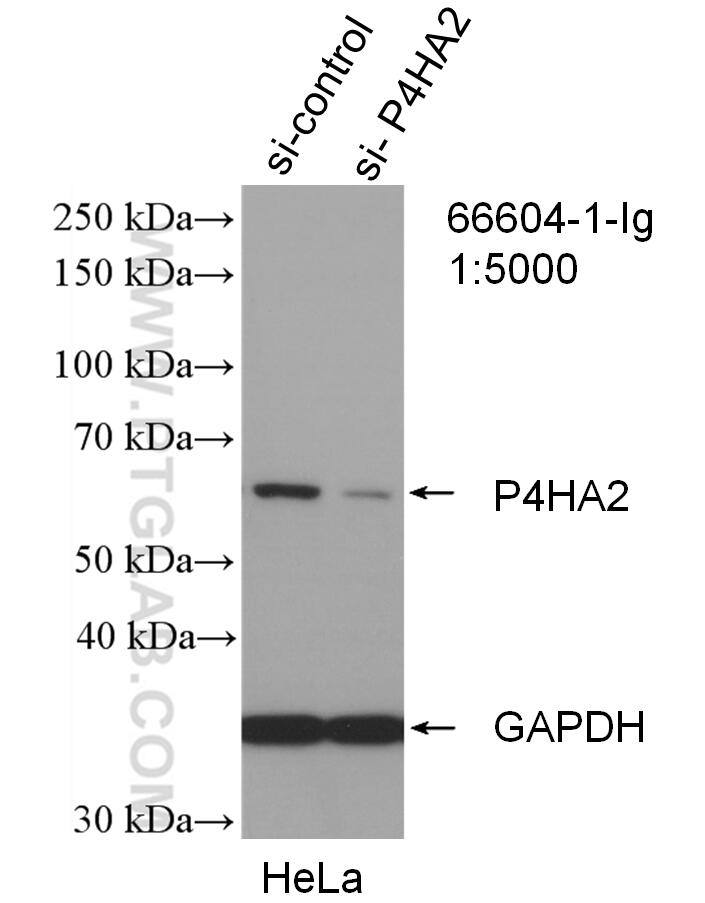
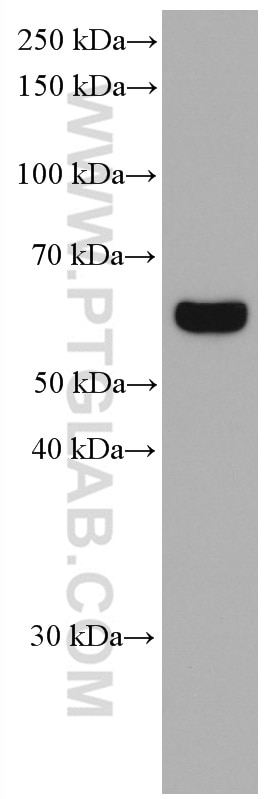
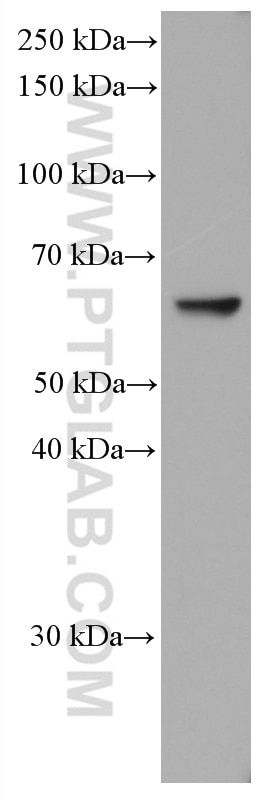
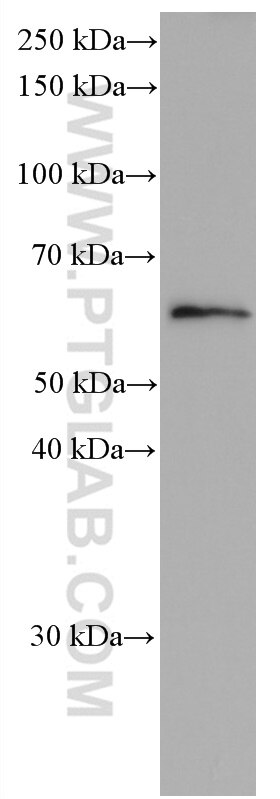
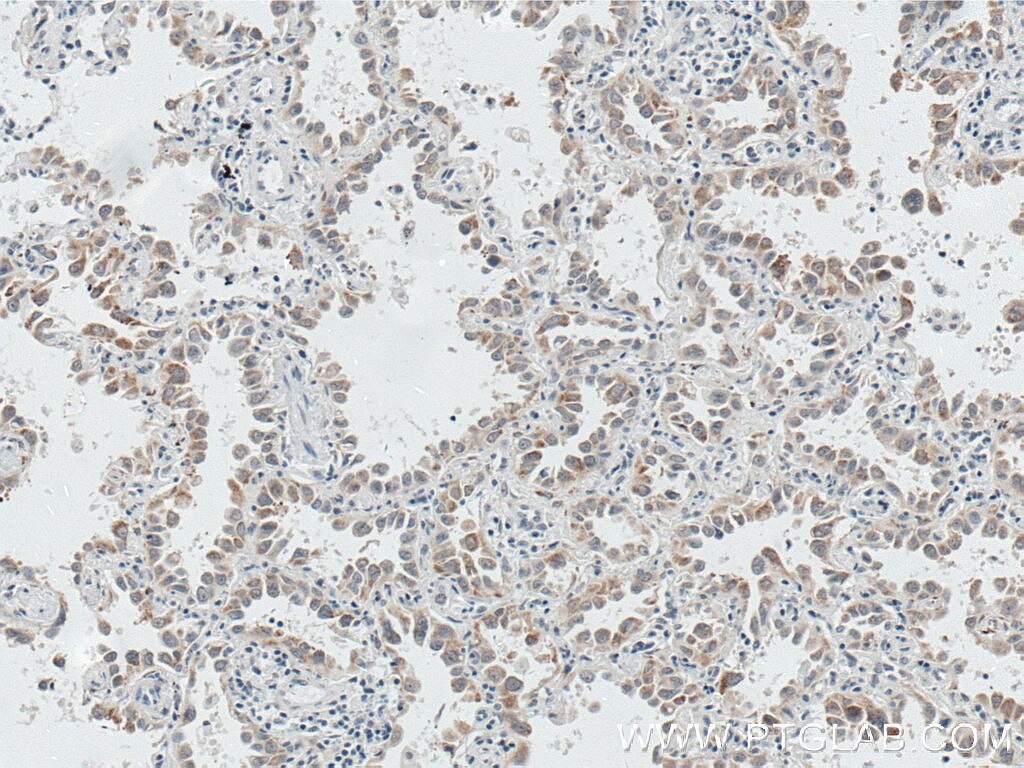
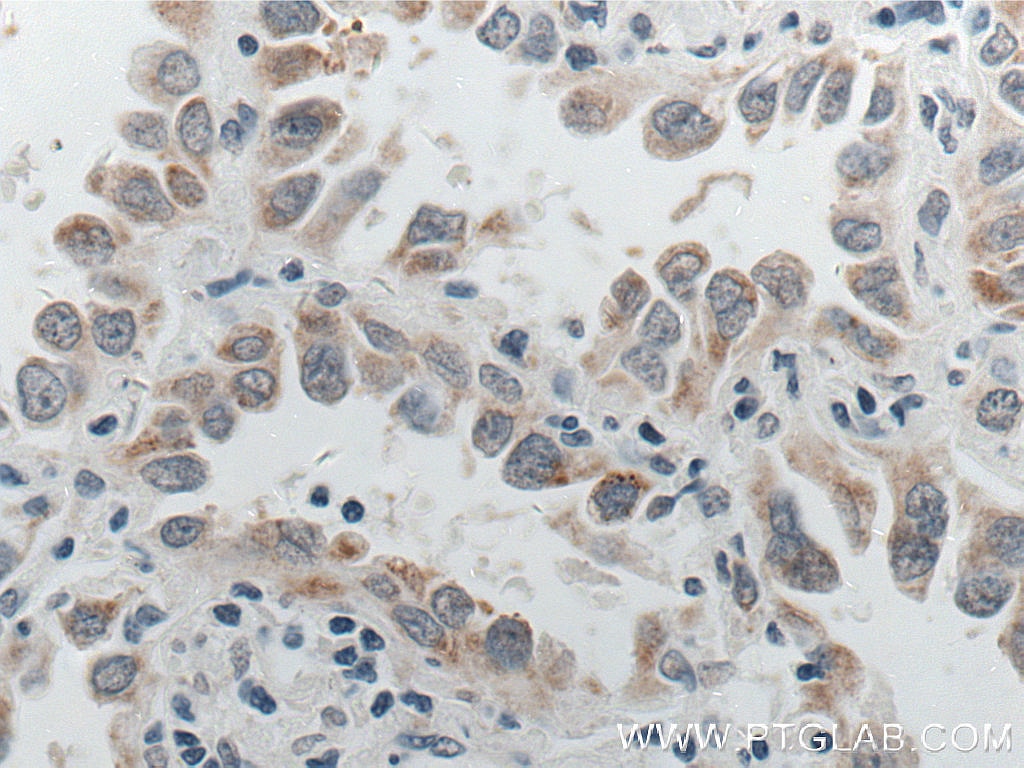

Tested Applications
| Positive WB detected in | HSCT6 cells, HeLa cells, HSC-T6 cells, NIH/3T3 cells |
| Positive IHC detected in | human lung cancer tissue Note: suggested antigen retrieval with TE buffer pH 9.0; (*) Alternatively, antigen retrieval may be performed with citrate buffer pH 6.0 |
Recommended dilution
| Application | Dilution |
|---|---|
| Western Blot (WB) | WB : 1:2000-1:10000 |
| Immunohistochemistry (IHC) | IHC : 1:400-1:1000 |
| It is recommended that this reagent should be titrated in each testing system to obtain optimal results. | |
| Sample-dependent, Check data in validation data gallery. | |
Product Information
66604-1-Ig targets P4HA2 in WB, IHC, IF, ELISA applications and shows reactivity with human, mouse, rat samples.
| Tested Reactivity | human, mouse, rat |
| Cited Reactivity | human, mouse |
| Host / Isotype | Mouse / IgG1 |
| Class | Monoclonal |
| Type | Antibody |
| Immunogen |
CatNo: Ag4714 Product name: Recombinant human P4HA2 protein Source: e coli.-derived, PET28a Tag: 6*His Domain: 184-533 aa of BC035813 Sequence: HTVLWMEQVLKQLDAGEEATTTKSQVLDYLSYAVFQLGDLHRALELTRRLLSLDPSHERAGGNLRYFEQLLEEEREKTLTNQTEAELATPEGIYERPVDYLPERDVYESLCRGEGVKLTPRRQKRLFCRYHHGNRAPQLLIAPFKEEDEWDSPHIVRYYDVMSDEEIERIKEIAKPKLARATVRDPKTGVLTVASYRVSKSSWLEEDDDPVVARVNRRMQHITGLTVKTAELLQVANYGVGGQYEPHFDFSRRPFDSGLKTEGNRLATFLNYMSDVEAGGATVFPDLGAAIWPKKGTAVFWYNLLRSGEGDYRTRHAACPVLVGCKWVSNKWFHERGQEFLRPCGSTEVD Predict reactive species |
| Full Name | prolyl 4-hydroxylase, alpha polypeptide II |
| Calculated Molecular Weight | 533 aa, 61 kDa |
| Observed Molecular Weight | 61 kDa |
| GenBank Accession Number | BC035813 |
| Gene Symbol | P4HA2 |
| Gene ID (NCBI) | 8974 |
| RRID | AB_2881964 |
| Conjugate | Unconjugated |
| Form | Liquid |
| Purification Method | Protein G purification |
| UNIPROT ID | O15460 |
| Storage Buffer | PBS with 0.02% sodium azide and 50% glycerol, pH 7.3. |
| Storage Conditions | Store at -20°C. Stable for one year after shipment. Aliquoting is unnecessary for -20oC storage. 20ul sizes contain 0.1% BSA. |
Background Information
Prolyl 4-hydroxylase catalyzes the posttranslational formation of 4-hydroxyproline in collagens. The vertebrate enzyme is a tetramer of 2 alpha subunits and 2 beta subunits. P4HA2 is one of at least 2 alpha subunit isoforms. It catalyzes the post-translational formation of 4-hydroxyproline in -Xaa-Pro-Gly- sequences in collagens and other proteins. This pprotein has 2 isoforms produced by alternative splicing.
Protocols
| Product Specific Protocols | |
|---|---|
| IHC protocol for P4HA2 antibody 66604-1-Ig | Download protocol |
| WB protocol for P4HA2 antibody 66604-1-Ig | Download protocol |
| Standard Protocols | |
|---|---|
| Click here to view our Standard Protocols |
Publications
What published studies show
Anti-P4HA2 antibody (Cat# 66604-1-Ig) has 8 total citations published in journals including Cell Communications & Signaling, Journal of Experimental Medicine, International Journal of Biological Macromolecules, Communications Biology, BBA Molecular Basis of Disease, Cell Signaling, Cancer Management and Research, and NAR Molecular Medicine. Research fields span follicle biology and subfertility, immune checkpoint therapy resistance, thyroid cancer glycolysis, osteoblast differentiation, endoplasmic reticulum stress in bone development, glioma proliferation, ovarian carcinoma prognosis, and transposon-derived gene regulation.
| Species | Application | Title |
|---|---|---|
J Exp Med IL-17-induced HIF1α drives resistance to anti-PD-L1 via fibroblast-mediated immune exclusion. | ||
Cell Commun Signal GDF9His209GlnfsTer6/S428T and GDF9Q321X/S428T bi-allelic variants caused female subfertility with defective follicle enlargement | ||
Int J Biol Macromol YTHDF3-induced degradation of P4HA2 mRNA inhibits glycolysis in papillary thyroid cancer through Hippo signaling pathway
| ||
Commun Biol Protein disulfide isomerase is essential for osteoblast differentiation in mice | ||
Biochim Biophys Acta Mol Basis Dis Endoplasmic reticulum stress causes long bone shortening in P4hbC402R/+ mice: A mouse model exhibiting significant features of cole-carpenter syndrome driven by P4HB mutations | ||
Cell Signal P4HA2 promotes glioma cell proliferation by interacting with Hsp27 to activate the EGFR/ERK signaling pathway.
|







