
Tested Applications
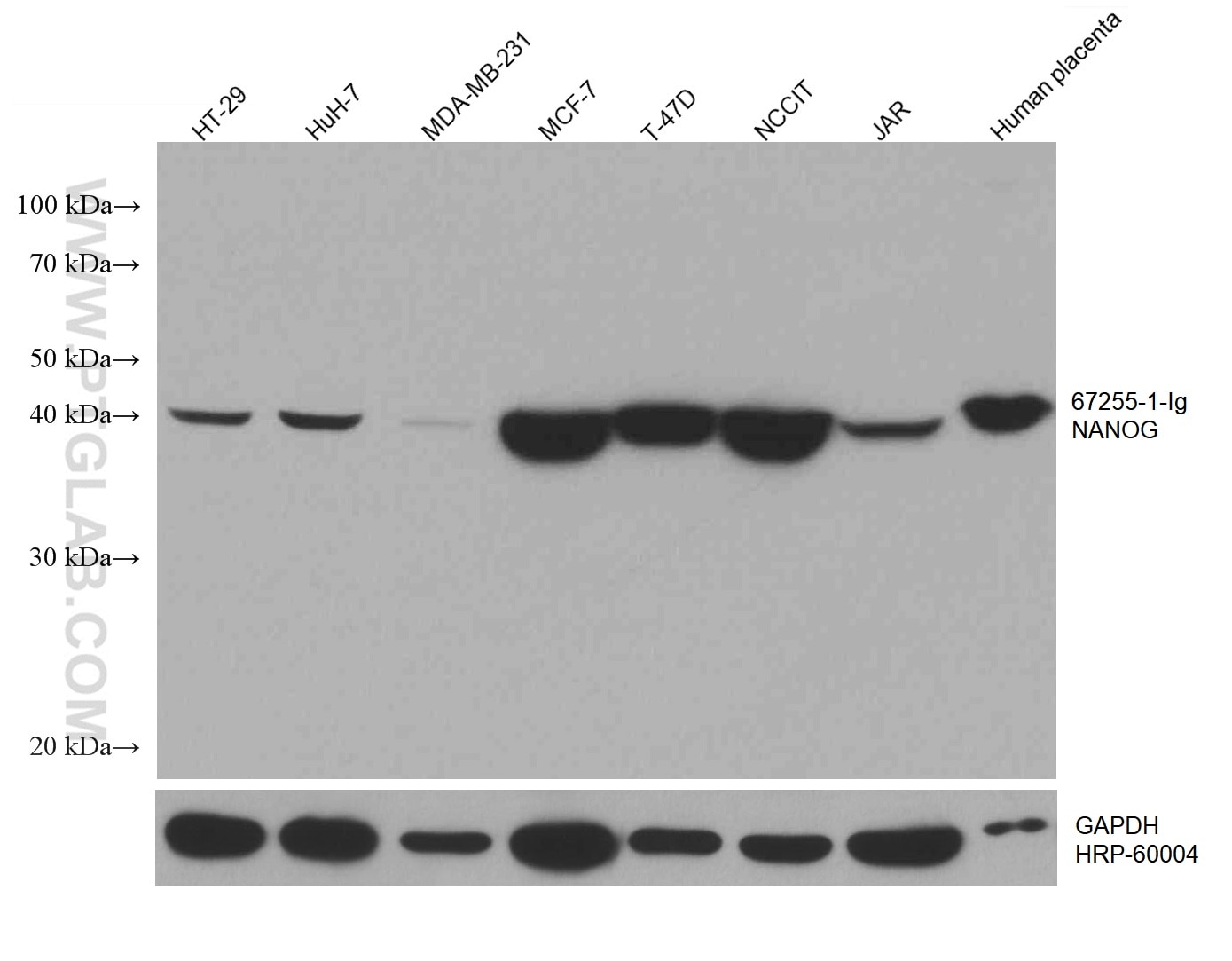
| Positive WB detected in | HT-29 cells, HuH-7 cells, MDA-MB-231 cells, MCF-7 cells, T-47D cells, NCCIT cells, JAR cells, human placenta tissue |
Recommended dilution
| Application | Dilution |
|---|---|
| Western Blot (WB) | WB : 1:5000-1:50000 |
| It is recommended that this reagent should be titrated in each testing system to obtain optimal results. | |
| Sample-dependent, Check data in validation data gallery. | |
Product Information
67255-1-Ig targets Nanog in WB, IF, ELISA applications and shows reactivity with human samples.
| Tested Reactivity | human |
| Cited Reactivity | human, mouse |
| Host / Isotype | Mouse / IgG2a |
| Class | Monoclonal |
| Type | Antibody |
| Immunogen |
CatNo: Ag21364 Product name: Recombinant human NANOG protein Source: e coli.-derived, PET28a Tag: 6*His Domain: 1-305 aa of BC160187 Sequence: MSVDPACPQSLPCFEASDCKESSPMPVICGPEENYPSLQMSSAEMPHTETVSPLPSSMDLLIQDSPDSSTSPKGKQPTSAEKSVAKKEDKVPVKKQKTRTVFSSTQLCVLNDRFQRQKYLSLQQMQELSNILNLSYKQVKTWFQNQRMKSKRWQKNNWPKNSNGVTQKASAPTYPSLYSSYHQGCLVNPTGNLPMWSNQTWNNSTWSNQTQNIQSWSNHSWNTQTWCTQSWNNQAWNSPFYNCGEESLQSCMQFQPNSPASDLEAALEAAGEGLNVIQQTTRYFSTPQTMDLFLNYSMNMQPEDV Predict reactive species |
| Full Name | Nanog homeobox |
| Calculated Molecular Weight | 35 kDa |
| Observed Molecular Weight | 42 kDa |
| GenBank Accession Number | BC160187 |
| Gene Symbol | Nanog |
| Gene ID (NCBI) | 79923 |
| RRID | AB_2882529 |
| Conjugate | Unconjugated |
| Form | Liquid |
| Purification Method | Protein A purification |
| UNIPROT ID | Q9H9S0 |
| Storage Buffer | PBS with 0.02% sodium azide and 50% glycerol, pH 7.3. |
| Storage Conditions | Store at -20°C. Stable for one year after shipment. Aliquoting is unnecessary for -20oC storage. 20ul sizes contain 0.1% BSA. |
Background Information
Nanog is a member of the homeobox family of DNA binding transcription factors and has been shown to maintain embryonic stem (ES) cell self-renewal independently of leukemia inhibitory factor (LIF)/Stat3. Nanog mRNA is present in pluripotent mouse and human cell lines, and absent from differentiated cells. Functionally, Nanog works together with other key pluripotent factors (Oct4, Sox2, and Lin28) to reprogram human fibroblasts and generate induced pluripotent stem (iPS) cells. These key factors form a regulatory network to support or limit each other's expression level, which maintains the properties of ES cells. Affinity purified rabbit anti-Nanog can be used to demonstrate pluripotency of ES and IPS cells. There are two kinds of variants could recognized by NANOG, one is normal form (~39kd), the other is post-translation modified form (~48kd) (21136380 ). Nanog exists two isoforms with molecular weight 34.4 kDa and 31.9 kDa. (PMID: 21969378)
Protocols
| Product Specific Protocols | |
|---|---|
| WB protocol for Nanog antibody 67255-1-Ig | Download protocol |
| Standard Protocols | |
|---|---|
| Click here to view our Standard Protocols |
Publications
What published studies show
| Species | Application | Title |
|---|---|---|
J Exp Clin Cancer Res Membrane RRM2-positive cells represent a malignant population with cancer stem cell features in intrahepatic cholangiocarcinoma | ||
Adv Sci (Weinh) MYC/TET3-Regulated TMEM65 Activates OXPHOS-SERPINB3 Pathway to Promote Progression and Cisplatin Resistance in Triple-Negative Breast Cancer | ||
Cancer Lett Loss of Claudin-1 incurred by DNMT aberration promotes pancreatic cancer progression | ||
Int J Biol Sci eNAMPT/Ac-STAT3/DIRAS2 Axis Promotes Development and Cancer Stemness in Triple-Negative Breast Cancer by Enhancing Cytokine Crosstalk Between Tumor-Associated Macrophages and Cancer Cells | ||
Oncogene SIX1 transmits signals for breast cancer progression via the ZEB1/IL6/STAT3 signaling axis | ||
Apoptosis NRP1 contributes to stemness and potentiates radioresistance via WTAP-mediated m6A methylation of Bcl-2 mRNA in breast cancer |


