
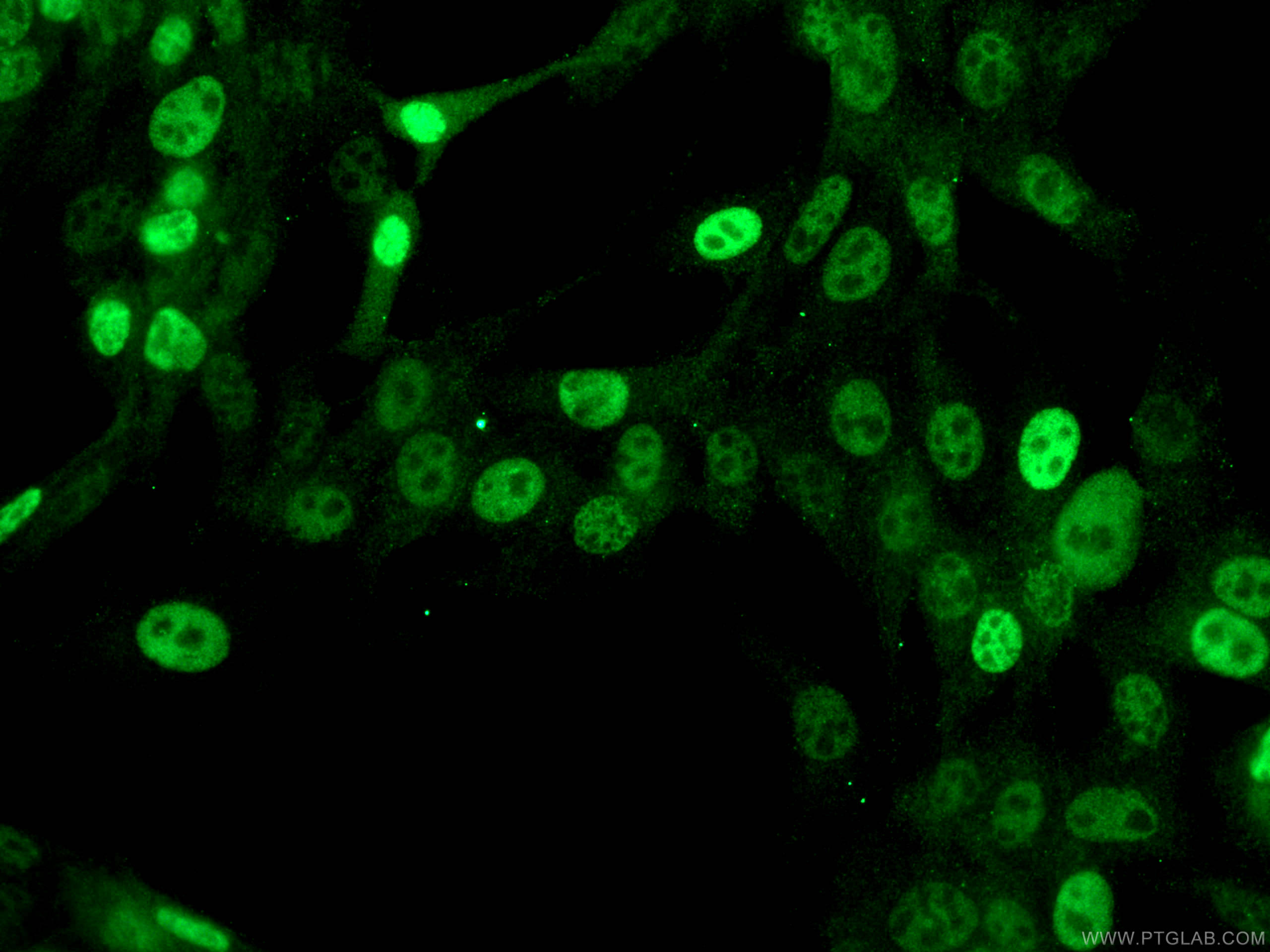

Tested Applications
| Positive IF/ICC detected in | NIH/3T3 cells |
Recommended dilution
| Application | Dilution |
|---|---|
| Immunofluorescence (IF)/ICC | IF/ICC : 1:50-1:500 |
| It is recommended that this reagent should be titrated in each testing system to obtain optimal results. | |
| Sample-dependent, Check data in validation data gallery. | |
Product Information
67362-1-Ig targets p21 in IF/ICC, ELISA applications and shows reactivity with mouse samples.
| Tested Reactivity | mouse |
| Cited Reactivity | human, mouse, canine |
| Host / Isotype | Mouse / IgG2b |
| Class | Monoclonal |
| Type | Antibody |
| Immunogen |
CatNo: Ag28394 Product name: Recombinant mouse Cdkn1a protein Source: e coli.-derived, PET28a Tag: 6*His Domain: 1-159 aa of NM_001111099 Sequence: MSNPGDVRPVPHRSKVCRCLFGPVDSEQLRRDCDALMAGCLQEARERWNFDFVTETPLEGNFVWERVRSLGLPKVYLSPGSRSRDDLGGDKRPSTSSALLQGPAPEDHVALSLSCTLVSERPEDSPGGPGTSQGRKRRQTSLTDFYHSKRRLVFCKRKP Predict reactive species |
| Full Name | cyclin-dependent kinase inhibitor 1A (P21) |
| Calculated Molecular Weight | 18 kDa |
| GenBank Accession Number | NM_001111099 |
| Gene Symbol | p21 |
| Gene ID (NCBI) | 12575 |
| RRID | AB_2882614 |
| Conjugate | Unconjugated |
| Form | Liquid |
| Purification Method | Protein A purification |
| UNIPROT ID | P39689 |
| Storage Buffer | PBS with 0.02% sodium azide and 50% glycerol, pH 7.3. |
| Storage Conditions | Store at -20°C. Stable for one year after shipment. Aliquoting is unnecessary for -20oC storage. 20ul sizes contain 0.1% BSA. |
Background Information
CDKN1A (p21, CIP1, WAF1) is a cyclin-dependent kinase inhibitor. CDKN1A binds to and inhibits the activity of cyclin-CDK2 or -CDK4 complexes, and thus functions as a regulator of cell cycle progression at the G1 phase. The expression of CDKN1A is induced by wild-type but not mutant p53 protein, through which CDKN1A mediates the p53-dependent cell cycle G1 phase arrest in response to a variety of stress stimuli. CDKN1A can interact with proliferating cell nuclear antigen (PCNA), and plays a regulatory role in S phase DNA replication and DNA damage repair. CDKN1A was reported to be specifically cleaved by CASP3-like caspases, which thus leads to a dramatic activation of CDK2, and may be instrumental in the execution of apoptosis following caspase activation.
Protocols
| Product Specific Protocols | |
|---|---|
| IF protocol for p21 antibody 67362-1-Ig | Download protocol |
| Standard Protocols | |
|---|---|
| Click here to view our Standard Protocols |
Publications
What published studies show
The p21 Monoclonal antibody (catalog number 67362-1-Ig) has 20 citations. These appear in journals including Autophagy, Theranostics, Phytomedicine, J Transl Med, Chemosphere, Environ Res, Cell Prolif, Life Sci, Cells, Noncoding RNA Res, Front Pharmacol, Mol Med Rep, iScience, Hum Vaccin Immunother, Heliyon, Bioorg Med Chem, bioRxiv, Int J Mol Sci, and Neurobiol Dis. The research fields center on cellular senescence, autophagy, cancer, vascular and cardiovascular aging, metabolic disorders, and neurodegeneration, with applications mainly in immunofluorescence across human, mouse, and canine models.
| Species | Application | Title |
|---|---|---|
Autophagy Autophagy regulates cellular senescence by mediating the degradation of CDKN1A/p21 and CDKN2A/p16 through SQSTM1/p62-mediated selective autophagy in myxomatous mitral valve degeneration | ||
Theranostics GLSP mitigates vascular aging by promoting Sirt7-mediated Keap1 deacetylation and Keap1-Nrf2 dissociation | ||
Phytomedicine Ginsenoside Rh2 and luteolin synergistically induce cellular senescence to suppress hepatocellular carcinoma progression through oxidative stress-mediated mechanisms. | ||
J Transl Med IP6K2 mutations as a novel mechanism of resistance to oncolytic virus therapy | ||
Chemosphere NBR1-dependent Autophagy Activation Protects Against Environmental Cadmium-evoked Placental Trophoblast Senescence | ||
Environ Res Emerging perfluoroalkyl substances retard skeletal growth by accelerating osteoblasts senescence via ferroptosis |


