

Tested Applications
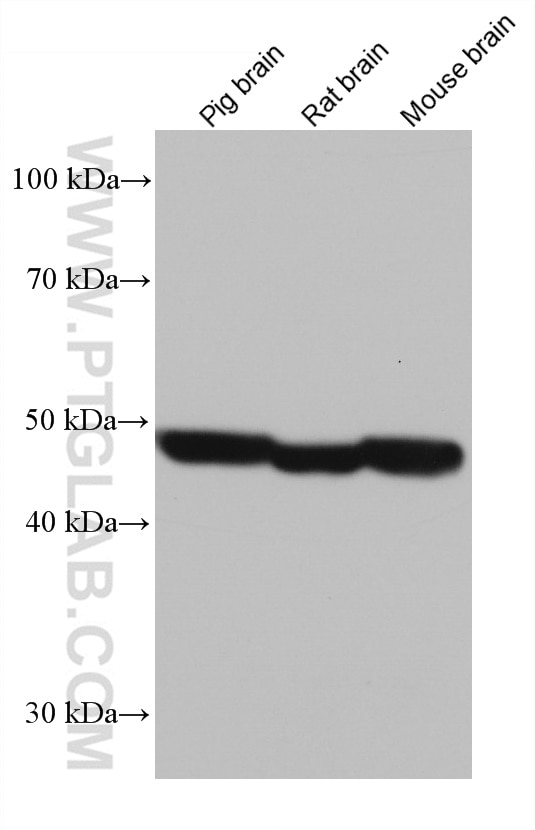
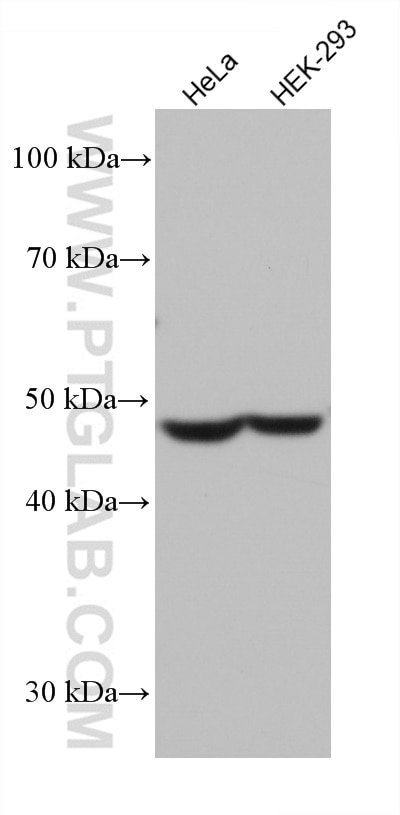
| Positive WB detected in | pig brain tissue, HeLa cells, HEK-293 cells, mouse brain tissue, rat brain tissue |
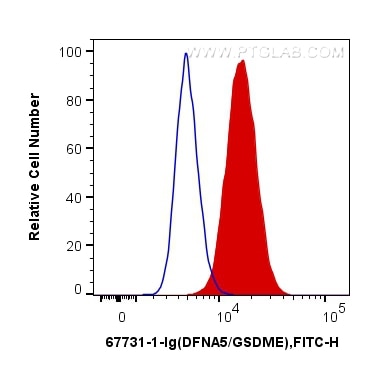
| Positive FC (Intra) detected in | SH-SY5Y cells |
Recommended dilution
| Application | Dilution |
|---|---|
| Western Blot (WB) | WB : 1:1000-1:4000 |
| Flow Cytometry (FC) (INTRA) | FC (INTRA) : 0.20 ug per 10^6 cells in a 100 µl suspension |
| It is recommended that this reagent should be titrated in each testing system to obtain optimal results. | |
| Sample-dependent, Check data in validation data gallery. | |
Product Information
67731-1-Ig targets DFNA5/GSDME in WB, IHC, FC (Intra), ELISA applications and shows reactivity with human, mouse, rat, pig samples.
| Tested Reactivity | human, mouse, rat, pig |
| Cited Reactivity | human, mouse, rat, pig |
| Host / Isotype | Mouse / IgG1 |
| Class | Monoclonal |
| Type | Antibody |
| Immunogen |
CatNo: Ag30514 Product name: Recombinant human DFNA5 protein Source: e coli.-derived, PET28a Tag: 6*His Domain: 111-460 aa of BC019689 Sequence: SQSSFGTLRKQEVDLQQLIRDSAERTINLRNPVLQQVLEGRNEVLCVLTQKITTMQKCVISEHMQVEEKCGGIVGIQTKTVQVSATEDGNVTKDSNVVLEIPAATTIAYGVIELYVKLDGQFEFCLLRGKQGGFENKKRIDSVYLDPLVFREFAFIDMPDAAHGISSQDGPLSVLKQATLLLERNFHPFAELPEPQQTALSDIFQAVLFDDELLMVLEPVCDDLVSGLSPTVAVLGELKPRQQQDLVAFLQLVGCSLQGGCPGPEDAGSKQLFMTAYFLVSALAEMPDSAAALLGTCCKLQIIPTLCHLLRALSDDGVSDLEDPTLTPLKDTERFGIVQRLFASADISL Predict reactive species |
| Full Name | deafness, autosomal dominant 5 |
| Calculated Molecular Weight | 496 aa, 55 kDa |
| Observed Molecular Weight | 50-55 kDa |
| GenBank Accession Number | BC019689 |
| Gene Symbol | DFNA5 |
| Gene ID (NCBI) | 1687 |
| RRID | AB_2882917 |
| Conjugate | Unconjugated |
| Form | Liquid |
| Purification Method | Protein G purification |
| UNIPROT ID | O60443 |
| Storage Buffer | PBS with 0.02% sodium azide and 50% glycerol, pH 7.3. |
| Storage Conditions | Store at -20°C. Stable for one year after shipment. Aliquoting is unnecessary for -20oC storage. 20ul sizes contain 0.1% BSA. |
Background Information
DFNA5 (deafness, autosomal dominant 5), also known as GSDME or ICERE-1, is a 496 amino acid protein that is expressed in cochlea tissue, as well as in placenta, brain, heart, liver, lung and pancreas. Defects in the gene encoding DFNA5 are the cause of non-syndromic sensorineural deafness autosomal dominant type 5 (DFNA5), a form of sensorineural hearing loss that results from damage to one of various structures that receive sound information in the brain.
Protocols
| Product Specific Protocols | |
|---|---|
| FC protocol for DFNA5/GSDME antibody 67731-1-Ig | Download protocol |
| WB protocol for DFNA5/GSDME antibody 67731-1-Ig | Download protocol |
| Standard Protocols | |
|---|---|
| Click here to view our Standard Protocols |
Publications
What published studies show
The GSDME antibody (Cat# 67731-1-Ig) has 11 citations across journals including J Exp Clin Cancer Res, J Control Release, Mater Today Bio, ACS Appl Mater Interfaces, Cancer Cell Int, J Agric Food Chem, Exp Neurol, ACS Chem Neurosci, Appl Biochem Biotechnol, and Resusc Plus. Research fields span pyroptosis, cancer (pancreatic, glioblastoma, head and neck), neurology, cardiology, renal injury, and nanomedicine-based immunotherapy.
| Species | Application | Title |
|---|---|---|
J Exp Clin Cancer Res IKBKE downregulation increases chemosensitivity through pyroptosis mediated by the caspase-3/GSDME pathway in pancreatic cancer. | ||
J Control Release Biomimetic nanovesicle mediated GSDME delivery reprograms the tumor immune microenvironment via pyroptosis to enhance radiotherapy. | ||
Mater Today Bio An MRI-visible nanotheranostic establishes a self-amplifying pyroptosis-STING-IFN-β circuit for CD8(+) T cell immunoactivation. | ||
ACS Appl Mater Interfaces Mitochondria-Targeting Pyroptosis Amplifier of Lonidamine-Modified Black Phosphorus Nanosheets for Glioblastoma Treatments | ||
Cancer Cell Int Comprehensive analysis, diagnosis, prognosis, and cordycepin (CD) regulations for GSDME expressions in pan-cancers | ||
J Agric Food Chem GSDME-Mediated Pyroptosis and the mtDNA-cGAS-STING Pathway Drive Deoxynivalenol-Induced Porcine Intestinal Inflammatory Injury. |
Reviews
What customers say
The single review for this product is negative. The reviewer performed Western Blot at a 1:1000 dilution on MDA-MB-231 and HCT-15 cells and reported that the antibody produced bright bands at approximately 50 kDa and 30 kDa, neither of which corresponds to the expected human GSDME molecular weight. The reviewer noted that these bands appeared even in cell lines that do not express GSDME, and further pointed out that the manufacturer's own sample blots also showed bands too small to represent GSDME. The overall conclusion was that the antibody does not appear to specifically target GSDME.
The reviews below have been submitted by verified Proteintech customers who received an incentive for providing their feedback.
William (Verified Customer) (05-12-2021) | This antibody brightly stained bands of just over 50 kDa and just under 30 kDa, neither of which correspond to human GSDME, and it did so in samples from cells that do not express GSDME. The sample blots provided by ProteinTech also show bands that are too small to be GSDME. This does not appear to target GSDME.
|




