

Tested Applications
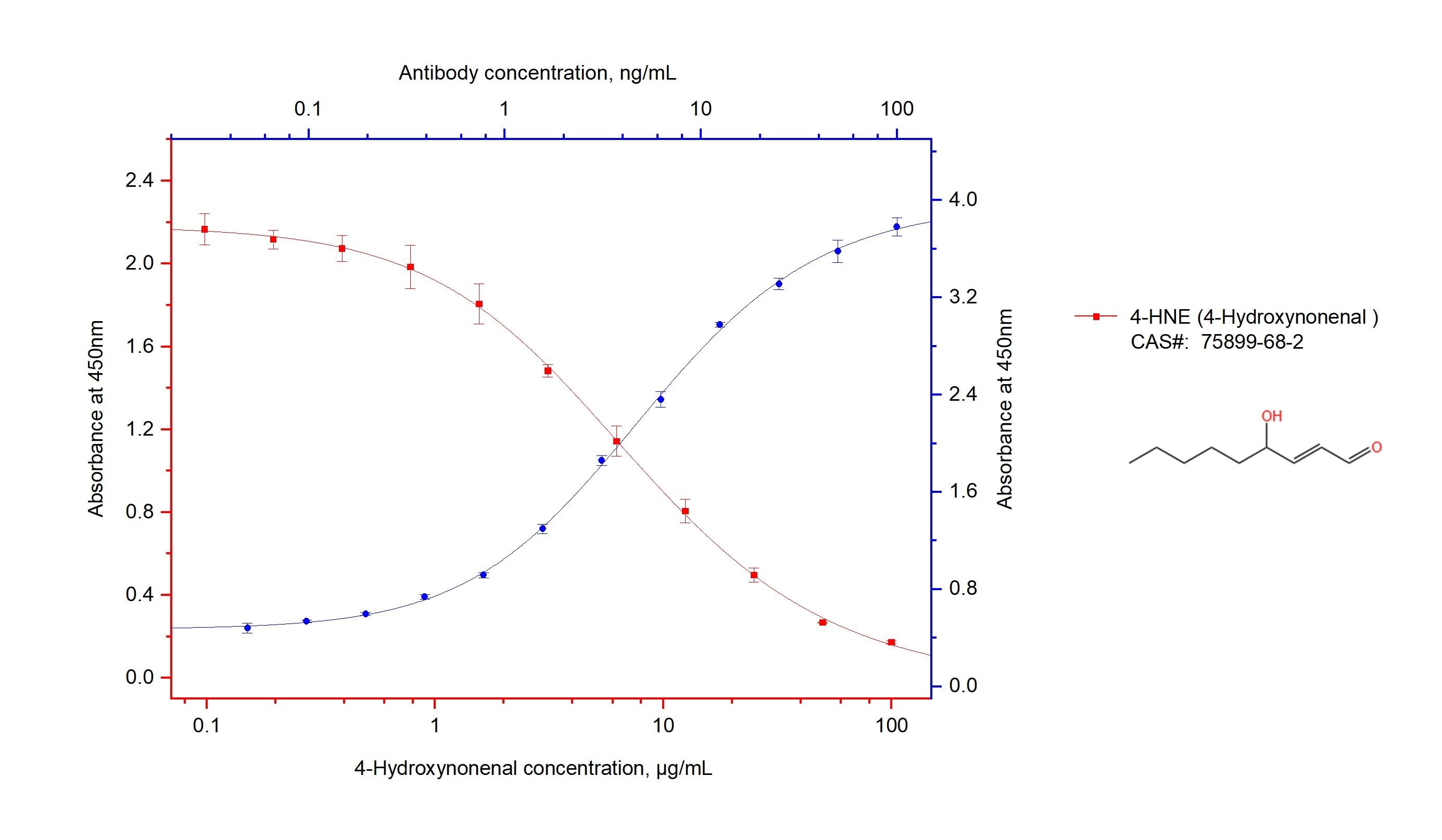
| Positive ELISA detected in | 4-Hydroxynonenal |
Recommended dilution
| Application | Dilution |
|---|---|
| Enzyme-linked Immunosorbent Assay (ELISA) | ELISA : 1:5000-1:20000 |
| It is recommended that this reagent should be titrated in each testing system to obtain optimal results. | |
| Sample-dependent, Check data in validation data gallery. | |
Product Information
68538-1-Ig targets 4-Hydroxynonenal in WB, IHC, IF, ELISA applications and shows reactivity with 4-hydroxynonenal, chemical compound samples.
| Tested Reactivity | 4-hydroxynonenal, chemical compound |
| Cited Reactivity | human, mouse, rat |
| Host / Isotype | Mouse / IgG2a |
| Class | Monoclonal |
| Type | Antibody |
| Immunogen |
Peptide Predict reactive species |
| Full Name | 4-Hydroxynonenal |
| Gene Symbol | |
| Gene ID (NCBI) | |
| RRID | AB_3085246 |
| Conjugate | Unconjugated |
| Form | Liquid |
| Purification Method | Protein A purification |
| Storage Buffer | PBS with 0.02% sodium azide and 50% glycerol, pH 7.3. |
| Storage Conditions | Store at -20°C. Stable for one year after shipment. Aliquoting is unnecessary for -20oC storage. 20ul sizes contain 0.1% BSA. |
Background Information
4-Hydroxynonenal is a uremic toxin. Uremic toxins can be subdivided into three major groups based upon their chemical and physical characteristics: 1) small, water-soluble, non-protein-bound compounds, such as urea; 2) small, lipid-soluble and/or protein-bound compounds, such as the phenols and 3) larger so-called middle-molecules, such as beta2-microglobulin. 4-Hydroxynonenal (4-HNE) is a major aldehydic product of ω-6-unsaturated fatty acid peroxidation. It is considered a lipid peroxidation specific marker. 4-HNE has been found to induce differentiation and inhibit proliferation of HL-60 human leukemic cells. It has also been found to induce murine alveolar macrophage cell death. 4-HNE has been shown to inhibit State 3 respiration, causing a transient cytosolic Ca2+ increase. In addition, it irreversibly inhibits Na+-K+-ATPase activity.
Publications
What published studies show
The 4-Hydroxynonenal Monoclonal antibody (2C1D10), catalog number 68538-1-Ig, has accumulated 35 citations. These appear in journals including Cell, ACS Nano, Bioactive Materials, Redox Biology, Advanced Science, Free Radical Biology and Medicine, iScience, FASEB Journal, Cell Reports, and Biomaterials. Research fields span ferroptosis, lipid peroxidation, oxidative stress, cancer, cardiovascular disease, osteoporosis, liver fibrosis, neurodegeneration, cuproptosis, and metabolic reprogramming.
| Species | Application | Title |
|---|---|---|
Bioact Mater ADGRG1-targeted hypoxia preconditioned extracellular vesicles ameliorate intervertebral disc degeneration by delivering taurine to disrupt the oxidative stress feedback loop-driven ferroptosis in nucleus pulposus cells. | ||
Drug Resist Updat Targeting the USP5-HSPB1 axis overcomes ferroptosis resistance in intrahepatic cholangiocarcinoma. | ||
ACS Nano A Blood-Triggered Adhesive Hydrogel Loaded with Reactive Oxygen Species-Responsive Liposomes for the Treatment of Acute Kidney Injury. | ||
J Adv Res SLC7A11 as a therapeutic target to attenuate phthalates-driven testosterone level decline in mice. | ||
Redox Biol A spinal USP7-Bach1 positive feedback loop drives NOX4-mediated ferroptosis in neuropathic pain. |


