

Product Information
69024-1-Ig targets NeutraKine®FGF basic in Neutralization, ELISA, Cell treatment applications and shows reactivity with human samples.
| Tested Reactivity | human |
| Cited Reactivity | human, rat |
| Host / Isotype | Mouse / IgG1 |
| Class | Monoclonal |
| Type | Antibody |
| Immunogen |
Product name: HumanKine® recombinant human FGFbasic-TS protein Source: -derived, Tag: Sequence: Predict reactive species |
| Full Name | fibroblast growth factor 2 (basic) |
| Gene Symbol | FGF2 |
| Gene ID (NCBI) | 2247 |
| RRID | AB_2918844 |
| Conjugate | Unconjugated |
| Form | Lyophilized Powder |
| Purification Method | Protein G purification |
| UNIPROT ID | P09038 |
| Storage Buffer | Sterile PBS, pH 7.4. |
| Endotoxin | <0.1 EU/μg |
| Reconstitution | This product was lyophilized from a 0.2 μm filtered solution in PBS. Reconstitute at 1.0 mg/mL in sterile H2O before use. |
| Stability and Storage | Lyophilized antibodies are stable for 1 year from the date of receipt if stored between (-20°C) and (-80°C). Upon reconstitution we recommend that the solution can be stored at (4°C) for short term or at (-20°C) to (-80°C) for long term. Repeated freeze thaw cycles should be avoided with reconstituted products. |
Background Information
Fibroblast growth factor-2 (FGF-2), also referred to as basic FGF, belongs to a family of growth factors that stimulate proliferation of cells of mesenchymal, epithelial and neuroectodermal origin. The mRNA for this gene contains multiple polyadenylation sites, and is alternatively translated from non-AUG (CUG) and AUG initiation codons, resulting in at least five different isoforms with distinct properties.
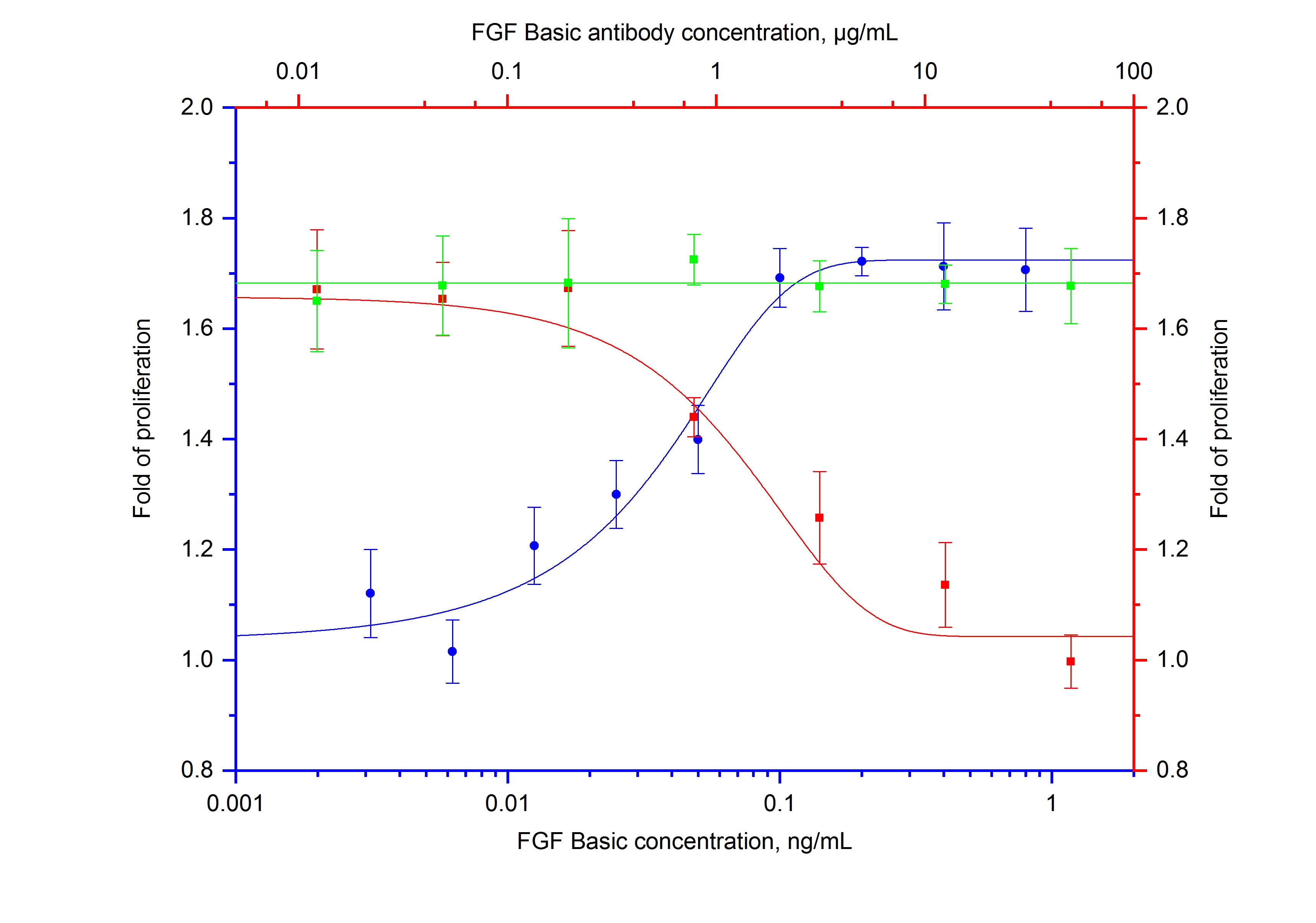
This antibody is used to neutralize the bioactivity of FGFbasic-TS.
Publications
What published studies show
The anti-FGF2 recombinant Ig (Cat# 69024-1-Ig) has 4 total citations. These appear in Advanced Healthcare Materials, International Immunopharmacology, Journal of Cellular and Molecular Medicine, and Biochemical and Biophysical Research Communications. Research fields span postoperative scarring inhibition in glaucoma via antibody-eluting implants, gastric cancer proliferation through FGF2-driven ribosome biogenesis, diabetic foot ulcer healing via angiogenesis, and ligamentum flavum fibrosis involving FGF-2/P38 MAPK signaling.
| Species | Application | Title |
|---|---|---|
Adv Healthc Mater Precise Control of Drug Release in Machine Learning-Designed Antibody-Eluting Implants for Postoperative Scarring Inhibition in Glaucoma. | ||
Int Immunopharmacol Cancer-associated fibroblasts promote gastric cancer cell proliferation by paracrine FGF2-driven ribosome biogenesis | ||
J Cell Mol Med FGFR2 is a Crucial Factor for Adipose-Derived Mesenchymal Stem Cells in Promoting Diabetic Foot Ulcer Healing Through Angiogenesis. | ||
Biochem Biophys Res Commun TGF-β1 promotes fibrosis of the ligamentum flavum by inducing FGF-2 release and activating the P38 MAPK pathway to regulate collagen synthesis. |


