
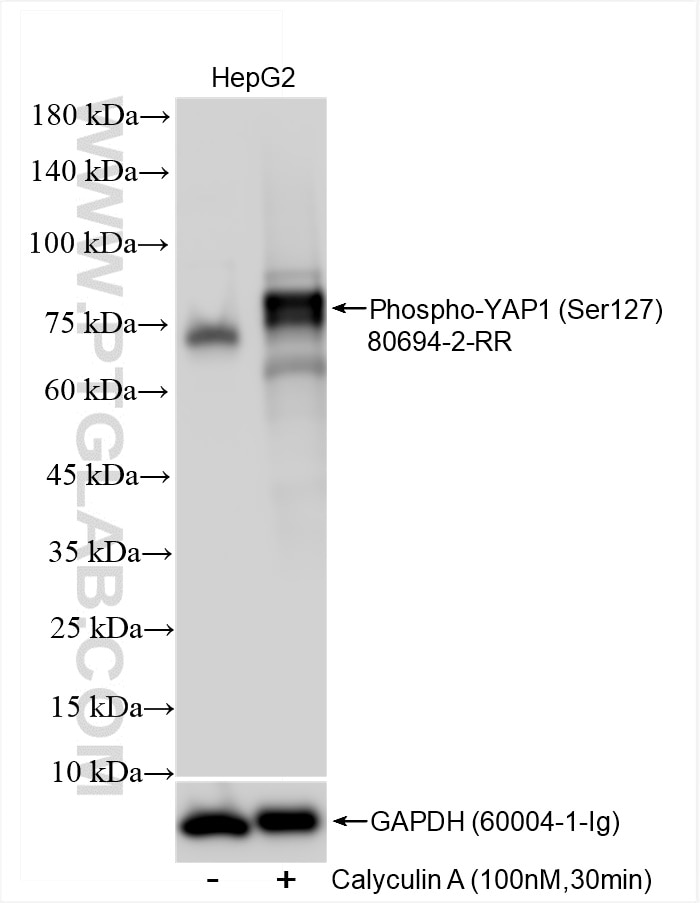
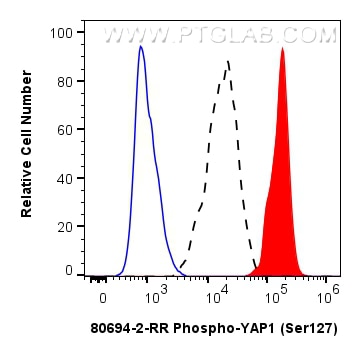

Tested Applications
| Positive WB detected in | Calyculin A treated HepG2 cells |
| Positive FC (Intra) detected in | Calyculin A treated HepG2 cells |
Recommended dilution
| Application | Dilution |
|---|---|
| Western Blot (WB) | WB : 1:2000-1:16000 |
| Flow Cytometry (FC) (INTRA) | FC (INTRA) : 0.13 ug per 10^6 cells in a 100 µl suspension |
| It is recommended that this reagent should be titrated in each testing system to obtain optimal results. | |
| Sample-dependent, Check data in validation data gallery. | |
Product Information
80694-2-RR targets Phospho-YAP1 (Ser127) in WB, FC (Intra), ELISA applications and shows reactivity with human samples.
| Tested Reactivity | human |
| Cited Reactivity | human, mouse, rat |
| Host / Isotype | Rabbit / IgG |
| Class | Recombinant |
| Type | Antibody |
| Immunogen |
Peptide Predict reactive species |
| Full Name | Yes-associated protein 1, 65kDa |
| Calculated Molecular Weight | 504 aa, 54 kDa |
| Observed Molecular Weight | 70-78 kDa |
| GenBank Accession Number | BC038235 |
| Gene Symbol | YAP1 |
| Gene ID (NCBI) | 10413 |
| RRID | AB_3670484 |
| Conjugate | Unconjugated |
| Form | Liquid |
| Purification Method | Protein A purification |
| UNIPROT ID | P46937 |
| Storage Buffer | PBS with 0.02% sodium azide and 50% glycerol, pH 7.3. |
| Storage Conditions | Store at -20°C. Stable for one year after shipment. Aliquoting is unnecessary for -20oC storage. 20ul sizes contain 0.1% BSA. |
Background Information
The transcriptional factors Yes-associated protein 1 (YAP1) and PDZ-binding motif (TAZ) act as downstream effectors of the Hippo pathway, and their subcellular location and transcriptional activities are affected by multiple post-translational modifications (PTMs). After phosphorylation, YAP1/TAZ binds to the 14-3-3 protein, which induces cytoplasmic retention of YAP1/TAZ. Moreover, phosphorylated YAP1/TAZ is likely to undergo ubiquitination degradation that is dependent on the β-transducin repeat-containing E3 ubiquitin protein ligase complex. The phosphorylation of YAP at Ser127 promotes its cytoplasmic retention, whereas phosphorylation at Ser397 induces degradation. (PMID: 29682330, PMID: 26039999)
Protocols
| Product Specific Protocols | |
|---|---|
| WB protocol for Phospho-YAP1 (Ser127) antibody 80694-2-RR | Download protocol |
| Standard Protocols | |
|---|---|
| Click here to view our Standard Protocols |
Publications
What published studies show
80694-2-RR (anti-YAP1) has 15 citations across journals including Advanced Science, Cell Death & Disease, Cell & Molecular Life Sciences, International Journal of Biological Macromolecules, Journal of Cellular and Molecular Medicine, Investigative Ophthalmology & Visual Science, Biological Direct, Journal of Cerebral Blood Flow & Metabolism, Colloids and Surfaces B, International Journal of Biological Sciences, and bioRxiv. Research fields span hepatocellular carcinoma, pulmonary fibrosis, retinal degeneration, intervertebral disc degeneration, cancer metastasis, ferroptosis, gastric cancer, breast cancer, and osteoporosis.
| Species | Application | Title |
|---|---|---|
Adv Sci (Weinh) Elevated TRIM25 Impairs Poly (ADP-ribose) Metabolism via PARG Degradation and Mediates Compression-Induced Intervertebral Disc Degeneration. | ||
Adv Sci (Weinh) Identification of PKN2 and MOB4 as Coordinators of Collective Cell Migration. | ||
Cell Death Dis O-GlcNAcylation of YAP1 promotes lung transplant ischemia-reperfusion injury via binding to HIF1α transcription factor and activating autophagy and mitophagy. | ||
Int J Biol Macromol Laminin β1 stimulates the Hippo-YAP1 pathway to advance the progression and lenvatinib resistance in hepatocellular carcinoma. | ||
Cell Mol Life Sci SYISL promotes pulmonary epithelial-mesenchymal transition and fibrosis through DSP-Hippo/YAP pathway. | ||
Colloids Surf B Biointerfaces Decellularized human amniotic member hydrogel promotes limbal stem cells proliferation |
Reviews
What customers say
The product received a 5-star rating for its use in Western Blot at a 1:5000 dilution on human mammary epithelial cells. The reviewer reported clear and well-defined bands, indicating strong performance and specificity for the target in WB applications.
The reviews below have been submitted by verified Proteintech customers who received an incentive for providing their feedback.
Li (Verified Customer) (10-08-2026) | Western blot. bands look well.
|



