

Tested Applications
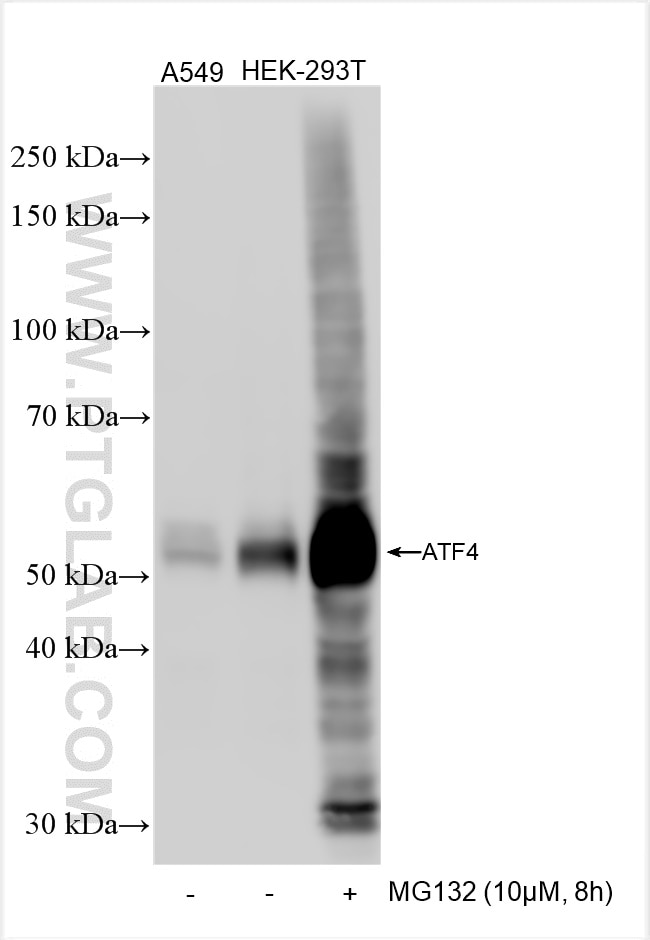
| Positive WB detected in | A549 cells, HEK-293T cells |
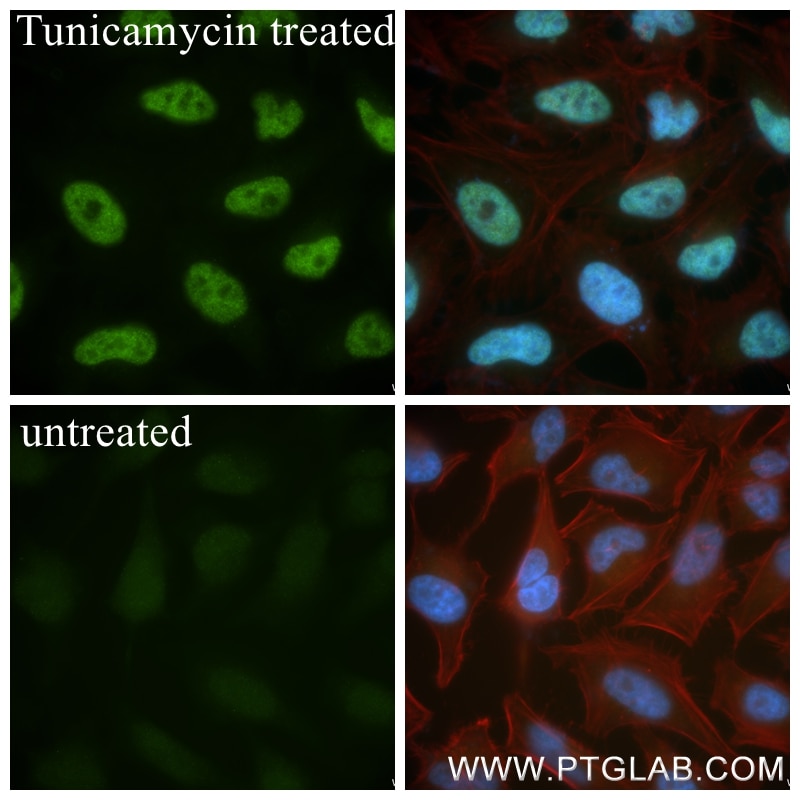
| Positive IF/ICC detected in | Tunicamycin treated HeLa cells |
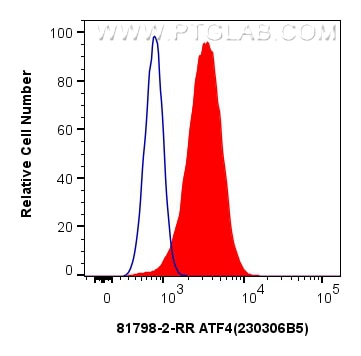
| Positive FC (Intra) detected in | HEK-293 cells |
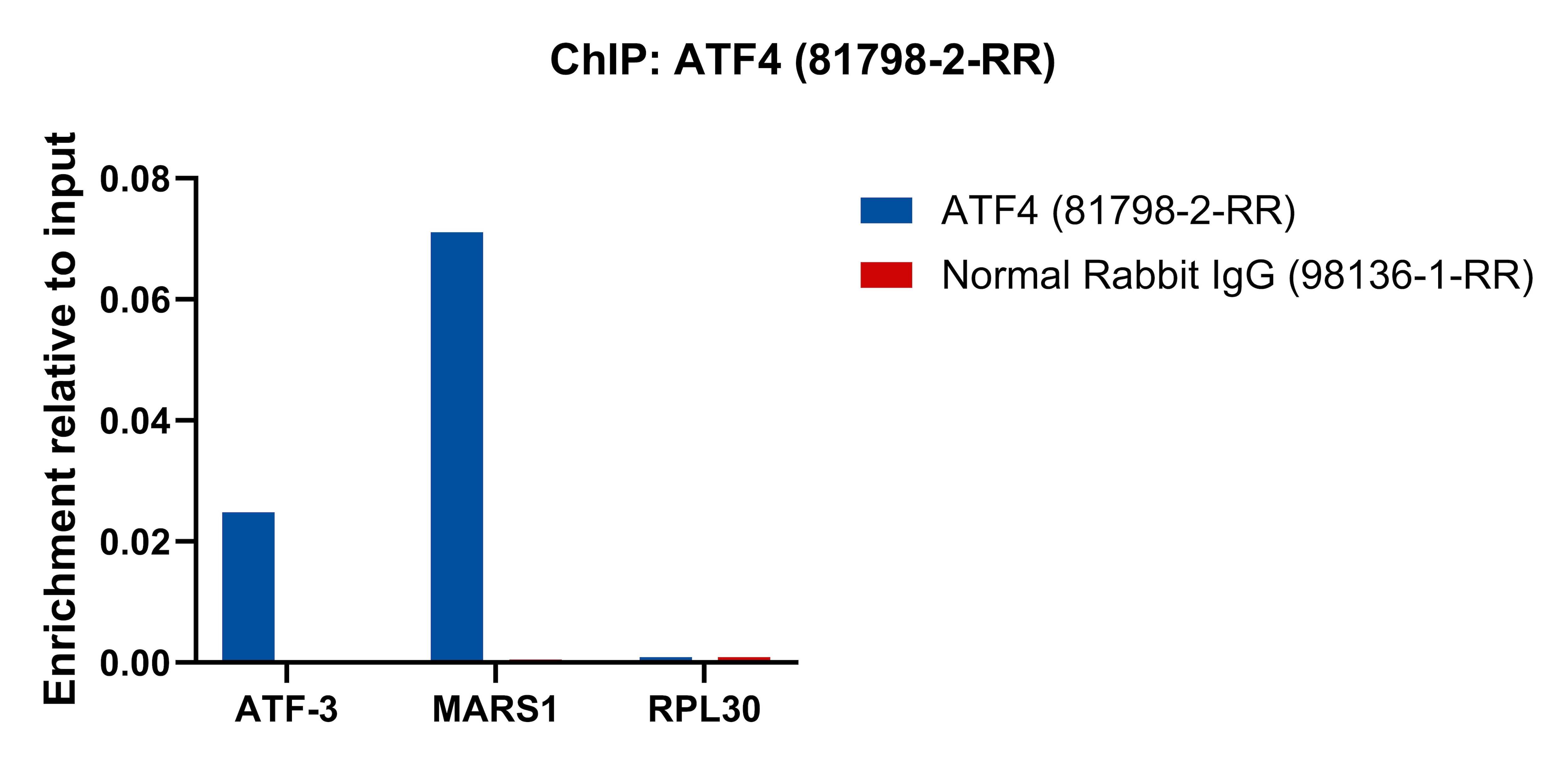
| Positive ChIP-qPCR detected in | Tunicamycin-NIH/3T3 (2ug/ml, overnight) NIH/3T3 cells |
Recommended dilution
| Application | Dilution |
|---|---|
| Western Blot (WB) | WB : 1:1000-1:8000 |
| Immunofluorescence (IF)/ICC | IF/ICC : 1:200-1:800 |
| Flow Cytometry (FC) (INTRA) | FC (INTRA) : 0.25 ug per 10^6 cells in a 100 µl suspension |
| CHIP-QPCR | CHIP-QPCR : 1:10-1:100 |
| It is recommended that this reagent should be titrated in each testing system to obtain optimal results. | |
| Sample-dependent, Check data in validation data gallery. | |
Product Information
81798-2-RR targets ATF4 in WB, IF/ICC, FC (Intra), ELISA, ChIP-qPCR applications and shows reactivity with human, mouse samples.
| Tested Reactivity | human, mouse |
| Cited Reactivity | human, mouse |
| Host / Isotype | Rabbit / IgG |
| Class | Recombinant |
| Type | Antibody |
| Immunogen |
CatNo: Ag1279 Product name: Recombinant human ATF4 protein Source: e coli.-derived, PGEX-4T Tag: GST Domain: 1-351 aa of BC022088 Sequence: MTEMSFLSSEVLVGDLMSPFDQSGLGAEESLGLLDDYLEVAKHFKPHGFSSDKAKAGSSEWLAVDGLVSPSNNSKEDAFSGTDWMLEKMDLKEFDLDALLGIDDLETMPDDLLTTLDDTCDLFAPLVQETNKQPPQTVNPIGHLPESLTKPDQVAPFTFLQPLPLSPGVLSSTPDHSFSLELGSEVDITEGDRKPDYTAYVAMIPQCIKEEDTPSDNDSGICMSPESYLGSPQHSPSTRGSPNRSLPSPGVLCGSARPKPYDPPGEKMVAAKVKGEKLDKKLKKMEQNKTAATRYRQKKRAEQEALTGECKELEKKNEALKERADSLAKEIQYLKDLIEEVRKARGKKRVP Predict reactive species |
| Full Name | activating transcription factor 4 (tax-responsive enhancer element B67) |
| Calculated Molecular Weight | 39 kDa |
| Observed Molecular Weight | 45-50 kDa |
| GenBank Accession Number | BC022088 |
| Gene Symbol | ATF4 |
| Gene ID (NCBI) | 468 |
| RRID | AB_3670506 |
| Conjugate | Unconjugated |
| Form | Liquid |
| Purification Method | Protein A purification |
| UNIPROT ID | P18848 |
| Storage Buffer | PBS with 0.02% sodium azide and 50% glycerol, pH 7.3. |
| Storage Conditions | Store at -20°C. Stable for one year after shipment. Aliquoting is unnecessary for -20oC storage. 20ul sizes contain 0.1% BSA. |
Background Information
ATF4 is a transcription factor, that accumulates predominantly in osteoblasts, where it regulates terminal osteoblast differentiation and bone formation. As a basic leucine-zipper (bZip) transcription factor, ATF4 can regulate amino acid metabolism, cellular redox state, and anti-stress responses. It also regulates age-related and diet-induced obesity and glucose homeostasis in mammals, and has conserved metabolic functions in flies. Due to its location at chromosome 22q13, a region linked to schizophrenia, ATF4 is considered as a positional candidate gene for schizophrenia. Otherwise, since ATF4 is induced by tumour microenvironmental factors, and regulates processes relevant to cancer progression, it might serve as a potential therapeutic target in cancer.
Protocols
| Product Specific Protocols | |
|---|---|
| FC protocol for ATF4 antibody 81798-2-RR | Download protocol |
| IF protocol for ATF4 antibody 81798-2-RR | Download protocol |
| WB protocol for ATF4 antibody 81798-2-RR | Download protocol |
| Standard Protocols | |
|---|---|
| Click here to view our Standard Protocols |
Publications
What published studies show
The ATF4 Recombinant monoclonal antibody (catalog no. 81798-2-RR) has 2 citations. They appear in Nature Communications (tumor metabolic adaptation and PARP1/2 vulnerability in B-cell lymphomas) and Journal of Photochemistry and Photobiology B (ROS-mediated apoptosis via mitochondrial complex I inhibition in acute myeloid leukemia). The research fields span oncology, metabolic adaptation, and apoptosis, with applications in WB for both human and mouse samples.
| Species | Application | Title |
|---|---|---|
Nat Commun Tumor metabolic adaptation induced by L-asparaginase reveals a vulnerability to PARP1/2 inhibitor in B-cell lymphomas. | ||
J Photochem Photobiol B Ultraviolet-treated riboflavin induces ROS-mediated apoptosis via inhibiting mitochondrial complex I in acute myeloid leukemia. |






