
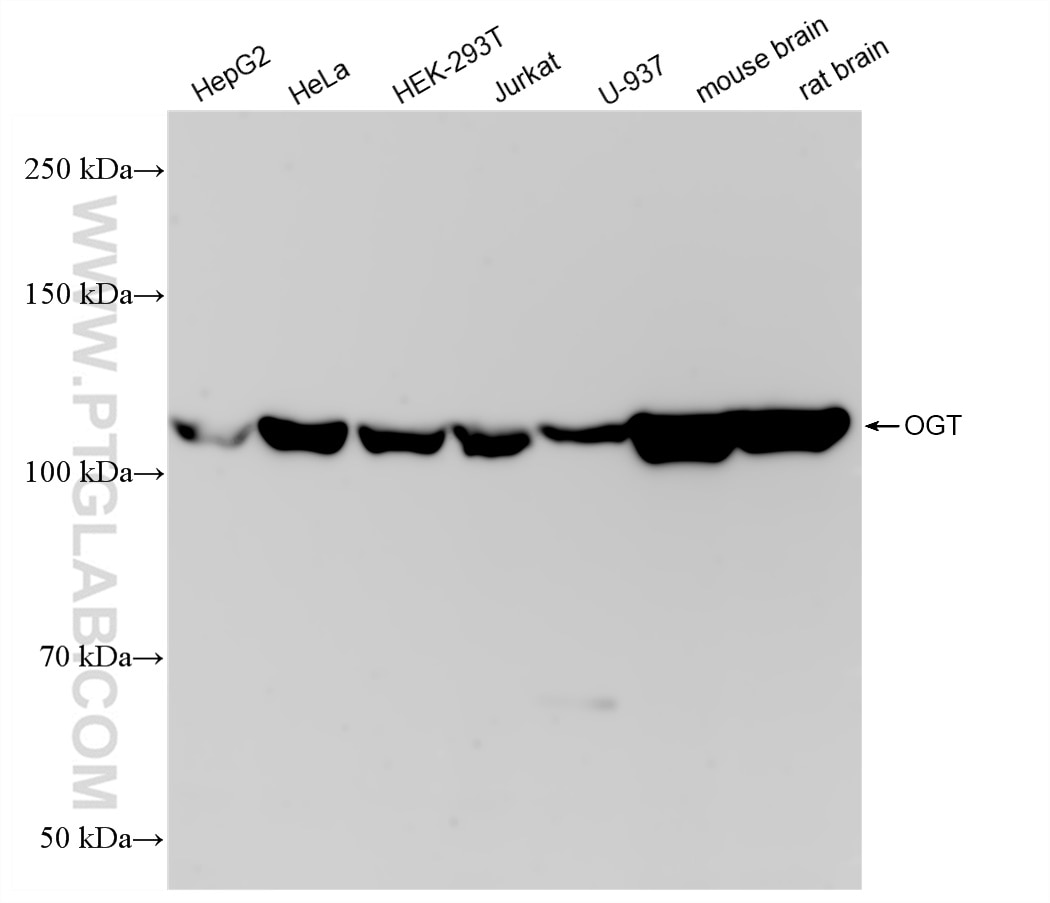
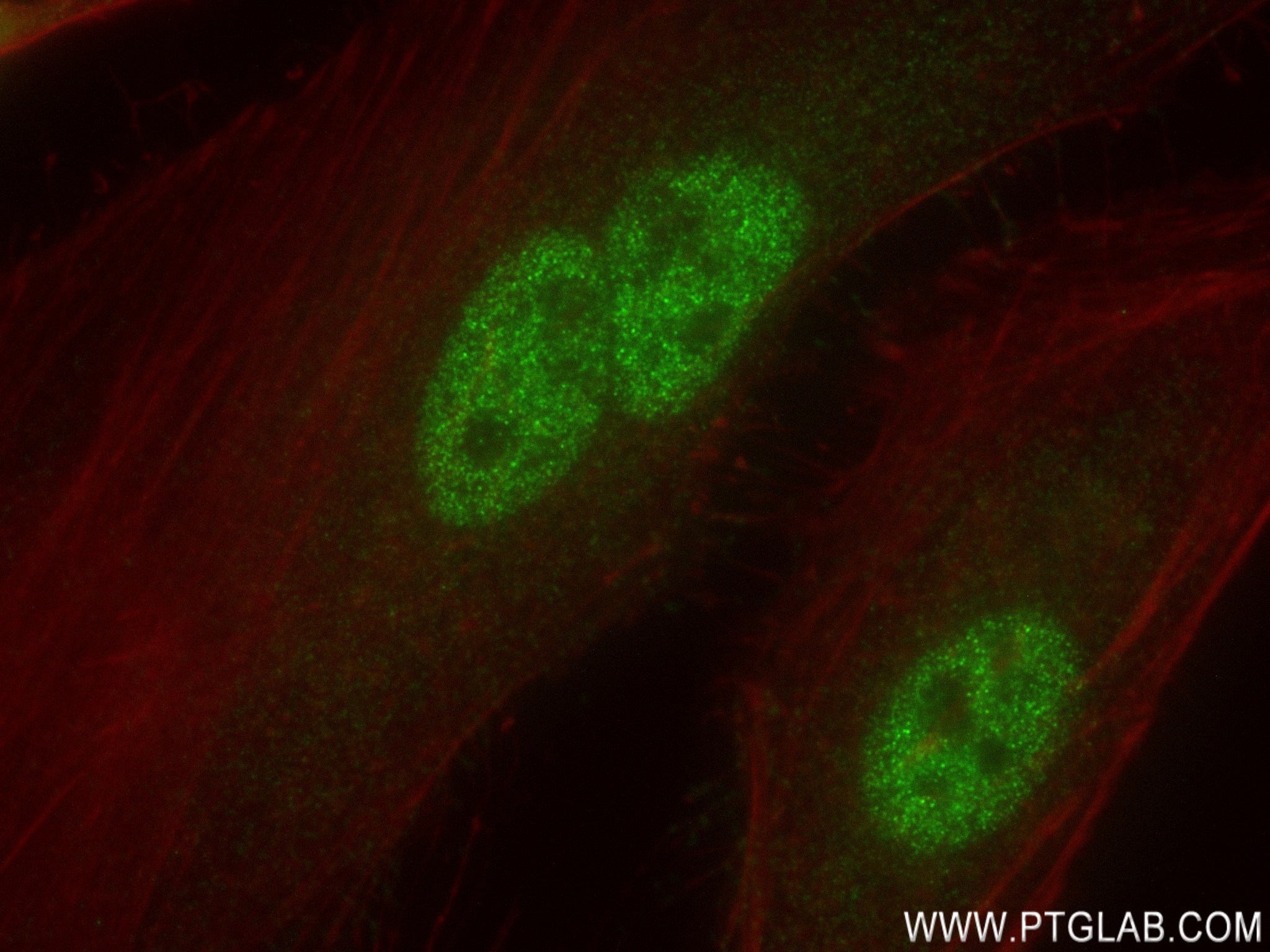
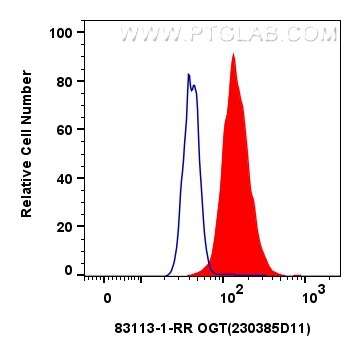
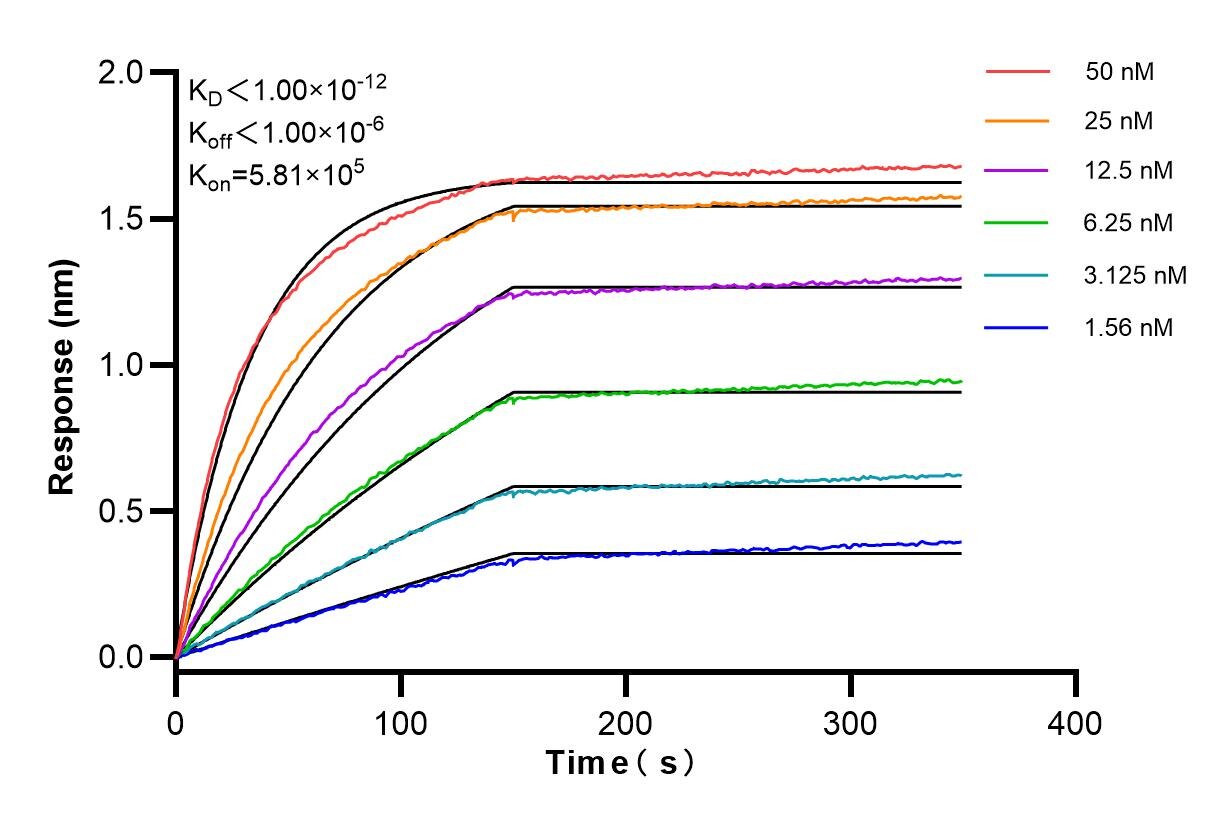

Tested Applications
| Positive WB detected in | HepG2 cells, HeLa cells, HEK-293T cells, Jurkat cells, U-937 cells, mouse brain tissue, rat brain tissue |
| Positive IF/ICC detected in | HeLa cells |
| Positive FC (Intra) detected in | HeLa cells |
Recommended dilution
| Application | Dilution |
|---|---|
| Western Blot (WB) | WB : 1:2000-1:10000 |
| Immunofluorescence (IF)/ICC | IF/ICC : 1:125-1:500 |
| Flow Cytometry (FC) (INTRA) | FC (INTRA) : 0.20 ug per 10^6 cells in a 100 µl suspension |
| It is recommended that this reagent should be titrated in each testing system to obtain optimal results. | |
| Sample-dependent, Check data in validation data gallery. | |
Product Information
83113-1-RR targets OGT in WB, IF/ICC, FC (Intra), CoIP, ELISA applications and shows reactivity with human, mouse, rat samples.
| Tested Reactivity | human, mouse, rat |
| Host / Isotype | Rabbit / IgG |
| Class | Recombinant |
| Type | Antibody |
| Immunogen |
CatNo: Ag2160 Product name: Recombinant human OGT protein Source: e coli.-derived, PGEX-4T Tag: GST Domain: 1-400 aa of BC014434 Sequence: MASSVGNVADSTGLAELAHREYQAGDFEAAERHCMQLWRQEPDNTGVLLLLSSIHFQCRRLDRSAHFSTLAIKQNPLLAEAYSNLGNVYKERGQLQEAIEHYRHALRLKPDFIDGYINLAAALVAAGDMEGAVQAYVSALQYNPDLYCVRSDLGNLLKALGRLEEAKACYLKAIETQPNFAVAWSNLGCVFNAQGEIWLAIHHFEKAVTLDPNFLDAYINLGNVLKEARIFDRAVAAYLRALSLSPNHAVVHGNLACVYYEQGLIDLAIDTYRRAIELQPHFPDAYCNLANALKEKGSVAEAEDCYNTALRLCPTHADSLNNLANIKREQGNIEEAVRLYRKALEVFPEFAAAHSNLASVLQQQGKLQEALMHYKEAIRISPTFADAYSNMGNTLKEMQD Predict reactive species |
| Full Name | O-linked N-acetylglucosamine (GlcNAc) transferase (UDP-N-acetylglucosamine:polypeptide-N-acetylglucosaminyl transferase) |
| Calculated Molecular Weight | 1046 aa, 117 kDa |
| Observed Molecular Weight | 110 kDa |
| GenBank Accession Number | BC014434 |
| Gene Symbol | OGT |
| Gene ID (NCBI) | 8473 |
| RRID | AB_3670825 |
| Conjugate | Unconjugated |
| Form | Liquid |
| Purification Method | Protein A purification |
| UNIPROT ID | O15294 |
| Storage Buffer | PBS with 0.02% sodium azide and 50% glycerol, pH 7.3. |
| Storage Conditions | Store at -20°C. Stable for one year after shipment. Aliquoting is unnecessary for -20oC storage. 20ul sizes contain 0.1% BSA. |
Background Information
O-linked N-acetylglucosamine transferase (OGT) catalyzes the attachment of N-acetylglucosamine (GlcNAc) monosaccharides to the hydroxyl group of serine or threonine residues of numerous nuclear and cytoplasmic proteins and may play important roles in a large number of diverse intracellular processes ranging from translational control, transcription, transcriptional repression, INS resistance and regulation of the cell cycle. It exists as a heterotrimeric complex with two 110 kDa and one 70 kDa subunits. Recent studies have shown that O-GlcNAcylation plays essential roles in cancer formation and progression. O-GlcNAcylation as well as OGT expression was found to be significantly elevated in the cancer tissues.
Protocols
| Product Specific Protocols | |
|---|---|
| FC protocol for OGT antibody 83113-1-RR | Download protocol |
| IF protocol for OGT antibody 83113-1-RR | Download protocol |
| WB protocol for OGT antibody 83113-1-RR | Download protocol |
| Standard Protocols | |
|---|---|
| Click here to view our Standard Protocols |
Publications
What published studies show
The OGT Recombinant monoclonal antibody (230385D11), catalog number 83113-1-RR, has 1 total citation. It appears in Neuroscience Bulletin (Impact Factor 6.8), published in May 2025. The cited study investigated OGT-mediated O-GlcNAcylation of ATF2 in protecting against sepsis-associated encephalopathy by inhibiting microglial pyroptosis. The research field encompasses neuroscience, neuroinflammation, and sepsis pathophysiology. The antibody was used for WB and CoIP applications in this publication.
| Species | Application | Title |
|---|---|---|
Neurosci Bull OGT-Mediated O-GlcNAcylation of ATF2 Protects Against Sepsis-Associated Encephalopathy by Inhibiting Microglial Pyroptosis
|





