

Tested Applications
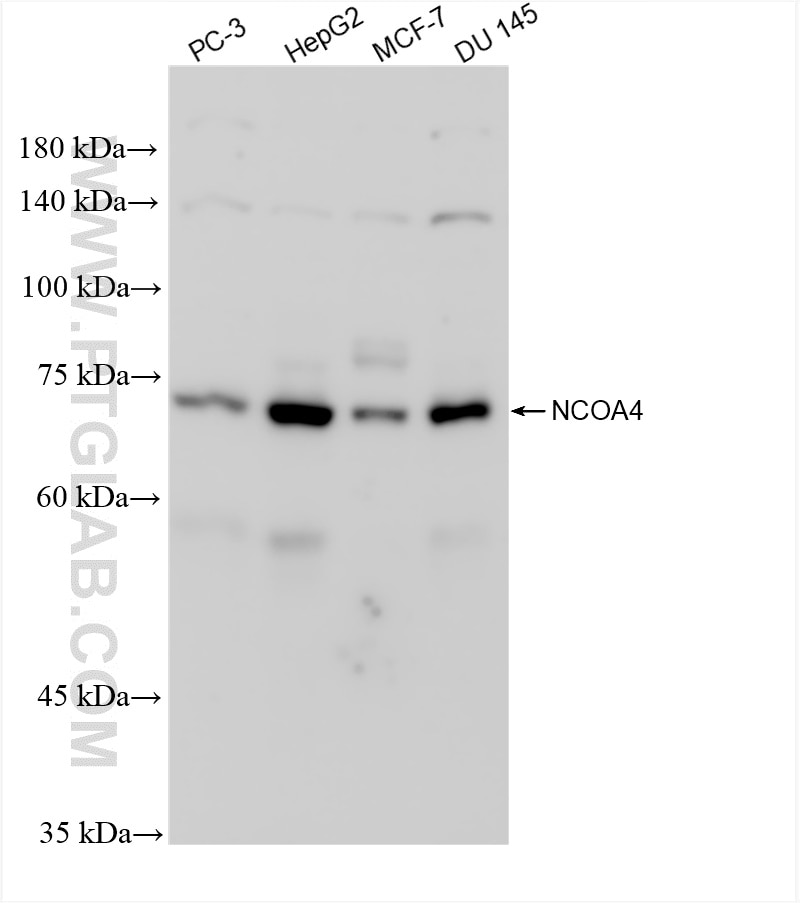
| Positive WB detected in | PC-3 cells, HepG2 cells, MCF-7 cells, DU 145 cells |
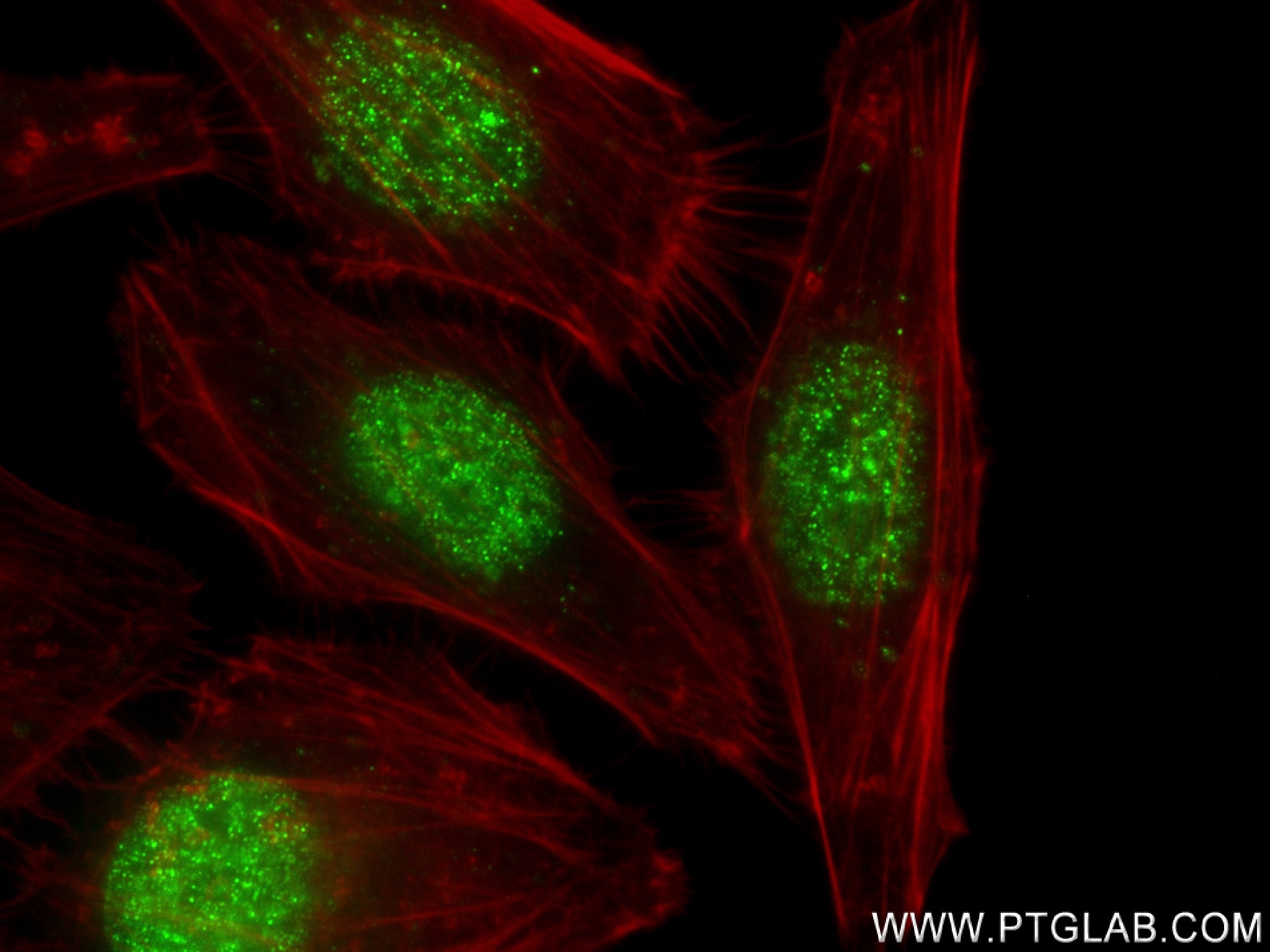
| Positive IF/ICC detected in | HepG2 cells |
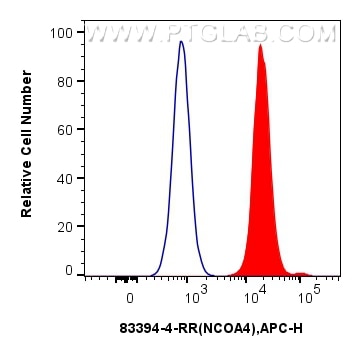
| Positive FC (Intra) detected in | HeLa cells |
Recommended dilution
| Application | Dilution |
|---|---|
| Western Blot (WB) | WB : 1:2000-1:10000 |
| Immunofluorescence (IF)/ICC | IF/ICC : 1:150-1:600 |
| Flow Cytometry (FC) (INTRA) | FC (INTRA) : 0.25 ug per 10^6 cells in a 100 ul suspension |
| It is recommended that this reagent should be titrated in each testing system to obtain optimal results. | |
| Sample-dependent, Check data in validation data gallery. | |
Product Information
83394-4-RR targets NCOA4 in WB, IHC, IF/ICC, FC (Intra), CoIP, ELISA applications and shows reactivity with human samples.
| Tested Reactivity | human |
| Cited Reactivity | human, bovine, sheep, duck |
| Host / Isotype | Rabbit / IgG |
| Class | Recombinant |
| Type | Antibody |
| Immunogen |
CatNo: Ag15277 Product name: Recombinant human NCOA4 protein Source: e coli.-derived, PET28a Tag: 6*His Domain: 1-400 aa of BC012736 Sequence: MNTFQDQSGSSSNREPLLRCSDARRDLELAIGGVLRAEQQIKDNLREVKAQIHSCISRHLECLRSREVWLYEQVDLIYQLKEETLQQQAQQLYSLLGQFNCLTHQLECTQNKDLANQVSVCLERLGSLTLKPEDSTVLLFEADTITLRQTITTFGSLKTIQIPEHLMAHASSANIGPFLEKRGCISMPEQKSASGIVAVPFSEWLLGSKPASGYQAPYIPSTDPQDWLTQKQTLENSQTSSRACNFFNNVGGNLKGLENWLLKSEKSSYQKCNSHSTTSSFSIEMEKVGDQELPDQDEMDLSDWLVTPQESHKLRKPENGSRETSEKFKLLFQSYNVNDWLVKTDSCTNCQGNQPKGVEIENLGNLKCLNDHLEAKKPLSTPSMVTEDWLVQNHQDPCKV Predict reactive species |
| Full Name | nuclear receptor coactivator 4 |
| Calculated Molecular Weight | 70 kDa |
| Observed Molecular Weight | 70-73 kDa |
| GenBank Accession Number | BC012736 |
| Gene Symbol | NCOA4 |
| Gene ID (NCBI) | 8031 |
| RRID | AB_3671047 |
| Conjugate | Unconjugated |
| Form | Liquid |
| Purification Method | Protein A purification |
| UNIPROT ID | Q13772 |
| Storage Buffer | PBS with 0.02% sodium azide and 50% glycerol, pH 7.3. |
| Storage Conditions | Store at -20°C. Stable for one year after shipment. Aliquoting is unnecessary for -20oC storage. 20ul sizes contain 0.1% BSA. |
Background Information
Nuclear receptor coactivator 4 (NCOA4) also named androgen receptor (AR) coactivator ARA70, RFG and ELE1, is a putative co-activator that specifically enhances the activity of the androgen receptor. In human thyroid carcinomas, the Ret proto-oncogene fuses to ARA70 to form Ret/PTC3 by an intrachromosomal inversion of chromosome 10 in vivo. ARA70a can function as a ligand-enhanced co-activator of PPARg in adipocytes. However, PPARg-ARA70 transactivation can be squelched by AR, which suggests cross talk between PPARg- and AR-mediated response. ARA70a has no intrinsic transcription activation domain or histone acetyltransferase activity, but it interacts with histone acetyltransferase, p/CAF, CBP and p300/CBP-associated factors, and the basal transcription factor TFIIB. The interaction between ARA70 and AR occurs through the ligand-binding domain. The presence of ARA70 can enhance the androgenic activity of 17-b Estradiol (E2) and antiandrogens toward AR. ARA70 may be involved in prostate carcinogenesis and ovarian cancer and may serve as a key mediator of estrogen-androgen synergism.
Protocols
| Product Specific Protocols | |
|---|---|
| FC protocol for NCOA4 antibody 83394-4-RR | Download protocol |
| IF protocol for NCOA4 antibody 83394-4-RR | Download protocol |
| WB protocol for NCOA4 antibody 83394-4-RR | Download protocol |
| Standard Protocols | |
|---|---|
| Click here to view our Standard Protocols |
Publications
What published studies show
The NCOA4 Recombinant monoclonal antibody (catalog 83394-4-RR) has 32 citations. These appear in journals including the Journal of Advanced Research, Redox Biology, Advanced Science, Autophagy, Cell Death & Disease, Phytomedicine, Free Radical Biology & Medicine, British Journal of Pharmacology, Scientific Reports, Frontiers in Immunology, Cell Signal, Journal of Dairy Science, and iScience. Research fields span ferroptosis and ferritinophagy mechanisms, cancer biology (lung, breast, colorectal, osteosarcoma, hepatocellular carcinoma), cardiovascular and liver injury, neurotoxicity, diabetic wound healing, immunology, and toxicology. Applications across studies predominantly involve Western blot, with some immunofluorescence, immunoprecipitation, and IHC applications across multiple species.
| Species | Application | Title |
|---|---|---|
J Adv Res Bio-inspired supramolecular hydrogel inhibits ferroptosis to accelerate diabetic wound healing. | ||
Redox Biol Quercetin alleviates LPS/iE-DAP-induced liver injury by suppressing ferroptosis via regulating ferritinophagy and intracellular iron efflux
| ||
J Nanobiotechnology Functional ferritin-mimetic iron homeostasis nanoregulator to suppress ferroptosis and promote angiogenesis as a new therapeutic strategy for diabetic wound healing. | ||
Adv Sci (Weinh) BZW1 Drives Immune Evasion in Lung Adenocarcinoma via Ferroptosis Suppression | ||
Phytomedicine Quercetagitrin targets EIF3D to activate NCOA4-mediated ferritinophagy-dependent ferroptosis for the treatment of non-small cell lung cancer. |





