
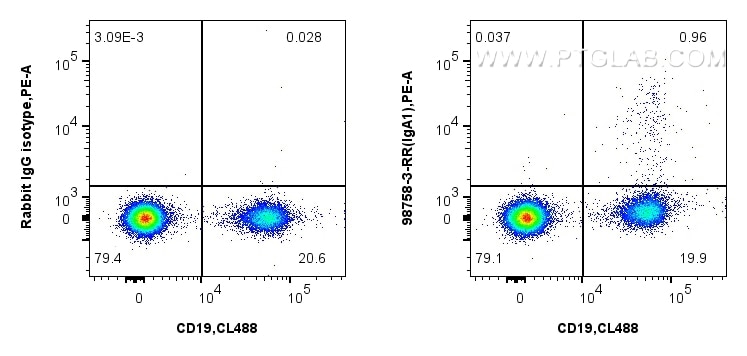
Tested Applications
| Positive FC detected in | human PBMCs |
Recommended dilution
| Application | Dilution |
|---|---|
| Flow Cytometry (FC) | FC : 0.25 ug per 10^6 cells in a 100 µl suspension |
| This reagent has been tested for flow cytometric analysis. It is recommended that this reagent should be titrated in each testing system to obtain optimal results. | |
| Sample-dependent, Check data in validation data gallery. | |
Product Information
98758-3-RR targets IgA1 in FC applications and shows reactivity with human samples.
| Tested Reactivity | human |
| Host / Isotype | Rabbit / IgG |
| Class | Recombinant |
| Type | Antibody |
| Immunogen |
CatNo: Eg9190 Product name: Recombinant human IgA1-IgK protein Source: mammalian cells-derived, pHZ-KIsec-C-6*HIS Tag: C-6*HIS Sequence: \ Predict reactive species |
| Full Name | immunoglobulin heavy constant alpha 1 |
| Gene Symbol | Human IgA Heavy Chain |
| Gene ID (NCBI) | 3493 |
| RRID | AB_3746325 |
| Conjugate | Unconjugated |
| Form | Liquid |
| Purification Method | Protein A purification |
| Storage Buffer | PBS with 0.09% sodium azide, pH 7.3. |
| Storage Conditions | Store at 2 - 8°C. Stable for one year after shipment. |
Background Information
Immunoglobulins (Ig), also known as antibodies, are glycoproteins produced by B cells and plasma cells. There are 5 main classes of mammalian immunoglobulin heavy chains. Each class defines the IgM, IgG, IgA, IgD, and IgE isotypes (PMID: 20176268). IgA is the most prevalent antibody class at mucosal sites with an important role in mucosal defense. There are 2 subclasses of IgA, IgA1 and IgA2, which differ over a stretch of 18 amino acids in their hinge region, with the hinge of IgA1 being 13 amino acids longer than that of IgA2 (PMID: 21691145). This antibody specifically recognizes human IgA1 and does not cross-react with IgA2.
Protocols
| Product Specific Protocols | |
|---|---|
| FC protocol for IgA1 antibody 98758-3-RR | Download protocol |
| Standard Protocols | |
|---|---|
| Click here to view our Standard Protocols |


