
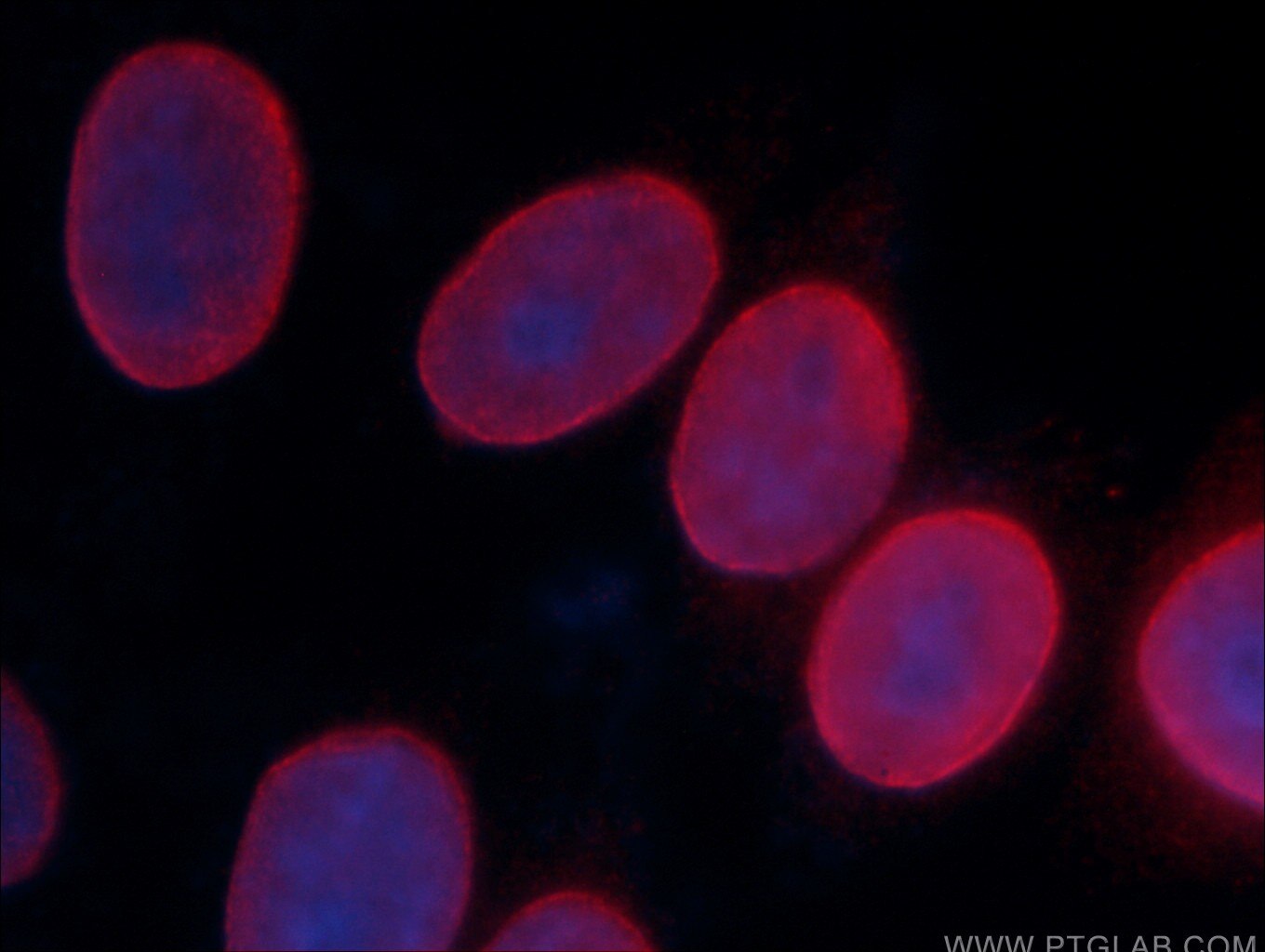
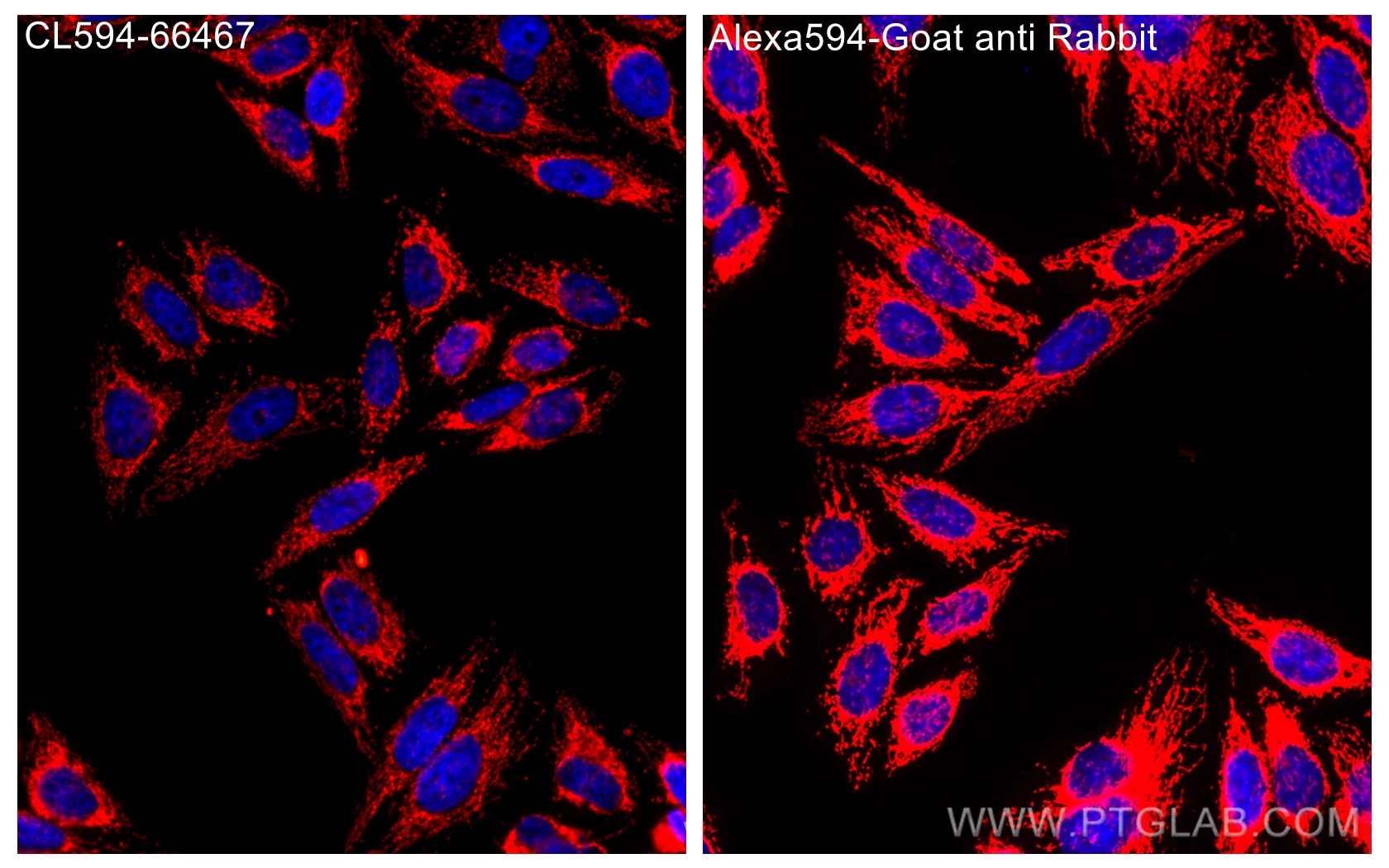

Tested Applications
| Positive IF/ICC detected in | HeLa cells, HepG2 cells |
Recommended dilution
| Application | Dilution |
|---|---|
| Immunofluorescence (IF)/ICC | IF/ICC : 1:200-1:800 |
| It is recommended that this reagent should be titrated in each testing system to obtain optimal results. | |
| Sample-dependent, Check data in validation data gallery. | |
Product Information
CL594-66467 targets Heavy chain of Rabbit IgG in IF/ICC applications and shows reactivity with rabbit samples.
| Tested Reactivity | rabbit |
| Host / Isotype | Mouse / IgG1 |
| Class | Monoclonal |
| Type | Antibody |
| Immunogen |
Protein Predict reactive species |
| Full Name | Heavy chain of Rabbit IgG |
| Gene Symbol | |
| Gene ID (NCBI) | |
| RRID | AB_2883585 |
| Conjugate | CoraLite®594 Fluorescent Dye |
| Excitation/Emission Maxima Wavelengths | 588 nm / 604 nm |
| Excitation Laser | Yellow-Green Laser (561 nm) |
| Form | Liquid |
| Purification Method | Protein G purification |
| UNIPROT ID | N/A |
| Storage Buffer | PBS with 50% glycerol, 0.05% Proclin300, 0.5% BSA, pH 7.3. |
| Storage Conditions | Store at -20°C. Avoid exposure to light. Stable for one year after shipment. Aliquoting is unnecessary for -20oC storage. |
Background Information
This antibody specifically recognizes the heavy chain of Rabbit IgG. It can't detect the The heavy chain of other species. This antibody can be used as the secondary antibody which is specific to the heavy chain of Rabbit IgG. This anitbody is CL594(Ex/Em 593 nm/614 nm) conjugated.
Protocols
| Product Specific Protocols | |
|---|---|
| IF protocol for CL594 Heavy chain of Rabbit IgG antibody CL594-66467 | Download protocol |
| Standard Protocols | |
|---|---|
| Click here to view our Standard Protocols |
Publications
What published studies show
Heavy chain of Rabbit IgG Monoclonal antibody (1C9A5), catalog number CL594-66467, has 11 citations. These appear in journals including Signal Transduction and Targeted Therapy, Nucleic Acids Research, Small, ACS Applied Materials & Interfaces, Ecotoxicology and Environmental Safety, Hepatology Communications, Molecular Neurobiology, FASEB Journal, Journal of Cellular Physiology, and Frontiers in Medicine. Associated research fields span virology, meiosis, nanomedicine, tumor therapy, toxicology, hepatology, neuroscience, renal fibrosis, and gastroenterology.
| Species | Application | Title |
|---|---|---|
Signal Transduct Target Ther A dual-role of SARS-CoV-2 nucleocapsid protein in regulating innate immune response. | ||
Nucleic Acids Res MEIOK21: a new component of meiotic recombination bridges required for spermatogenesis. | ||
Small Microbial Lipopeptide Supramolecular Self-Assemblies as a Methuosis-Like Cell Death Inducer with In Vivo Antitumor Activity. | ||
ACS Appl Mater Interfaces Lipid-Polymer Hybrid Nanoparticles with Both PD-L1 Knockdown and Mild Photothermal Effect for Tumor Photothermal Immunotherapy | ||
Ecotoxicol Environ Saf Prenatal di-(2-ethylhexyl) phthalate exposure induced myocardial cytotoxicity via the regulation of the NRG1-dependent ErbB2/ErbB4-PI3K/AKT signaling pathway in fetal mice. | ||
Hepatol Commun TATA-box-binding protein promotes hepatocellular carcinoma metastasis through epithelial-mesenchymal transition |



