
Recombinant Mouse PLA2G7/PAFAH protein (rFc Tag)
Species
Mouse
Purity
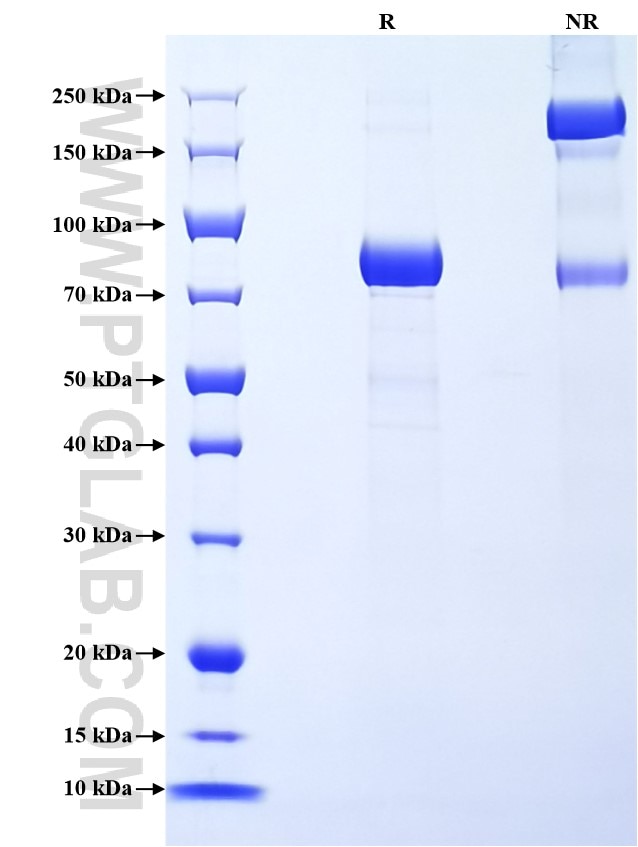
>90 %, SDS-PAGE
Tag
rFc Tag
Activity
not tested
Cat no : Eg2686
Validation Data Gallery
Product Information
| Purity | >90 %, SDS-PAGE |
| Endotoxin | <0.1 EU/μg protein, LAL method |
| Activity |
Not tested |
| Expression | HEK293-derived Mouse PLA2G7 protein Phe22-Asn440 (Accession# Q60963) with a rabbit IgG Fc tag at the C-terminus. |
| GeneID | 27226 |
| Accession | Q60963 |
| PredictedSize | 72.9 kDa |
| SDS-PAGE | 75-85 kDa, reducing (R) conditions |
| Formulation | Lyophilized from 0.22 μm filtered solution in PBS, pH 7.4. Normally 5% trehalose and 5% mannitol are added as protectants before lyophilization. |
| Reconstitution | Briefly centrifuge the tube before opening. Reconstitute at 0.1-0.5 mg/mL in sterile water. |
| Storage Conditions |
It is recommended that the protein be aliquoted for optimal storage. Avoid repeated freeze-thaw cycles.
|
| Shipping | The product is shipped at ambient temperature. Upon receipt, store it immediately at the recommended temperature. |
Background
PAFAH(platelet-activating factor acetylhydrolase, plasma) is also named as PLA2G7(phospholipase A2, group VII), Lp-PLA2 (Lipoprotein-associated phospholipase A2), LDL-PLA2, LDL-PLA and belongs to the AB hydrolase superfamily and lipase family. It is an enzyme which catalyzes the hydrolysis of acetyl ester at the sn-2 position of PAF. The family of PAF-Ahs consists of two intracellular isoforms (Ib and II), and one secreted isoform (plasma). Plasma PAF-AH is a monomeric polypeptide with a molecular weight of 45 kDa and it can show broad bands with a molecular weight of 43-67 kDa that it can be extensively N-glycosylated(PMID:12547653). Defects in PLA2G7 are the cause of platelet-activating factor acetylhydrolase deficiency (PAFAD), susceptibility to asthma (ASTHMA), susceptibility to atopic hypersensitivity (ATOPY).
References:
1. Karasawa K. et al. (2003). Prog Lipid Res. 42(2):93-114.