
Recombinant Human PTH1R protein (rFc Tag)
Species
Human
Purity
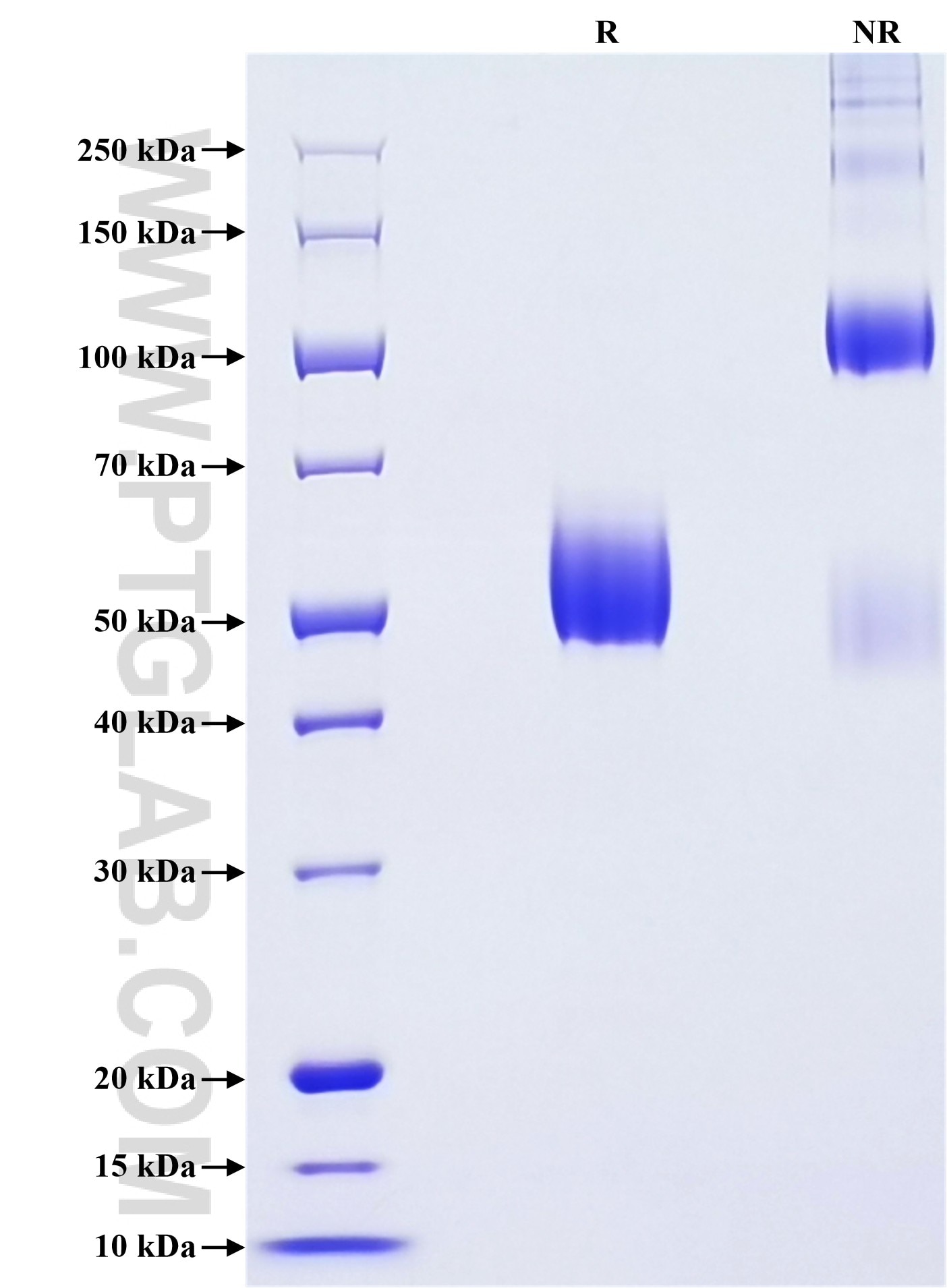
>90 %, SDS-PAGE
Tag
rFc Tag
Activity
not tested
Cat no : Eg6501
Validation Data Gallery
Product Information
| Purity | >90 %, SDS-PAGE |
| Endotoxin | <0.1 EU/μg protein, LAL method |
| Activity |
Not tested |
| Expression | HEK293-derived Human PTH1R protein Asp27-Gly188 (Accession# Q03431) with a rabbit IgG Fc tag at the C-terminus. |
| GeneID | 5745 |
| Accession | Q03431 |
| PredictedSize | 44.2 kDa |
| SDS-PAGE | 47-65 kDa, reducing (R) conditions |
| Formulation | Lyophilized from 0.22 μm filtered solution in PBS, pH 7.4. Normally 5% trehalose and 5% mannitol are added as protectants before lyophilization. |
| Reconstitution | Briefly centrifuge the tube before opening. Reconstitute at 0.1-0.5 mg/mL in sterile water. |
| Storage Conditions |
It is recommended that the protein be aliquoted for optimal storage. Avoid repeated freeze-thaw cycles.
|
| Shipping | The product is shipped at ambient temperature. Upon receipt, store it immediately at the recommended temperature. |
Background
PTH1R (Parathyroid Hormone 1 Receptor) is a class B1 G protein-coupled receptor (GPCR) that serves as the principal mediator of calcium and phosphate homeostasis by responding to two endogenous peptide ligands—parathyroid hormone (PTH) and parathyroid hormone-related protein (PTHrP). Predominantly expressed in kidney, bone, and breast tissue, PTH1R activation triggers divergent intracellular signaling cascades, including the Gαs-adenylyl cyclase-cAMP-PKA pathway and the Gαq-PLC-PKC axis, thereby regulating renal calcium reabsorption, bone remodeling, and skeletal development. Germline mutations in PTH1R cause contrasting skeletal disorders: constitutively activating mutations lead to Jansen-type metaphyseal chondrodysplasia (hypercalcemia and short stature), while inactivating mutations result in Blomstrand lethal chondrodysplasia. In adult medicine, intermittent PTH1R activation by teriparatide or abaloparatide is exploited pharmacologically to promote bone formation in osteoporosis, underscoring the receptor's dual significance in both physiological mineral ion balance and clinical therapeutics.
References:
1.Alekos, Nathalie S et al. JCI insight vol. 8,6 (2023): e165604.
2.Culhane, Kelly J et al. ACS chemical biology vol. 13,8 (2018): 2347-2358.
3.Shimomura-Kuroki, Junko et al. Odontology vol. 105,2 (2017): 150-154.
4.Kim, Beomchang et al. Experimental and therapeutic medicine vol. 22,6 (2021): 1379.
5.Nampoothiri, Sheela et al. The Journal of clinical endocrinology and metabolism vol. 101,11 (2016): 4283-4289.