
Filter:

Able AI
What's the best dilution for CD20 in ?
Tested Applications
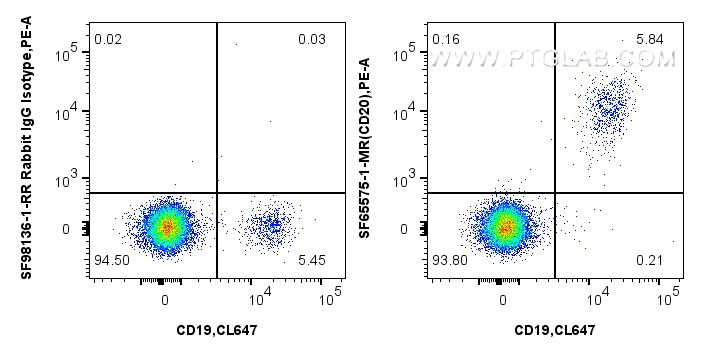
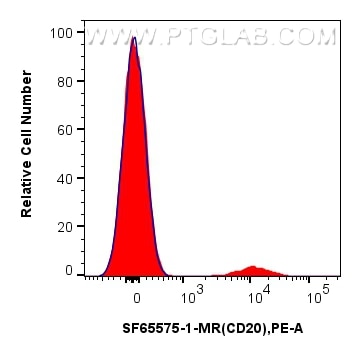
| Positive FC detected in | human PBMCs |
Recommended dilution
| Application | Dilution |
|---|---|
| Flow Cytometry (FC) | FC : 0.25 ug per 10^6 cells in a 100 µl suspension |
| It is recommended that this reagent should be titrated in each testing system to obtain optimal results. | |
| Sample-dependent, Check data in validation data gallery. | |
Product Information
SF65575-1-MR targets CD20 in FC applications and shows reactivity with human, cynomolgus monkey samples.
| Tested Reactivity | human, cynomolgus monkey |
| Host / Type | Mouse / scFv |
| Class | Recombinant |
| Type | Single-chain variable fragment antibody (scFv) |
| Immunogen |
Human tonsillar B cells Predict reactive species |
| Full Name | membrane-spanning 4-domains, subfamily A, member 1 |
| Calculated Molecular Weight | 297 aa, 33 kDa |
| GenBank Accession Number | BC002807 |
| Gene Symbol | CD20 |
| Gene ID (NCBI) | 931 |
| RRID | AB_3750140 |
| Conjugate | Unconjugated |
| Source | Anti-Human CD20 scFv from clone 2H7, consisting of VH-GGGGS linker-VL (N- to C-terminus), with a His-C tag at the C-terminus. |
| Form | Liquid |
| Purification Method | Affinity purification |
| Storage Buffer | 50mM HEPES, 150mM NaCl, 5mM EDTA, 0.1% CHAPS, 10% Sucrose and 0.1% Proclin300, pH 7.3. |
| Storage Conditions | Store at 2-8°C. Stable for one year after shipment. 20ul sizes contain 0.1% BSA. |
Background Information
CD20 is a 33-37 kDa transmembrane phosphoprotein belonging to the membrane-spanning 4A family (PMID: 3260267; 16785532). CD20 is a B-lymphocyte surface molecule that is widely expressed during B-cell ontogeny, from early pre-B-cell developmental stages until final differentiation into plasma cells (PMID: 7524522). CD20 functions as calcium-permeable cation channel (PMID: 7684739). It is involved in the regulation of B-cell activation, proliferation and differentiation (PMID: 7524522).
Protocols
| Product Specific Protocols | |
|---|---|
| FC protocol for CD20 antibody SF65575-1-MR | Download protocol |
| Standard Protocols | |
|---|---|
| Click here to view our Standard Protocols |



