

Tested Applications
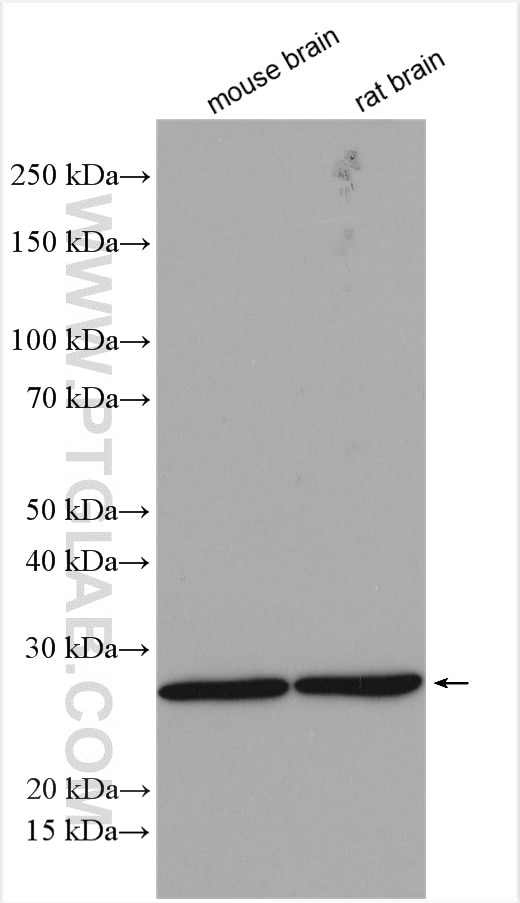
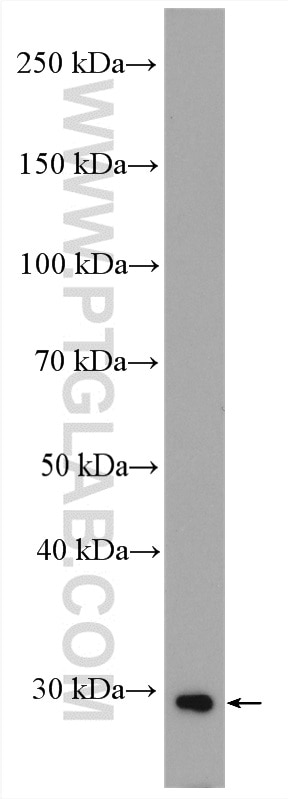
| Positive WB detected in | mouse brain tissue, C2C12 cells, rat brain |
Recommended dilution
| Application | Dilution |
|---|---|
| Western Blot (WB) | WB : 1:500-1:1000 |
| It is recommended that this reagent should be titrated in each testing system to obtain optimal results. | |
| Sample-dependent, Check data in validation data gallery. | |
Product Information
55313-1-AP targets ATP6 in WB, IHC, IF, ELISA applications and shows reactivity with human, mouse, rat samples.
| Tested Reactivity | human, mouse, rat |
| Cited Reactivity | human, mouse, rat |
| Host / Isotype | Rabbit / IgG |
| Class | Polyclonal |
| Type | Antibody |
| Immunogen |
Peptide Predict reactive species |
| Full Name | ATP synthase 6; ATPase subunit 6 |
| Calculated Molecular Weight | 25 kDa |
| Observed Molecular Weight | 25-30 kDa |
| GenBank Accession Number | J01415 |
| Gene Symbol | ATP6 |
| Gene ID (NCBI) | 4508 |
| RRID | AB_2881305 |
| Conjugate | Unconjugated |
| Form | Liquid |
| Purification Method | Antigen affinity purification |
| UNIPROT ID | P00846 |
| Storage Buffer | PBS with 0.02% sodium azide and 50% glycerol, pH 7.3. |
| Storage Conditions | Store at -20°C. Stable for one year after shipment. Aliquoting is unnecessary for -20oC storage. 20ul sizes contain 0.1% BSA. |
Background Information
ATP synthase, also known as FoF1 complex, is a critical mitochondrial OXPHOS enzyme involved in the regulation of mitochondrial ATP production and in the maintenance of the mitochondrial membrane potential. It is composed of three components (F1, Fo and the peripheral stalk). F1, the soluble catalytic core, is above the membrane, inside the matrix of the mitochondria; consists of 5 different subunits (alpha, beta, gamma, delta, and epsilon); Fo, comprising the proton channel, is within the membrane; Fo seems to have nine subunits (a, b, c, d, e, f, g, F6 and 8). ATP6 is the a subunit of Fo region.
Protocols
| Product Specific Protocols | |
|---|---|
| WB protocol for ATP6 antibody 55313-1-AP | Download protocol |
| Standard Protocols | |
|---|---|
| Click here to view our Standard Protocols |
Publications
What published studies show
The ATP6 Polyclonal antibody (Cat# 55313-1-AP) has 74 citations spanning journals including Nature, Cell, Cell Metabolism, Nature Communications, Nature Cell Biology, Molecular Cell, Nucleic Acids Research, Redox Biology, Cell Death & Disease, and Journal of Biological Chemistry, among others. Research fields covered include mitochondrial biology, mitochondrial DNA maintenance, mitochondrial translation, neurodegeneration (Alzheimer's, Parkinson's), cancer, oxidative stress, ferroptosis, metabolic disorders, and mitochondrial quality control.
| Species | Application | Title |
|---|---|---|
Cell Systematic identification of anticancer drug targets reveals a nucleus-to-mitochondria ROS-sensing pathway | ||
Cell Metab Transketolase promotes MAFLD by limiting inosine-induced mitochondrial activity | ||
Cell Metab Aging-induced tRNAGlu-derived fragment impairs glutamate biosynthesis by targeting mitochondrial translation-dependent cristae organization | ||
Cell Stem Cell Epitranscriptomic regulation of cortical neurogenesis via Mettl8-dependent mitochondrial tRNA m3C modification |
Reviews
What customers say
One reviewer tested this antibody for Western Blot at a 1:1000 dilution on HCT116 cells and rated it 2 out of 5. They reported that the antibody did not work on either total or mitochondrial protein extracts, indicating it failed to produce detectable signal in their experimental setup.
The reviews below have been submitted by verified Proteintech customers who received an incentive for providing their feedback.
Morgane (Verified Customer) (01-28-2026) | I couldn't make it work on neither total or mitochondrial protein extract
|



