


Tested Applications
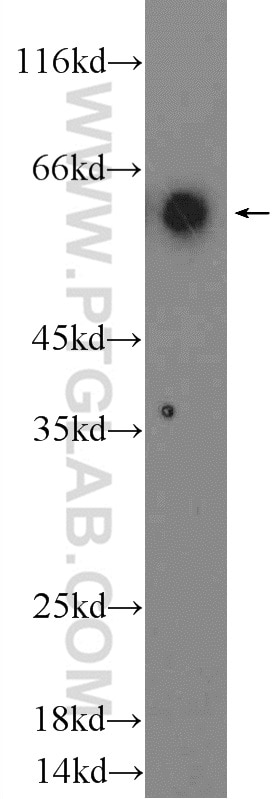
| Positive WB detected in | RAW 264.7 cells, human peripheral blood leukocyte, Daudi cells, Raji cells, Ramos cells, J774A.1 cells |
Recommended dilution
| Application | Dilution |
|---|---|
| Western Blot (WB) | WB : 1:300-1:8000 |
| It is recommended that this reagent should be titrated in each testing system to obtain optimal results. | |
| Sample-dependent, Check data in validation data gallery. | |
Product Information
14292-1-AP targets CD80 in WB, ELISA applications and shows reactivity with human, mouse samples.
| Tested Reactivity | human, mouse |
| Cited Reactivity | human, mouse, rat |
| Host / Isotype | Rabbit / IgG |
| Class | Polyclonal |
| Type | Antibody |
| Immunogen |
CatNo: Ag5615 Product name: Recombinant human B7-1 protein Source: e coli.-derived, PGEX-4T Tag: GST Domain: 36-228 aa of BC042665 Sequence: IHVTKEVKEVATLSCGHNVSVEELAQTRIYWQKEKKMVLTMMSGDMNIWPEYKNRTIFDITNNLSIVILALRPSDEGTYECVVLKYEKDAFKREHLAEVTLSVKADFPTPSISDFEIPTSNIRRIICSTSGGFPEPHLSWLENGEELNAINTTVSQDPETELYAVSSKLDFNMTTNHSFMCLIKYGHLRVNQT Predict reactive species |
| Full Name | CD80 molecule |
| Calculated Molecular Weight | 33 kDa |
| Observed Molecular Weight | 60 kDa |
| GenBank Accession Number | BC042665 |
| Gene Symbol | CD80 |
| Gene ID (NCBI) | 941 |
| RRID | AB_10640809 |
| Conjugate | Unconjugated |
| Form | Liquid |
| Purification Method | Antigen affinity purification |
| UNIPROT ID | P33681 |
| Storage Buffer | PBS with 0.02% sodium azide and 50% glycerol, pH 7.3. |
| Storage Conditions | Store at -20°C. Stable for one year after shipment. Aliquoting is unnecessary for -20oC storage. 20ul sizes contain 0.1% BSA. |
Background Information
CD80 (also known as B7-1) is a type I membrane protein that is a member of the immunoglobulin superfamily, with an extracellular immunoglobulin constant-like domain and a variable-like domain required for receptor binding. It is expressed on antigen-presenting cells (APCs), including B cells, dendritic cells, monocytes, and macrophages. CD80 is the receptor for the proteins CD28 and CTLA-4 found on the surface of T-cells. It is involved in the costimulatory signal essential for T-lymphocyte activation. T-cell proliferation and cytokine production is induced by the binding of CD28, binding to CTLA-4 has opposite effects and inhibits T-cell activation. CD80 also acts as a cellular attachment receptor for adenovirus subgroup B. (PMID: 7545666; 12015893; 16920215)
Protocols
| Product Specific Protocols | |
|---|---|
| WB protocol for CD80 antibody 14292-1-AP | Download protocol |
| Standard Protocols | |
|---|---|
| Click here to view our Standard Protocols |
Publications
What published studies show
The CD80 Polyclonal antibody (catalog no. 14292-1-AP) has 48 citations. These appear in journals including Cell Research, Bioactive Materials, ACS Nano, J Nanobiotechnology, Biomaterials, J Control Release, Small, J Immunother Cancer, Int J Biol Sci, J Transl Med, iScience, PLoS Pathog, and Mol Immunol. Research fields center on macrophage polarization (M1/M2), tumor immunotherapy, photodynamic therapy, inflammation, and disease models such as cancer, atherosclerosis, spinal cord injury, and acute lung injury, with applications mainly in WB and ELISA.
| Species | Application | Title |
|---|---|---|
Cell Res Dynamic magneto-mechanical force in lysosomes induces durable macrophage repolarization for antitumor immunity. | ||
Bioact Mater Photosynthetic microorganisms coupled photodynamic therapy for enhanced antitumor immune effect. | ||
ACS Nano Antigen Self-Presented Personalized Nanovaccines Boost the Immunotherapy of Highly Invasive and Metastatic Tumors | ||
J Nanobiotechnology Pro-efferocytic macrophage membrane biomimetic nanoparticles for the synergistic treatment of atherosclerosis via competition effect | ||
J Nanobiotechnology Curcumin/pEGCG-encapsulated nanoparticles enhance spinal cord injury recovery by regulating CD74 to alleviate oxidative stress and inflammation | ||
J Nanobiotechnology Targeting and repolarizing M2-like tumor-associated macrophage-mediated MR imaging and tumor immunotherapy by biomimetic nanoparticles |



