
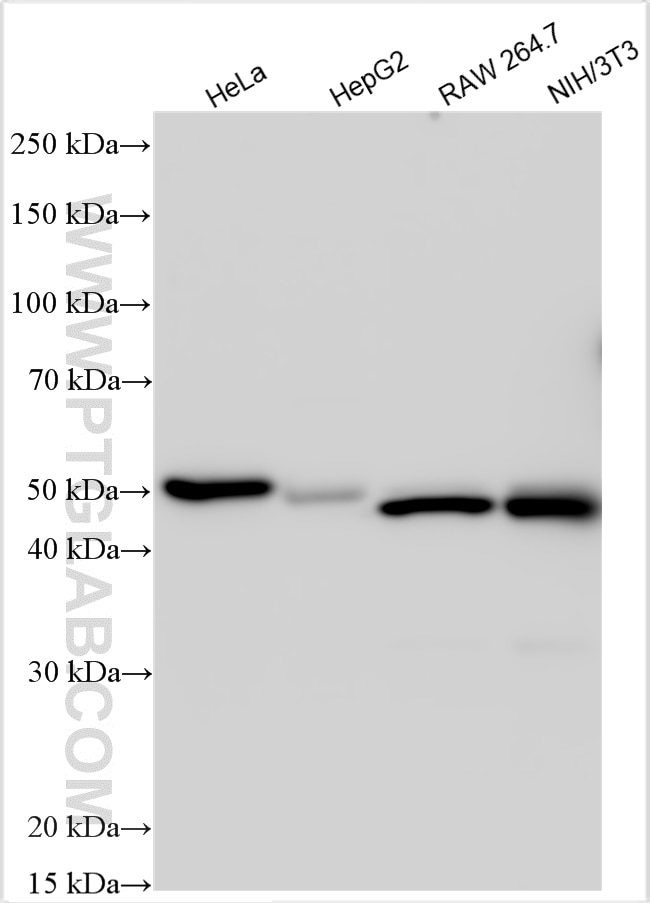
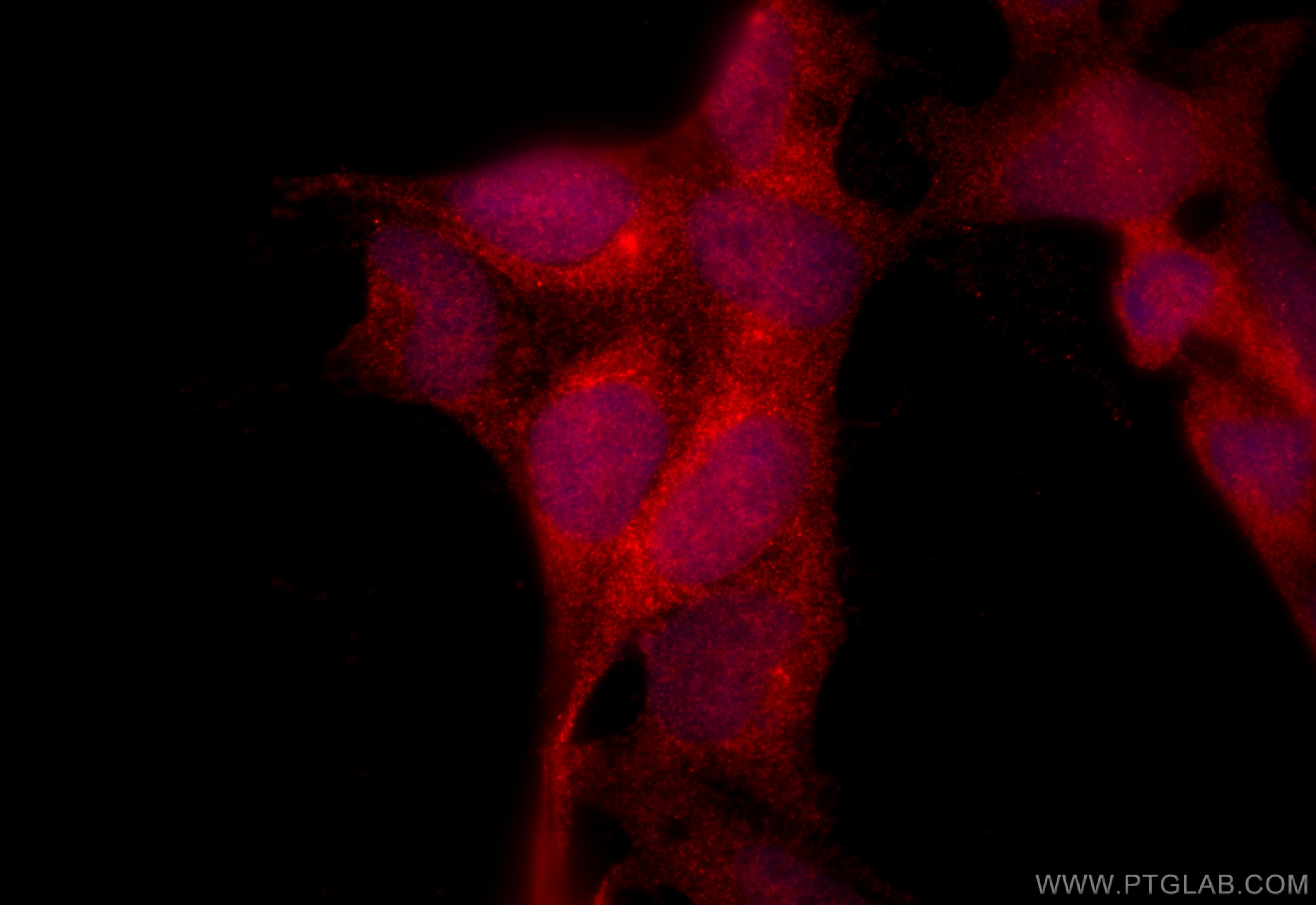

Tested Applications
| Positive WB detected in | HeLa cells, HepG2 cells, RAW 264.7 cells, NIH/3T3 cells |
| Positive IF/ICC detected in | HEK-293 cells |
Recommended dilution
| Application | Dilution |
|---|---|
| Western Blot (WB) | WB : 1:500-1:1000 |
| Immunofluorescence (IF)/ICC | IF/ICC : 1:200-1:800 |
| It is recommended that this reagent should be titrated in each testing system to obtain optimal results. | |
| Sample-dependent, Check data in validation data gallery. | |
Product Information
20169-1-AP targets BRP16 in WB, IHC, IF/ICC, ELISA applications and shows reactivity with human, mouse samples.
| Tested Reactivity | human, mouse |
| Cited Reactivity | human |
| Host / Isotype | Rabbit / IgG |
| Class | Polyclonal |
| Type | Antibody |
| Immunogen |
CatNo: Ag13998 Product name: Recombinant human BRP16 protein Source: e coli.-derived, PET28a Tag: 6*His Domain: 41-390 aa of BC003035 Sequence: AVRHVLALTGCGPGRALLAGQAALLQALMELAPASAPARDAARALVNLAADPGLHETLLAADPGLPARLMGRALDPQWPWAEEAAAALANLSREPAPCAALMAALAAAEPADSGLERLVRALCTPGYNARAPLHYLAPLLSNLSQRPAARAFLLDPDRCVVQRLLPLTQYPDSSVRRGGVVGTLRNCCFEHRHHEWLLGPEVDILPFLLLPLAGPEDFSEEEMERLPVDLQYLPPDKQREPDADIRKMLVEAIMLLTATAPGRQQVRDQGAYLILRELHSWEPEPDVRTACEKLIQVLIGDEPERGMENLLEVQVPEDVEQQLQQLDCREQEQLERELAPEPWVERATPT Predict reactive species |
| Full Name | chromosome 8 open reading frame 30A |
| Calculated Molecular Weight | 390 aa, 42 kDa |
| Observed Molecular Weight | 42-50 kDa |
| GenBank Accession Number | BC003035 |
| Gene Symbol | BRP16 |
| Gene ID (NCBI) | 51236 |
| RRID | AB_2878652 |
| Conjugate | Unconjugated |
| Form | Liquid |
| Purification Method | Antigen affinity purification |
| UNIPROT ID | Q9BTY7 |
| Storage Buffer | PBS with 0.02% sodium azide and 50% glycerol, pH 7.3. |
| Storage Conditions | Store at -20°C. Stable for one year after shipment. Aliquoting is unnecessary for -20oC storage. 20ul sizes contain 0.1% BSA. |
Background Information
HGH1 (HGH1 homolog; also known as BRP16/brain protein 16, FAM203A or C8orf30A) is a 390-residue, armadillo-repeat protein of the HGH1 family that acts as a co-chaperone of eukaryotic elongation factor 2 (eEF2) (PMID: 30876804). In yeast, it binds the dynamic central domain III of nascent eEF2 through a bipartite interface and recruits the chaperonin TRiC/CCT to the C-terminal module, and without HGH1 a substantial fraction of newly synthesized eEF2 is degraded or aggregates. HGH1 also cooperates with the Hsp90 co-chaperone Cns1 in a quaternary complex with eEF2 and Hsp90 (PMID: 30876805), and hgh1-deleted yeast contain eEF2 that lacks the diphthamide modification (PMID: 39825589). In human breast cancer cells, HGH1 depletion reduces global translation efficiency and proliferation (PMID: 38844963). HGH1 is upregulated in breast tumors, predicts poor prognosis and promotes proliferation, migration and invasion through PI3K/AKT/NF-kappa B signaling (PMID: 40256249).
Protocols
| Product Specific Protocols | |
|---|---|
| IF protocol for BRP16 antibody 20169-1-AP | Download protocol |
| WB protocol for BRP16 antibody 20169-1-AP | Download protocol |
| Standard Protocols | |
|---|---|
| Click here to view our Standard Protocols |
Publications
What published studies show
The BRP16 Polyclonal antibody (Cat# 20169-1-AP) has 2 total citations. Both appear in breast cancer journals: Breast Cancer Research (2024) and Breast Cancer (Dove Med Press) (2025). The research fields cover breast cancer progression, m⁵C RNA methylation (NSUN2/YBX1/HGH1 axis), and the PI3K/AKT/NF-κB signaling pathway. Applications cited include IHC and WB in human samples.
| Species | Application | Title |
|---|---|---|
Breast Cancer Res NSUN2/YBX1 promotes the progression of breast cancer by enhancing HGH1 mRNA stability through m(5)C methylation. | ||
Breast Cancer (Dove Med Press) HGH1 Promotes Breast Cancer Progression Through the PI3K/AKT/NF-κB Signaling Pathway: Potential Role for Prognosis and Targeted Therapy |



