

Product Information
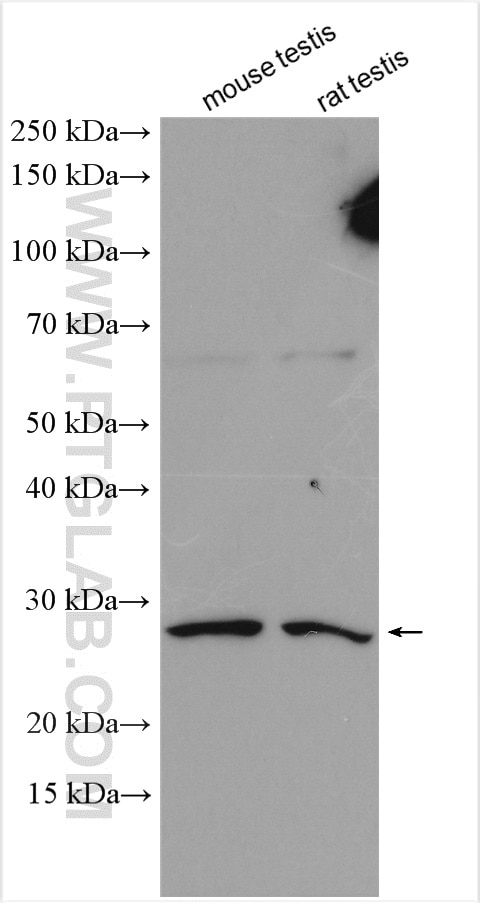
21330-1-PBS targets C9orf7 / CACFD1 in WB, Indirect ELISA applications and shows reactivity with human, mouse, rat samples.
| Tested Reactivity | human, mouse, rat |
| Host / Isotype | Rabbit / IgG |
| Class | Polyclonal |
| Type | Antibody |
| Immunogen |
CatNo: Ag15336 Product name: Recombinant human C9orf7 protein Source: e coli.-derived, PGEX-4T Tag: GST Domain: 1-172 aa of BC030558 Sequence: MSSSGGAPGASASSAPPAQEEGMTWWYRWLCRLSGVLGAVSCAISGLFNCITIHPLNIAAGVWMIMNAFILLLCEAPFCCQFIEFANTVAEKVDRLRSWQKAVFYCGMAVVPIVISLTLTTLLGNAIAFATGVLYGLSALGKKGDAISYARIQQQRQQADEEKLAETLEGEL Predict reactive species |
| Full Name | chromosome 9 open reading frame 7 |
| Calculated Molecular Weight | 172 aa, 18 kDa |
| Observed Molecular Weight | ~25 kDa |
| GenBank Accession Number | BC030558 |
| Gene Symbol | CACFD1 |
| Gene ID (NCBI) | 11094 |
| RRID | AB_3085651 |
| Conjugate | Unconjugated |
| Form | Liquid |
| Purification Method | Antigen affinity purification |
| UNIPROT ID | Q9UGQ2 |
| Storage Buffer | PBS only, pH 7.3. |
| Storage Conditions | Store at -80°C. |
Background Information
Calcium Channel Flower Domain Containing 1 (CACFD1) also named as C9orf7 or human Flower protein (hFWE). In Drosophila, cell selection uses a cell selection mechanism based on 'fitness fingerprints', which allow it to delay ageing, prevent developmental malformations and replace old tissues during regeneration. At the molecular level, these fitness fingerprints consist of combinations of Flower membrane proteins. Proteins that indicate reduced fitness are called Flower-Lose, because they are expressed in cells marked to be eliminated. It has different isoforms, the calculated MW rang from 14-25 kDa. 21330-1-AP can detect a band around 25 kDa.(PMID:31341286)


