
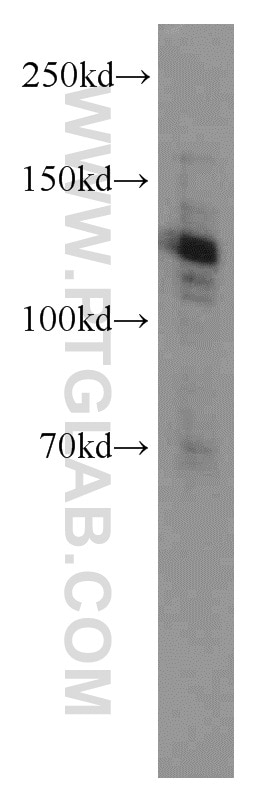

Tested Applications
| Positive WB detected in | HeLa cells |
Recommended dilution
| Application | Dilution |
|---|---|
| Western Blot (WB) | WB : 1:500-1:1000 |
| It is recommended that this reagent should be titrated in each testing system to obtain optimal results. | |
| Sample-dependent, Check data in validation data gallery. | |
Product Information
10400-1-AP targets CARD14 in WB, ELISA applications and shows reactivity with human, mouse, rat samples.
| Tested Reactivity | human, mouse, rat |
| Cited Reactivity | human, mouse |
| Host / Isotype | Rabbit / IgG |
| Class | Polyclonal |
| Type | Antibody |
| Immunogen |
CatNo: Ag0628 Product name: Recombinant human CARD14 protein Source: e coli.-derived, PGEX-4T Tag: GST Domain: 1-300 aa of BC018142 Sequence: MGELCRRDSALTALDEETLWEMMESHRHRIVRCICPSRLTPYLRQAKVLCQLDEEEVLHSPRLTNSAMRAGHLLDLLKTRGKNGAIAFLESLKFHNPDVYTLVTGLQPDVDFSNFSGLMETSKLTECLAGAIGSLQEELNQEKGQKEVLLRRCQQLQEHLGLAETRAEGLHQLEADHSRMKREVSAHFHEVLRLKDEMLSLSLHYSNALQEKELAASRCRSLQEELYLLKQELQRANMVSSCELELQEQSLRTASDQESGDEELNRLKEENEKLRSLTFSLAEKDILEQSLDEARGSRQE Predict reactive species |
| Full Name | caspase recruitment domain family, member 14 |
| Calculated Molecular Weight | 113 kDa |
| Observed Molecular Weight | 113-140 kDa |
| GenBank Accession Number | BC018142 |
| Gene Symbol | CARD14 |
| Gene ID (NCBI) | 79092 |
| Conjugate | Unconjugated |
| Form | Liquid |
| Purification Method | Antigen affinity purification |
| UNIPROT ID | Q9BXL6 |
| Storage Buffer | PBS with 0.02% sodium azide and 50% glycerol, pH 7.3. |
| Storage Conditions | Store at -20°C. Stable for one year after shipment. Aliquoting is unnecessary for -20oC storage. 20ul sizes contain 0.1% BSA. |
Background Information
CARD14/CARMA2 is a novel caspase recruitment domain-containing protein 14 and is also a membrane-associated guanylate kinase (MAGUK) family member. CARD domain is a protein-binding element that mediates the assembly of CARD-containing proteins into apoptosis and NF-kappaB signaling complexes, which has been implicated in inflammatory disorders. CARD14 activates NF-kappaB signaling via interaction with BCL10. Defects in CARD14 are the cause of susceptibility to psoriasis type 2 (PSORS2), which is a common inflammatory disorder of the skin and other organs caused by abnormal keratinocyte proliferation and infiltration of inflammatory cells into the dermis and epidermis.
Publications
What published studies show
The CARD14 Polyclonal antibody (Cat# 10400-1-AP) has 6 citations published in Oncogene, EMBO Molecular Medicine, Biochemical Pharmacology, EMBO Reports, Biomedicines, and Biochemical Journal. Research fields include NF-κB signaling, cancer metastasis, intestinal inflammation, psoriasis, prostate cancer, and keratinocyte proliferation.
| Species | Application | Title |
|---|---|---|
Oncogene MALT1 is a critical mediator of PAR1-driven NF-κB activation and metastasis in multiple tumor types. | ||
EMBO Mol Med CARD14 signaling in intestinal epithelial cells induces intestinal inflammation and intestinal transit delay. | ||
Biochem Pharmacol Polo-like kinase 1 (PLK1) is a novel CARD14-binding protein in keratinocytes. | ||
Biomedicines CARD14 Signalling Ensures Cell Survival and Cancer Associated Gene Expression in Prostate Cancer Cells | ||
Biochem J CARD14 signalosome formation is associated with its endosomal relocation and mTORC1-induced keratinocyte proliferation |


