
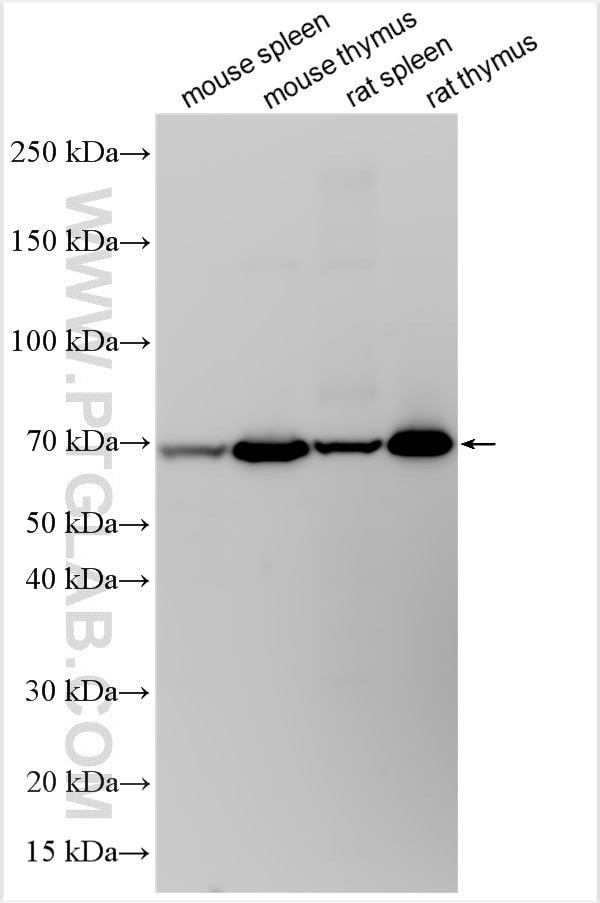

Tested Applications
| Positive WB detected in | mouse spleen tissue, mouse thymus tissue, rat spleen tissue, rat thymus tissue |
Recommended dilution
| Application | Dilution |
|---|---|
| Western Blot (WB) | WB : 1:500-1:2000 |
| It is recommended that this reagent should be titrated in each testing system to obtain optimal results. | |
| Sample-dependent, Check data in validation data gallery. | |
Product Information
32546-1-AP targets CD122/IL-2RB in WB, ELISA applications and shows reactivity with mouse, rat samples.
| Tested Reactivity | mouse, rat |
| Host / Isotype | Rabbit / IgG |
| Class | Polyclonal |
| Type | Antibody |
| Immunogen |
Recombinant protein Predict reactive species |
| Full Name | interleukin 2 receptor, beta chain |
| Calculated Molecular Weight | 61 kDa |
| Observed Molecular Weight | 70 kDa |
| GenBank Accession Number | NM_008368.4 |
| Gene Symbol | Il2rb |
| Gene ID (NCBI) | 16185 |
| RRID | AB_3742652 |
| Conjugate | Unconjugated |
| Form | Liquid |
| Purification Method | Antigen affinity Purification |
| UNIPROT ID | P16297 |
| Storage Buffer | PBS with 0.02% sodium azide and 50% glycerol, pH 7.3. |
| Storage Conditions | Store at -20°C. Stable for one year after shipment. Aliquoting is unnecessary for -20oC storage. 20ul sizes contain 0.1% BSA. |
Background Information
The interleukin 2 receptor, which is involved in T cell-mediated immune responses, is present in 3 forms with respect to the ability to bind interleukin 2. The low-affinity form is a monomer of the alpha subunit and is not involved in signal transduction. The intermediate affinity form consists of an alpha/beta subunit heterodimer, while the high affinity form consists of an alpha/beta/gamma subunit heterotrimer. The beta subunit (IL2RB, also known as CD122 and p75) is involved in receptor-mediated endocytosis and transduces the mitogenic signals of interleukin 2.
Protocols
| Product Specific Protocols | |
|---|---|
| WB protocol for CD122/IL-2RB antibody 32546-1-AP | Download protocol |
| Standard Protocols | |
|---|---|
| Click here to view our Standard Protocols |


